Parabola

I’ve been kind of quiet here.  It’s not because I’m behind or because I’m not enjoying myself.  Indeed, I’m really caught up in the book, but with the focus lately on the wild life of Slothrop there wasn’t a lot that I was thinking about aside from reckless speculation about plot.

But this week’s section about parabolas got me thinking outside the plot.

It’s obvious that Pynchon has done his homework for this book.  I mean, his knowledge of WWII, Germany and Africa are more than impressive.

I’ve already mentioned a vague parallelism to Ulysses (which I think has fallen by the wayside at this point).  So let me posit a new structural question/theory.

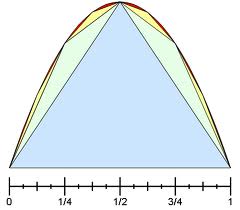
Is Gravity’s Rainbow structured in a parabolic arc in any way?  (Obviously this cannot be answered and remain within spoiler limits, so tread lightly).  I initially thought about this because I found the sections about Enzian and Tchitcherine kind of slow and difficult, especially compared to the fast paced earlier scenes.  (A second read made that less so).  But it seemed as if the book was moving along pretty briskly and then, just as it reached the center (or thereabouts) of the book, these two sections were heavy and laden with history and back story and complex stuff–very much unlike the Slothrop romp and fun sections.  True, there is a Slothrop section in between these dense sections, so that kind of blows the (poor) theory away.

Nevertheless, I wonder if anyone else has noticed any kind of structure to the book as a whole (in the way that Infinite Jest was superficially a Sierpinski Triangle) parabolic or otherwise.

Tannhäuser

In a note to 3.2 of Gravity’s Rainbow, Weisenburger explains Pynchon’s use of the word “Tannhäuserism” as follows:

The tragic error of Tannhäuser — for example, in Richard Wagner’s operatic version of the myth — was to postpone his quest in order to linger for one year of sensual, “mindless pleasure” with the goddess Venus under her mountain called Venusberg.

For further details, I’ve taken the easy route and discovered from Wikipedia (also, Wagner’s version) that legend has knight/singer/poet Tannhäuser discovering Venusberg and lingering there for a while. Venus being the goddess of love, one assumes that he frolics and fornicates a bit, much to the consternation of God and, if I read it correctly, sort of behind the back of one Elisabeth, whose heart he later wins back with a song (just how it always goes, eh?). Further hilarity and songmaking ensue, and poor Tannhäuser goofs up again, praising Venus to the point of basically insulting Elisabeth to her face, when she’s poised to give the winner of what amounts to an old Teutonic rap battle the wish of his choice — which I presume to be a setup for betrothal. Tannhäuser screws it up to the horror of the court and goes looking for the Pope to seek absolution. The Pope replies that it’s more likely that his own staff will  sprout blossoms (I’m going to snicker here for Christine’s benefit) than that Tannhäuser will be forgiven, and Tannhäuser goes back to Venusberg dejected. Three days later he arose from the dead the Pope’s staff in fact blooms, but our venery-seeking poet is gone forever.

The Wikipedia entry adds this:

The legend has been interpreted as a traditional folk tale which has been subject to Christianization where the familiar story of the seduction of a human being by an elf or fairy leads to the delights of the fairy-realm but later the longing for his earthly home. His desire is granted, but he is not happy, and in the end returns to the fairy-land.

Well of course this makes me think back to an earlier post in which I noodle a bit on the costs of succumbing to temptation. You may recall that I considered Pointsman’s temptation alongside Slothrop’s. It turns out that Pointsman also has a subterranean Venusian connection (which I discovered by landing on this pretty much by accident). In 1.13, we find this (emphasis mine):

Surely the volume preceding The Book — the first Forty-one Lectures — came to him at age 28 like a mandate from the submontane Venus he could not resist: to abandon Harley Street for a journey more and more deviant, deliciously on, into a labyrinth of conditional-reflex work in which only now, thirteen years along the clew, he’s beginning to circle back, trip across old evidence of having come that path before, here and there to confront consequences of his younger, total embrace… But she did warn him — did she not? was he ever listening? of the deferred payment, in its full amount. Venus and Ariadne! She seemed worth any price, the labyrinth looking, in those days, too intricate for them…

So, as Pointsman ventured into the labyrinth of science as if at the behest of the love goddess beckoning from under Venusberg, Slothrop too now goes into the tunnels of the Mittelwerke, where he is taunted (though nobody’s actually aware of the fact) by what amount to gnomes singing of a man horny for a rocket. And just as Pointsman’s quest for knowledge has lured him into the confusing labyrinth of his work, Slothrop’s quest for knowledge of Imipolex G has led him underground as well, to the very place where the object of his unwitting affection has been forged.

Interestingly, for Pointsman, the labyrinth is a place to have been avoided. His thoughts as laid out in the quote above suggest regret, a wish that he had heeded the warning not to enter the labyrinth. Slothrop’s view of the underworld seems less — or at least differently — depressive:

There is that not-so-rare personality disorder known as Tannhäuserism. Some of us love to be taken under mountains, and not always with horny expectations — Venus, Frau Holda, her sexual delights — no, many come, actually, for the gnomes, the critters smaller than you, for the sepulchral way time stretches along your hooded strolls down here, quietly through courtyards that go for miles, with no anxiety about getting lost … no one stares, no one is waiting to judge you … out of the public eye … even a Minnesinger needs to be alone … long cloudy-day indoor walks … the comfort of a closed place, where everyone is in complete agreement about Death.

This poor fellow, who has an increasingly keen and correct sense that he’s been watched all his life, and never more openly or oppressively than as at present, just wants a refuge.

Like Tannhäuser, Slothrop’s had the odd carnal dalliance or two himself, debatably with more outwardly catastrophic consequences (or at least associations). I’m a little ahead in the reading and am in a position to give you the head’s up that the Tannhäuser theme continues to appear. So if it’s a thread that interests you, keep your eyes peeled.

The narrator sez

On a mission to figure out a rhyme or reason behind the use of the colloquial “sez” in Gravity’s Rainbow, I rescanned Section Two.

Here’s a quick chronicle from my 1995 Vintage edition copy:

p. 223 the “ID bracelet. Sez KATJE BORGESIUS” [Slothrop’s learning something]

p. 238 “‘It’s Slothrop,’ sez Bloat” [Bloat’s feigning discovery]

p. 239 “‘Shit,’ sez Slothrop” [Slothrop’s in pain]

p. 245 “‘Oink, oink, oink,’ sez Slothrop” [Slothrop’s gleeful]

p. 250 “‘Bad Guy,’ sez Slothrop” [Slothrop’s wishfully thinking; he’s boastful]

p. 264 “‘Hey, Katje’ ‘s all he sez” [after the classic ‘he rapes her but she likes it’ scene; Slothrop’s tentatively probing {not like that}]

p. 266 “‘Come on upstairs,’ sez Slothrop” [Slothrop’s hoping and timidly probing]

p. 271 “‘Your Interested Parties again?’ sez Rollo Groat” [Slothrop’s timidly probing]

p. 288 “Flagnote on the flagnote sez” [major revelation about plastics]

Sez is not the only word the narrator spells phonetically. There are other instances of colloquial spellings. Slothrop says, “whyzat?” on page 287.  The Webley Silvernail section on page 272 is all in phonetically written dialect with “dey wuz” kind of theater.

So why the “sez”?

It’s not when someone is being a phony…

It’s not when someone is being dumb…

It’s not when someone is feigning casualness when in danger…

It’s not when someone is on the verge of an important discovery…

It’s used for men and for inanimate objects with writing on them but never about women…

It’s only the narrator who uses “sez.”

So the best I can come up with is it’s an inconsistent narrator tic that serves to remind us of the fundamental unreliability of our narrator? That much is writ large in the 294 minute detailing of Tamara and Perlimpinpin’s debt, the long description of which ends with “Something like that.”

Perhaps the narrator uses “sez” when he’s being particularly intimate with the reader. Clueing us in on something important, peeking in on a private moment, being technically insubordinate to let us see what he’s seen. (I’m assuming the narrator is male. He is visually fixated on genitalia, and I could find pages of clues to convince you, but until I hear a good argument for the narrator being female, I’m going to default to my IPR argument and say we’re being told a story by a man.) At least two-thirds of the above listed “sez”s fit that intimation idea. But two-thirds is not enough for me.

Is it, perhaps, a slip, when the narrator lets down his guard because he’s most engaged in the story? Do we see his true voice rather than his storytelling voice when he’s enrapt with the details of the novel? That fits 100% of the above incidents, presuming the narrator is engrossed in the most significant bits of the book’s prose. So our narrator is pretending to fit in and have clearance to get the gig of telling us the story? That means his true self, the “sez” self, revealed when he’s not paying attention to his persona, is younger, less well educated and connected, and less experienced than he pretends?

I couldn’t find the etymology of “sez” or when it came into fashion. I sense that it was a post-Flapper flippancy that gained ground in the ’40s (as Paul noted) or with Beat writers in the ’50s (as Daryl noted).

In none of  the historical slang dictionaries have I found an etymology for “Jackson,” Slothrop’s infrequent pet phrase, either. I have found, though, that Slothrop uses “Jackson” in his internal monologue when he’s seriously terrified. To wit: 221 (octopus), 232 (wardrobe’s a fake), and 287 (with Bounce talking about Shell).

I don’t have the e-version, so I’m sure I’m missing some sezes and some Jacksons. If you come across some, do they help or hurt my theory?
A new post, coming soon…

I’m working feverishly. I’m throwing together any freaking thought I can manage crafting careful sentences that delve into the beauty and thoughtfulness that is Pynchon’s prose.

[I’m definitely not stalling while I finish the last few pages of this week’s reading. That would be intellectually dishonest and morally lazy. And way too predictable.]

But I really have to know, to gauge the timbre of my post:

Am I the only one going absolutely nuts every time the lazyologism “sez” appears in the text?

Because when I googled “Pynchon sez” I found this awesome irreverent Pynchon mockery that should be in the sidebar would be wholly inappropriate to include in our studied and thoughtful approach to Gravity’s Rainbow.

So I need to know: does “sez” bug you, too? Or do I need to back off my self-assigned role as the Zombies’ resident linguistic curmudgeon?

Alchemy

In section 2.7 of Gravity’s Rainbow, we see a number of things that might be considered sorts of alchemy. Slothrop is converted into Ian Scuffing, who goes on a quest to learn about Imipolex G, a quest that requires the conversion of capital into information. Then of course there’s the conversion of molecules into plastics like Imipolex G. Earlier, we saw some of the history of such processes as we learned that the nasty (base?) substance coal-tar was discovered to be of great use in creating beautiful dyes in the purple/mauve family (royal colors, note). Coal-tar derivative indole, which Pynchon mentions by name, is also used to convert chemicals into the mind-altering drug LSD, which also comes up. Maybe it’s a stretch to suggest a sort of alchemical interchangeability between the (mind-altered?) nuts and the keepers who emerge in the silly chorus line number that describes Slothrop’s experience with information traders in Zürich, but the transmogrification of air into diamonds within that episode seems alchemical enough. Even the baking of bread — a conversion of flour, water, yeast, and a few pinches of salt and sugar into a delightful, aromatic loaf of sustenance — struck me as being something of a nod to alchemy. But the kicker is Pynchon’s mention of an alembic, which Weisenburger describes as “the sealed vessel in which the adept seeks to achieve a conjunction of all opposites to produce gold.” Although I do not herewith propose a debt on Pynchon’s part to renascence dramatist Ben Jonson, I also couldn’t help thinking of the social climbers in his great play The Alchemist and of Pynchon’s persistent references to the preterite (and by implication the elect). As is often the case, I have no great thesis here — just a few observations.

Too Much Fun

Part 2 of Gravity’s Rainbow opens at a seaside casino around Christmas and ends at a seaside amusement park on Whitsunday, which to the Americans among us is Pentecost, or the day that the Holy Spirit descended upon Christ’s disciples a few weeks after Easter. Both holidays would seem to be holidays of great joy, as casinos and amusement parks would seem to be places of great fun, but of course we know that Slothrop has rather a hard time at the casino, and the closing scene of part 2 just oozes the despair of a forced, joyless professional retreat.

This makes me think back to our second week’s reading and my thoughts on temptation. The fun-seekers in part 2 call to mind for me the abandoned children in the Hansel and Gretel tale who happen upon a delightful house of candy only to find it a gateway to suffering.

As we come to the end of part 2, we discover that Pointsman is hallucinating and that his hallucinations are telling him to find a way to get rid of Jessica Swanlake so that he can keep Roger Mexico’s talents on hand for his nefarious research. His impulse, in other words, is to use people as a means toward his own Faustian ends (he’s previously demonstrated a lack of concern for Slothrop’s well-being).

I had made a few very brief notes on all of this when I encountered on the pynchon-l discussion list a link to a video in which artist and writer (and apparent Pynchon friend) Jules Siegel says that Pynchon had been somehow party to the government’s experimentation with LSD on the baby boomers and that Gravity’s Rainbow is something of a confession. I suppose the pieces are there: unconscionable experimentation on people in states of altered consciousness, a mad scientist who sees people as essentially disposable, a growing entanglement between the military and industry, and of course in part 2 the explicit introduction of LSD and some vague ties between its production and the coal-tar-based substance “indole” used to make LSD (see Weisenburger on coal-tar, indole, IG Farben, and Imipolex G).

The short segment of an interview with Siegel embedded below strikes me as being the stuff of the tinfoil hat crowd, but that’s not exactly out of place within the context of Gravity’s Rainbow.

Moby-Dick Art

A while back, we did a group read of Moby-Dick, and artist Matt Kish was kind enough not only to endure an interview about his project to illustrate each page of the book but also to contribute several posts about his process. His project went on to be turned into a gorgeous book, and now he’s moving on to other projects. As part of that move, he’s looking to get shed of the remaining unsold pieces of Moby-Dick artwork. If you’re into Moby-Dick or are familiar with Matt’s work and think you might like to own a piece of it (I’ve bought several, and they’re among my most prized possessions), now’s a good time to buy. If you haven’t run across the work before, you at least owe it to yourself to see it online.

Signs and Symptoms

I couldn’t help noticing in this week’s reading (1.19 – 2.3) that Pynchon writes a whole lot about things beneath the surface, including most notably the machinations leading to the theft of Slothrop’s identity so that, stuck, he can be manipulated and monitored as part of Pointman’s great experiment. Much has been choreographed with the intention — failed — of hoodwinking Slothrop without letting him know he’s being hoodwinked. Weisenburger points out that section 2.1 is very theatrical and that Katje pulls something of a magician’s stunt by covering Slothrop with a red cloth so that his identity can be made to disappear. And of course it’s worth noting that the epigraph that opens part 2 references a movie about an animal that captures a woman, much as the octopus Grigori somewhat comically captures Katje. Movies, of course, also attempt to dupe you into believing the stories they put before you, so the epigraph does more than simply prefigure the Grigori scene; it telegraphs something about the understanding that creeps along beneath the surface of at least the opening chapters of the section: that there’s the way things seem and there’s the manipulation being carried out to make them seem that way.

But it starts before we even get into part 2. Consider this exchange between Franz and Leni Pökler in 1.19:

She even tried, from what little calculus she’d picked up, to explain it to Franz as Δt approaching zero, eternally approaching, the slices of time growing thinner and thinner, a succession of rooms each with walls more silver, transparent, as the pure light of the zero comes nearer….

But he shook his head. “Not the same, Leni. The important thing is taking a function to its limit. Δt is just a convenience, so that it can happen.”

What Leni sees as a way of understanding something about the way the world works Franz brushes aside as a convenience. A scientist, he sees the way things operate under the surface, while Leni tries to use a mathematical metaphor to explain to him her outward perception of the world. In other words, it’s as if he sees what lies beneath while she sees only the surface; he seeks cause while she’s stuck with effect.

He was the cause-and-effect man: he kept at her astrology without mercy, telling her what she was supposed to believe, then denying it. “Tides, radio interference, damned little else. There is no way for changes out there to produce changes here.”

“Not produce,” she tried, “not cause. It all goes along together. Parallel, not series. Metaphor. Signs and symptoms. Mapping on to different coordinate systems, I don’t know…” She didn’t know, all she was trying to do was reach.

We learn next that Franz can’t stay awake during films (and how filmlike that description of sliced time), and that he watches them “nodding in and out of sleep,” as if his experience of movies mimics the way moving pictures themselves worked, stills spliced together but always with gaps in between. Leni wonders how “did he connect together the fragments he saw while his eyes were open?” Moreover, he’s unable simply to enjoy films, picking at technical points because he’s more tuned in to the mechanisms of the films than the feelings they evoke. Yet we find him pasting up advertisements for a film and finally attempting to attend the film only to find the theater empty. This misadventure brings him to the rocket, which ignites in him a passion for the work, though at the cost of his partnership with Leni. The cause-and-effect man indeed.

This is all of course in the past. Jumping back to the present of the novel and all its obfuscations, we find the American Slothrop forced to go about confusingly in a British uniform, speaking with Dodson-Truck about signs and symbols and their hidden meanings, trying to grok schematics whose symbols are reversed as if to camouflage them, growing one of many possible types of mustache that could provide different cues about what type of person he might be. As he encounters the somewhat chameleonish Katje in the Himmler-Spielsaal room and ponders the roulette wheel, he thinks of “the game behind the game.” Within a page or so, we learn that Slothrop knows of some room in his past he doesn’t have access to, some horrible hidden thing that Katje seems to know about that he doesn’t. Later, as Dodson-Truck confides in Slothrop, we read again of this “terrible secret.”

Then we move into a séance and learn that the medium Eventyr, who channels the control Peter Sascha, doesn’t even have access to the very information he channeled, that he gets only the censored (read: manipulated) transcripts after the fact. He thinks of his “hidden life” and mentions “acrostics” — a sort of poetry but also a sort of crude code in which one message is buried within another. And this very notion of a person with access to some other plane hidden to most seems related to the concept of things being other than they seem.

It took delving into the chemistry of coal-tar to produce from an unlikely nasty substance a whole dye industry that made beautiful things.

And, finally, there is Slothrop’s unpleasant feeling that everybody around him seems to know something that he doesn’t. Is it paranoia if it’s true? He has access to the facts as they seem, but the machinery driving the great theater of his capture is a little off-kilter, a little bit too funhouse maybe, and he’s aware dimly that something fishy’s going on, though he lacks the hidden knowledge he’d need to have in order to understand just what.

Several times now, we’ve seen this funny little word “preterite,” which before reading Gravity’s Rainbow I had encountered only as it pertained to verb tense. Pynchon uses the word to mean something like “common people,” but there’s also the more specific meaning (rare according to the OED) “a person not elected to salvation by God.” In other words, the preterite are people denied access to certain knowledge/salvation/whatever that the elect do have access to, which would seem to apply pretty well to poor Slothrop, as, with less dire ramifications, to those of us consuming the shuddering frames a film is edited down to, or the jump-cut narrative of a book like Gravity’s Rainbow.

Christine Stole My Title

(The longer this continues, the more I think we’re cosmic brain twins.)

A tsunami of work blew up in my face this week and sucked all the time right out my lungs, but like Carlotta Campion, I’m still here (skip ahead to 24:36 if you must).

Wow, we had a doozy of a reading for this week. I feel like I have so many things to say that they’re almost fighting for my attention and my words. It’s like Three Stooges Syndrome (illustrated at right), only with thoughts instead of germs. Part of the reason for this, of course, is that we’ve got some very dense sections this week. There’s so very much that I know I’ll leave out something I had planned to cover. One of the benefits of being Jeff-come-lately, though: Daryl and Christine have already covered some of it.

I want to look mostly at the Katje section (1.14), although the points that interest me the most also come up in the Christmas section (1.16). Okay but first, on the level of pure plot: The message that Pirate Prentice, um, revealed in 1.11—that was the order to extract Katje, right? Or, since rockets ostensibly launched from the occupied Netherlands would make for an awfully inefficient way for the Allies to transmit orders among themselves, was it instead a request from Katje herself? (If this is a spoiler thing, just tell me as much; I can be patient.)

I’ve called it the Katje section because she bookends it (being secretly videotaped for some kind of conditioning experiment on an octopus?), but it’s really got a number of centers of gravity: the S/M-drag-kinky-Hansel-and-Gretel setup with Blicero, Blicero’s own experience in Südwestafrika, Gottfried, and Frans van der Groov and the dodos. Like I said, too much going on, so I want to focus on the thread of expansionism that runs through the whole thing. I actually sideswiped at this idea in my first post, and then this week it jumped up at me.

It took me a couple times through to figure this out, but the house where Katje, Gottfried, and Blicero play out their little game is in the Netherlands (it’s just outside the Hague, near Wassenaar and the Duindigt racecourse). Katje thinks of how to behave “in a conquered country, in one’s own occupied country.” The whole explanation for their setup—from her end, anyway—is that it’s about “formalizing” (better, say stylizing) the experience of extralegal subjugation as a way of coping through control. As Christine and Daryl both discuss, Blicero’s getting something else from it, and Gottfried seems to need the domination (incidentally, from what I’ve been able to find about conscription in the Wehrmacht at the time, Gottfried’s probably 17—not the child I originally thought), but for Katje it’s explicitly a strategy of living through military expansion into her home country.

As for Blicero, much of how he now relates to the world seems to have been formed by “his own African conquest.” The mere existence of German South-West Africa is obviously tied to colonialism, but more specifically, imperial Germany’s treatment of the Herero offers a premonition of Nazi policies toward the Jews. Rape, slave labor, and confiscation of land and property led the Herero to revolt; Germany’s response was the first genocide of the twentieth century, complete with concentration camps, corporate collusion, and medical experimentation. Blicero visits twenty years later and…falls in love? There’s obviously a huge amount of exploitation built into the situation (look for the narration calling Blicero “the white man” and “the European,” not to mention the likely pedophilia), but Blicero gives the boy a German name (power play, like renaming the towns and cities) from his beloved Rilke and calls him “Liebchen.” And then plays out the pattern again, but debased (further?), with Gottfried and his “doubleganger” Katje.

And then Frans van der Groov. I was boggled by this bit at first. (Love your reaction, Daryl, because it’s so close to mine.) But it turns out to be another story about expansionism, exploitation, and genocide. The Dutch went to Mauritius and found a strange bunch of birds with the audacity to not fear them. The dodos apparently deserved what they got because they were stupid, ugly, and not very tasty. Obviously they ought then to be extinguished. And for what? Nothing, as it turned out: “The enterprise here would have lasted about a human lifetime.” That’s a horrible enough story (and I found it surprisingly affecting that Frans forbore firing on the egg he found, but it didn’t make a difference since the dodos all died anyway), but then Frans turns it into a religious fantasy about bringing all the natives of wherever to God (“It is the purest form of European adventuring”), and suddenly it ties back to Enzian’s asking Blicero to make Ndjambi Karuna.

I was also going to talk about the Jamaican countertenor in 1.16, but it’s dinner time on Sunday; I think I’m late enough as it is. So let me just remark this:

These are not heresies so much as imperial outcomes, necessary as the black man’s presence, from acts of minor surrealism—which, taken in the mass, are an act of suicide, but which in its pathology, in its dreamless version of the real, the Empire commits by the thousands every day, completely unaware of what it’s doing. . . .

Seems to me to say that imperialism programs its own death the same way that Blicero looks to act out a story that inevitably ends with his.