An Interview with Robert Berry, of Ulysses “Seen”

It’s been a busy year for Ulysses-fans, with the book getting a lot of attention on the internet through reading groups like our own, Twitter members posting quotes and page summaries, but especially through the ambitious adaptation being undertaken at Ulysses “Seen,” which has received a bonanza of media attention due to a recent controversy with Apple over the iPad version. Robert Berry, the artist heading the Ulysses “Seen” team, was gracious enough to take some time away from the drawing board to answer a few questions about his project.

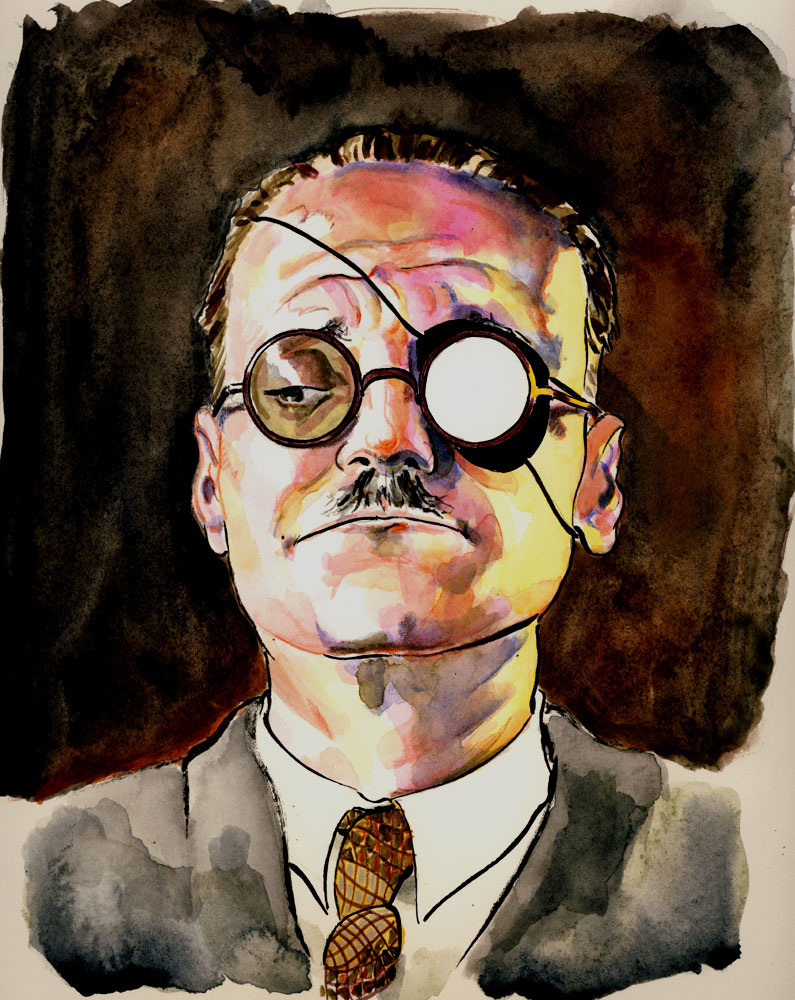
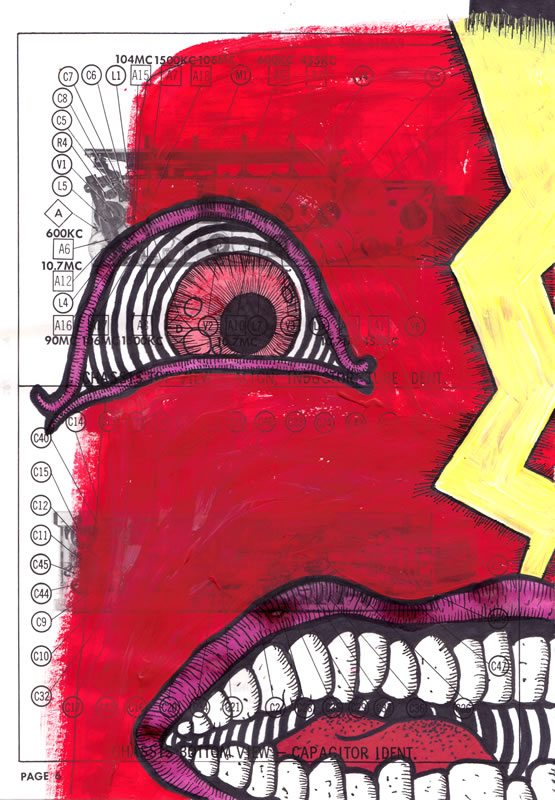
Berry’s portrait of a “Disapproving Joyce”:

JS: Let’s start with some general stuff (I realize you’ve discussed this elsewhere, including on your own blog at the site, but it’s worth rehashing for people who might not know about your project): Why Ulysses? Is there something about this novel in particular that you think lends itself to the kind of adaptation you’re doing? 

RB: Some years back, while first noodling around with the idea of working in comics and graphic novels, another cartoonist and I attended a BloomsDay reading here in Philadelphia. I’d read the novel before then of course, so I was there more as a celebrant than a novice, but this was first time I’d been to something like this.  Hearing passages from novel read aloud, particularly to a crowd, is a completely different experience than tackling it on your own. When it’s good, when the reader is really getting it, you can see it on the faces of everyone in the crowd and you can see that they’re getting it too. It’s like theatre and everyone’s just standing around in the twisting turning halls of Joyce’s language and wit.

But it’s not theatre, of course. It’s novel, an intentionally very complex novel, with a very bad reputation as being “difficult”. Unlike theatre, novels have a very one-on-one relationship with the reader; they’re something you can carry with you, pause to think about and unravel at your own pace. Something to stage in your own imagination.

I wanted to make a comic that could give people that same kind of one-on-one relationship with the text but could also give them that same kind of stage direction you get out of the theatre combined with an easy reference guide to what’s going on. A way to “see” the novel as you’re reading or hearing it.

 JS: Speaking of which: Why a comic book? (Is that the term we’re using?: certainly Joyce considered his work a “comedy,” in the old, Dantean sense of the word, but what you’re doing isn’t exactly a book, is it?) And why publish online, panel-by-panel?

RB: Over a few pints of Guinness at the pub on that same BloomsDay, my friend and I got into a discussion of how comics was the only media that could do a faithful adaptation of Joyce’s novel. Theatre and film don’t work because they happen in the real time of the audience. The reading experience works in a completely different way with comics and text. Comics have a linear flow, one image following another, but that line has more freedom, more plasticity, in how it relates to time.

Comics on-line, or on the iPad, have an even greater plasticity than they do in print. What we’re able to do on-line is use a comic panel to freeze a moment in reading Ulysses and allow the reader to jump “behind the page” to look at annotations from the novel or ask questions about what is going on and who some of the characters are. The comic itself serves as a kind of guide for all the external materials, discussions and concepts one might get from reading the novel in a classroom environment.

And Joyce is just waaaay funnier than Dante was.

JS: I don’t know, I bet the Inferno was pretty friggin’ hilarious when it first came out…

RB: It definitely raised more than a few laughs at the time, but it’s a bit more of a “had to be there” kinda humor I think…

JS: Tell me a little bit about your process: how do you go about deciding what a given “page” is going to look like, and then how do you achieve your vision? What’s the timeframe like: how long does a given page take, start-to-finish?

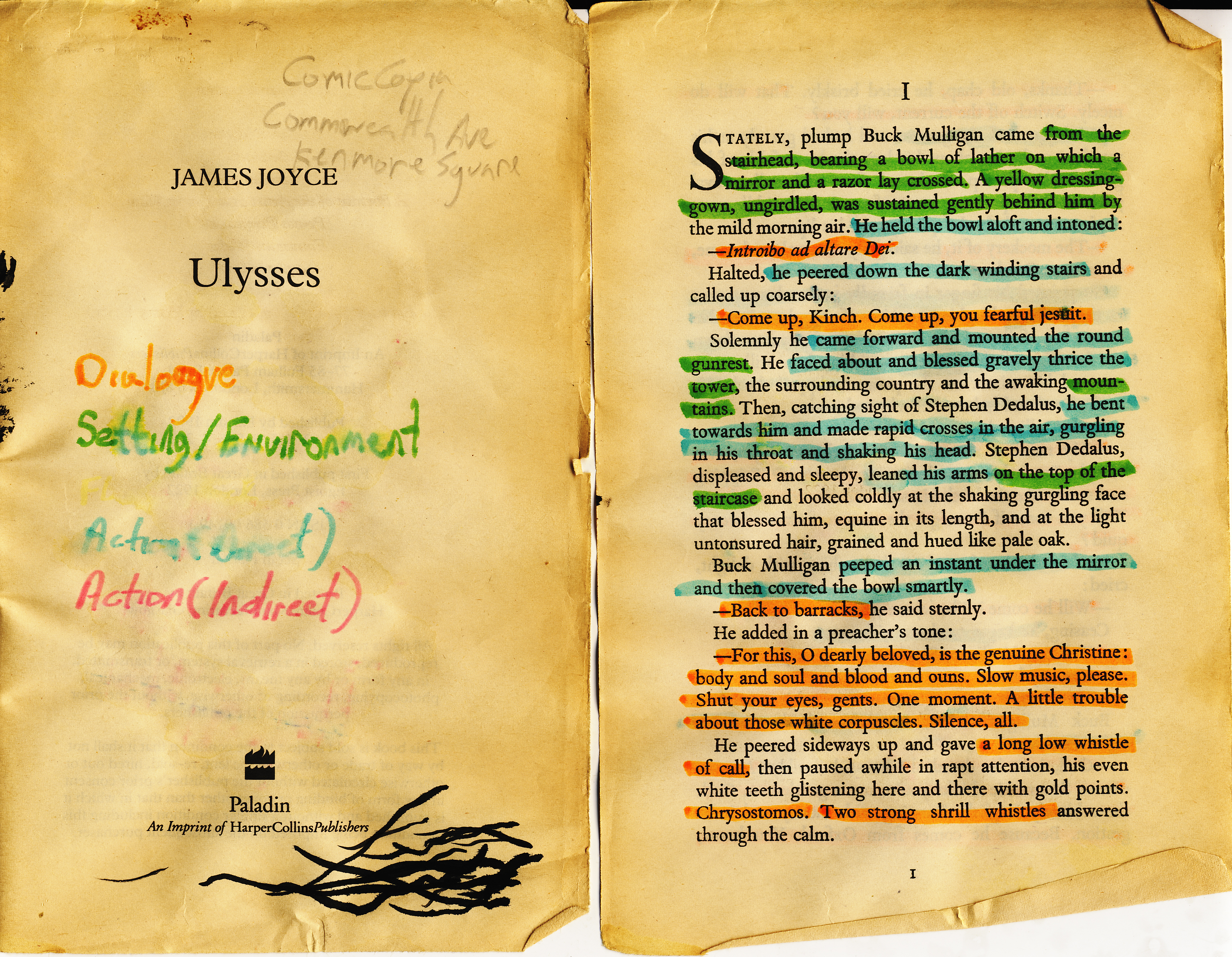
RB: The process is pretty unique in that I’ve never encountered anyone working on something like this, so we sort of took a little time to figure out the method. It all begins with the novel, of course. I have a replica of the 1922 edition, our sole source for the text, that I’ve color-coded with about six different highlighter markers to indicate the differences between action, spoken dialogue, internal monologue, etc.

The first page of Berry’s working copy of Ulysses:

Since each episode (or chapter) of Joyce’s novel presents new viewpoints and narrative styles, my four partners and I get together and talk over beers about the episode we’re doing next. Right now, that’s “Calypso”. This helps give me a set of guidelines to follow, a kind of a plan of what other people look for in a specific chapter. After that, I step away from the group for a while and make a set of storyboards, a rough comic, that includes all the original text. The goal at this stage is to pace and stage the flow of words as a director of a film might, looking for the beats implied by the language and giving just enough information so that readers can see who’s speaking as well as their relationship in space. This is a particularly complex stage, particularly when dealing with work as complex as Ulysses, so I tend to do this part on my own and don’t let anyone see it until I know I’ve made the right choices. It’s the guts of the comic.

After that is done, the storyboards go back to my partners for edits and a bit more discussion. It’s often surprising to see how differently each of us view the novel once it’s been drawn and there are occasional important changes that occur during this stage. From here, the work goes back to myself and our production designer Josh Levitas. Josh hand-letters and sets up the page files into what we call “floorplans”. This allows me to make drawings on hand-lettered pages around the text in accordance with my original storyboards. I think it keeps a freshness and a liveliness to the drawing that was lost in earlier versions in which we lettered with the computer over existing drawings. For the next chapter Josh is doing a lot of the set design as well, making drawings of objects in Mr Bloom’s house that we’ll see again much later in the novel.

In the meantime Mike Barsanti, our resident Joycehead, starts working on the Readers’ Guide entries for each page. He explains some of the major themes and issues in the novel, gives some Joycean anecdotes and tries to show links to other related topics and discussions. It’s an area of the project that I have very little to do with but am probably most proud of.

The goal here in all of our work is open up the world of the novel using comics and the internet, to make it a bit less daunting and to show how it connects to today’s readers as something more than just an English Literature merit badge. It’s a complex novel, certainly, but that complexity, once they’ve started to crack it, brings readers back again and again. It’s what makes it the most difficult book you’ll want to read many times.

JS: I see you’re doing the “Calypso” episode second, rather than “Nestor”: that makes sense to me, but would you care to comment on the decision?

RB: I decided pretty early on that I wanted to go chronologically through the first six episodes of the novel. They’ll still be sorted and numbered according to their original order, so “Calypso”, though it appears next, will still be called episode number 4. I made the decision when I was first thinking about how the web and the iPad are much more flexible platforms for annotation. It seems to me that the comparison between these two chapters is a useful learning guide for first time readers so we wanted to step up that process just a bit. But the main reason for it is that I’m going to do “Nestor” and “Lotus Eaters” simultaneously next year, shuffling their pages together to show the chronological relationship between Stephen’s day and Mr Bloom’s. I’ve already laid that chronology out and, believe me, it’s a great example of comics is such a good format for adapting Joyce.

Plus, I was a bit anxious to get to draw Bloom. If I’d have gone with the strict order of the novel that wouldn’t be happening for another year or two.

A sample of the forthcoming adaptation of “Calypso”:
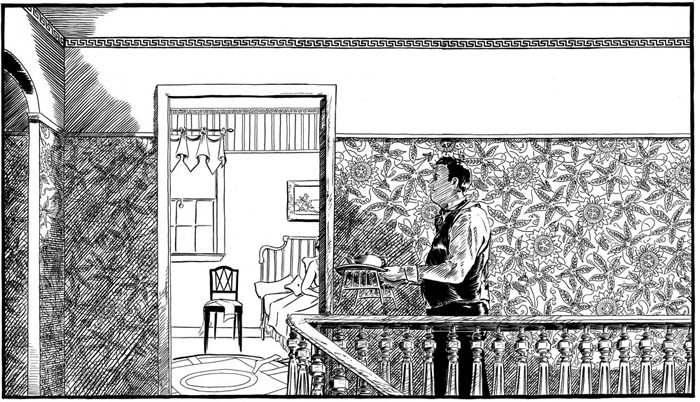
JS:  Are there any moments/panels that gave you particular trouble, in terms of interpretation/adaptation? 

RB: All of the internal monologue presents problems when you start it. As an illustrator you need to separate out a certain voice for each character and how they see the world. Mr Bloom’s inner mind can’t rely on the same visual devices as Stephen’s does and both have to be distinctly separate from the voice of the omniscient narrator. I could’ve cheated a bit, used different font styles to represent this, but I think that’s kind of a cheap parlor trick in comics and, with so many distinct voices in Ulysses, bound to be confusing later.

But establishing an order for how to slip into the imagination of each character is probably the hardest bit. I think you’ll notice it quite a bit in “Calypso” that Bloom doesn’t dream about the world in the same hard imagery and weight of words that Stephen does.

 JS: What are you looking forward to most, in terms of the coming chapters? Is there any particular moment/line that you can’t wait to illustrate?

RB: Off the top of my head it’s that scene in “Lestrygonians” when Bloom has the memory of the seedcake being passed into his mouth and notices the two flies, buzzing, stuck on the window. To me, that’s a very poetic combination of imagery and text, all of what comics can do better than most other narrative mediums.

JS: Wow… that’s pretty much my favorite moment in the whole book.

A big thank you to Rob and his collaborators at Ulysses “Seen.” Rob will be joining us on our reading, and will post his thoughts about the episodes that he has adapted so far in the coming weeks.
Ulysses on the Web

In my last post I discussed many of the “old-fashioned” (e.g. print) resources that are available for the struggling reader of Ulysses (and we’re all struggling readers when it comes to Joyce). But these resources have largely been supplanted in the Internet Age– the web has proven to be a very hospitable place for Joyce-studies. The man who is credited with inventing the term “weblog” was a Joyce-fanatic, to give you some idea (more on that in a moment).

I’ve referred you here before, but I think it’s a good place to start so I’ll mention it again: the Joyce page at the Modern Word has a lot of great background information and introductory essays (their Pynchon page is excellent as well, FYI). Here is their page introducing Ulysses in particular. They also have a page of links, but many of them are broken: the site does not appear to have been updated since 2004. (If anyone out there knows what happened to the site, I’d love to hear: I tried contacting them, but their email is out of service as well.)

A couple of commenters have mentioned Jorn Barger (the aforementioned coiner of the term “weblog”) and his incredible Robot Wisdom site. This is an incredibly extensive resource, but it is sometimes daunting: Barger is a lifelong Joycean, and his readings are often intricate and polemical. So, proceed with caution. (But do proceed!) The site is no longer being updated, but you can keep up with Jorn here.

More useful for the first-time reader are Michael Groden’s notes. Created to aid his students, Groden provides extensive background and though-provoking analysis of each episode (navigating the site takes some getting used to, though). It’s sort of like really smart Cliff’s Notes.

One of the most captivating (and distracting) sites is JoyceImages, which collects period images for all sorts of references throughout Ulysses. It is truly amazing, and was praised by Rob Berry at Ulysses “Seen” as “my favorite, most inspirational and most commonly used Joyce site. For a visual understanding of the world ULYSSES works in this is as seminal a text as Gifford’s.”

And, oh yeah, there’s also Ulysses “Seen” and their amazing Reader’s Guide. A work in progress, this site will get you through the first chapter, and leave you wanting more. (And more about that will be forthcoming, here, soon). 

These are the sites I’ve found most useful, but there are many, many more: not to mention the fact that people are writing about Joyce on blogs and Twitter every day (here’s a nice post from the past Bloomsday). Feel free to post links in the comments to any relevant sites I’ve failed to mention: I’m always looking for new distractions.

From Hell’s Heart He Stabs at—What, Exactly?

“The ‘elusiveness’ of Kafkaesque terror … is maybe the supersaturation of every possible line of allegorical reading (you can’t isolate what is everywhere).”

John Holbo.

(I know Kafka’s a long stretch from Moby-Dick, but he’s not why I used the quotation; I aim to connect the extract and the point below.)

We finally meet the White Whale! And he’s just as vicious as we’ve been led to expect: rocketing up out of the depths of the ocean to chomp an occupied boat in half, swatting at other boats with his tail as if they were flies, pulling a remarkable Three Stooges maneuver with two harpoon lines to smash their boats against each other, single-headedly staving an entire ship so that its whole crew (but one) drowns in a maelstrom. But then, after three chapters of mayhem, there’s a short epilogue and the book is over. That’s it, nothing more to see.

It seems an odd kind of book whose title character only appears in the final pages to kill practically every other character and then vanish. It all happens quickly, but I agree with Paul that it doesn’t feel rushed. Instead it just feels very final, and brutal. Speaking for myself, there’s something about the mystery of Moby Dick and the compactness of his “on-screen” presence in the book that I find irresistibly suggestive. There’s too much weight placed on him through the course of the narration to be borne by that tiny role, so I find myself again saying it must mean something.

It’s not just me, though: Many of the characters, and I would imagine much of the criticism, look to Moby Dick as a symbol of something. For Ahab, he’s an agent or principal of supernatural malice, an implacable nemesis. Starbuck seems to think he is a devil and expresses concern that they’ll get dragged to Hell if they harpoon him. (I don’t know how literally he means it.) Ishmael goes everybody one better and devotes an entire chapter to projecting his own meanings onto the empty canvas of the whiteness of the whale.

As far as that whiteness goes, Melville practically invites us to write our own interpretations onto the blank page that is the whale’s skin. It’s certainly easy enough to grope toward reading Ahab and Moby Dick’s contest as humanity vs. nature, or humanity vs. the greater powers, or will vs. matter, or (at least poetically comprehensibly) even past vs. progress, and probably any number of other allegories. The resonance and capaciousness and complexity of Melville’s writing give us lots of pitons to rope a reading through, and seem to support a great variety of interpretations. The book brandishes an enormous amount of knowledge about whales, and brings to bear on the plot and its giant albino a huge range of human discourses, including economics, biology, anatomy, physiology, oceanography, literature, psychology, and theology. Of course we can make him mean something!

But this is where the quotation I began with enters the picture: allegorical supersaturation. Moby Dick can mean all those things, at least tolerably well; which is too many meanings. The confusion of every possible meaning that can be attached to him cancels out to a nullity—you can’t isolate any one of them, because the others all impinge too much upon it. Consider: After all we’ve read, outside of his great savagery we know nothing significant about Moby Dick except for a probabilistic idea of where he’s more and less likely to be at a given season. He’s visible from a mile or two out, and we know less about him than about the electron. To steal a phrase from Daniel, we still don’t know dick about Moby Dick. He spends the vast majority of the book hidden both figuratively and literally below the surface; for all the psychological effect he has on the characters (and, I admit, this reader) before he appears, he remains wholly unknowable. We can squeeze him into any interpretation we want, but it will teach us no more about the whale and we will have made the same mistake as Ahab and Starbuck and who knows who else: We will have ignored the irreducible fact of the whale in favor of converting him to an interpretive object.

That’s what I find the most compelling about Moby Dick. He comes out of nowhere, without warning (dare I say “like a thief in the night”?), does whatever he is going to do, then vanishes. There is no taming him or managing your encounters with him or even understanding him. He’s almost like a Lovecraftian monster in his assault on the idea that human beings can master or even comprehend the world. He is purely sublime, and although he will bear a great number of interpretations, none of them will encompass him. For someone as intellectual and Enlightenment-infatuated as I am, it’s an exhilarating thing to read such a stimulating book and then get my face slammed right up against the wall of human understanding. I look forward to it every time.

How much “other stuff” do I have to read in order to understand Ulysses?

The short answer to this question is: none. No ancillary reading is necessary to enjoy Ulysses, and I tend to tell first-time readers to actually avoid all the guides and reference books: I think it’s best to just let Joyce’s prose carry you along, and enjoy the ride. You can try to figure out “what it all means” later.

However, I do recognize that this approach isn’t satisfying to everyone, and some people prefer to have some of the more difficult aspects of the text cleared up for them as they go. (This seems an appropriate thing to acknowledge in the light of Daryl’s post earlier today). So here are some of the things that you might like to take a look at, as we read.

1. In addition to a good dictionary, the one indispensible resource is Don Gifford’s Ulysses Annotated. This hefty tome will elucidate the vast majority of Joyce’s references, from literary allusions to local Dublin “street furniture.” Some people like to read with this open alongside, checking out Gifford’s commentary as they go. I did this, in fact, my second time through: it’s enlightening, but as you might imagine it really slows down the reading, and takes a lot away from the rhythm of Joyce’s writing, so I’m not crazy about it as an approach. Instead, I’d suggest marking words and passages you are curious about as you read, and then after you finish a chapter go to Gifford and look them up. But everyone reads differently, and you’ll have to find a method that works for you.

2. There are any number of guides to Ulysses, which provide plot summary and explain various allusions and parallels. There are two that are particularly worth mentioning. One was written by Joyce’s friend Stuart Gilbert, with Joyce’s guidance, and so it has the authorial imprimatur: it’s sort of the “official” guide to Ulysses. It is an excellent book. It’s rather heavy on the summary and quotation of the novel, but when you consider that it was published while Ulysses was still banned in most of the English-speaking world, that makes a lot of sense. Gilbert spends a lot of time on the Homeric parallels, cementing that mode of reading for a generation of Joyceans. His introduction to the book is fascinating (and almost as dense as Ulysses itself, at times), so I’d suggest looking at that at some point (preferably after you’ve finished your first reading of the novel), even if you don’t want read his summary/analysis of each individual chapter.

More recent than Gilbert, and rather more popular among contemporary readers, is Harry Blamires’ The Bloomsday Book. This is a lot less inflated than Gilbert’s book, and provides a sort of walk-through of the text, pointing out various connections that might escape the casual reader. It’s very helpful, but I often find myself questioning his conclusions. (I believe I’ve spotted a few outright errors, in fact.) But really, I think my problem is that I just find his reading a little too cut-and-dried, whereas I find Ulysses is more ambiguous.     

Then there is a more recent guide, which I’ve heard was actually a best-seller in Ireland (though I have not confirmed this to be true): Declan Kiberd’s Ulysses and Us: The Art of Everyday Living. As the title suggests, this is less a guide to the plot of the book or exegesis of its literary depths than a discussion of what the book has to tell us about being human. In that regard, it’s maybe a little touchy-feely for some, but it’s really quite good, and it’s interesting to see how Ulysses is regarded “today.” (Well, last year, anyway.)

3. Moving up the scale from “notes” to “guides” to “studies,” there are any number of great introductions to Ulysses that take a more whole-cloth approach, rather than walking the reader from chapter to chapter. One I particularly like is by Hugh Kenner, probably the greatest modernist scholar of his generation, and just a really good stylist in his own right. His book on Ulysses  is brief, but full of interesting observations. There are others, but this is my favorite.

4. Then there’s the literature that Joyce was drawing on for background. I don’t think reading the Odyssey is very important for understanding Ulysses: a grasp of its basic plot (a hero trying to get home, a son trying to reunite with his father) and major characters and mythological monsters (Cyclops, Sirens, etc.) is sufficient, and can be gained from reading a children’s “stories from the Odyssey” (which is, I believe, essentially what Joyce was drawing on). But if you have the time, of course, there’s no harm in reading the Great Poem of the Western Tradition (I like the Fagles translation). 

The other big canonical text referred to throughout Ulysses is Hamlet. I’d imagine everyone reading this has read Hamlet at some point, but if you have a free couple hours, it’s worth revisiting it: there’s a whole chapter (the ninth) that centers on it, so it’s good to have it fresh in your mind. But not necessary, by any means. (As a matter of fact, the discussion of Hamlet in the book strays pretty far from the play itself, looking more towards Shakespeare’s life for material. But you’ll see.)

The most important precursor to Ulysses is Joyce’s previous novel, A Portrait of the Artist as a Young Man. This you probably should read before you start. Ulysses picks up the story of Stephen Dedalus where Portrait left off, and a number of other characters carry over as well. Again, you’ll totally be able to get into Ulysses without it, but it provides useful context. There are also a number of characters from Dubliners, Joyce’s collection of short stories, that crop up, but it’s not necessary to have read that one first either.

5. And of course, like all his books, Joyce drew much of Ulysses from his own life, so Richard Ellmann’s magisterial biography provides a lot of useful background.

Of course, there’s also a lot of stuff online (for example, the annotations at Ulysses “Seen”): my next post will explore Ulysses on the web. And I’d like to invite comments on secondary sources from you, as well: I’m sure there’s a lot of stuff I didn’t mention, and probably people have their own ideas on how to best approach the book: please share.

Ultimately I’d like to reiterate, even though I’ve listed a semester’s-worth of reading here, absolutely none of it is necessary, and I strongly encourage first-time readers to just jump into the book without all this excess baggage holding you down. The book more than stands on its own.

It All Comes Back to Me

I’ve mentioned before that I’ve started and stopped Ulysses a number of times. The first was maybe a decade ago, when I checked it out from the library, read a few pages, and decided it wasn’t for me. Several years ago, I decided to buy my own copy of the book, and I’ve tried to start a couple of times since. I think I once got maybe 100 pages in before deciding it wasn’t for me. The experience is similar to my experience with Gravity’s Rainbow, another one I started who knows how many times before finishing. I think I once got some 300 pages into that one before being distracted by a shiny object and putting it down. I did finish GR at last a few years ago, and I was left feeling like it was a great book but not so terribly enjoyable a book on the whole. It was a bit like taking medicine.

Having started (and restarted, and restarted) Ulysses again, I begin to feel history repeating itself. I’ve read the first ten pages three or four times in the last few days. I’ve gotten only so far partially because it’s a busy time for me and I can’t ever seem to find more than a few minutes to read. And even then, I’m reading a page (or a part of a page) at a time before being interrupted. So I can’t place all blame on the text for my slow start so far.

But I think I am going to blame the text some. Or I am going to blame Modernism, which I now remember, not having read much from that camp in the last decade, I fucking hate. Before it occurred to me to affix that dread label to Ulysses this morning, I found myself trying to enumerate the reasons I was having difficulty slipping into the book. The best I could come up with was that it is obnoxiously allusive and meandering. Some meandering I’m ok with. I suppose I like meandering that is entertaining. But in the opening of Ulysses, I find little so far that entertains (or engages) me. There are words I don’t know and references that apparently even the scholars can’t agree upon the referents for. There are still others that I simply can’t make sense of (a gardener masked with Matthew Arnold’s face?). There are phrases in at least two foreign languages I don’t understand. And there’s stagnation. So far, a fop and a wet blanket are standing on a tower shaving and talking briefly but ornately about things as varied as death and money and clothes and dreams. There’s nothing so far to really hold my interest. I’m not dazzled by the prose, and I’m actually a bit put off by the allusiveness and meandering.

These seem to be the hallmarks of Modernism, at least as I understand it. Take “The Wasteland.” Take Pound. (Please!) One of the problems I have with this sort of literature is that it often seems like a big in-joke. Modernists seem to be intentionally obscure and to wink at and nudge one another about their smartness. It’s not an inviting sort of literature. It makes me feel not only like I’m not one of the cool kids but also like I’m not even one of the smart kids.

I don’t expect (or want) a book to be easy. Most of the books I read, I read because they have reputations as hard, worthwhile books. I enjoy working to grok a book. Sometimes, I even enjoy working hard to grok how to grok a book (I’m thinking in particular of Gaddis’s JR). But boy am I worried about my ability to hang on for this one. I will. I will, even if I just stare at every word on every page without really getting what Joyce is saying. But if the opening — which I must have read a dozen times in my life by now — is any indication, this is going to be a slog and a half.

More to Think About

Moby-Dick is such a rich book with so much going on that I’ve left just tons of things by the wayside that I would love to have picked up and run with. Some things you might think about as you digest the book:

  • The tension between land/grass/prairie and the sea. The book is just brimming with these contrasts. Does Melville draw this contrast so starkly (and almost systematically) merely for effect or is there some more significant reason for it?
  • Moby-Dick is published in the decade prior to the Civil War with slavery as a backdrop. The fear of mutiny makes an appearance several times in the book (not least of all in one of the longest chapters, “The Town Ho’s Story”). Melville also wrote about conscription and mutiny in other works (Billy Budd comes to mind). To what extent and to what effect is Melville writing here about freedom of will and, by extension, about slavery?
  • Was Melville gay? Lots of historians have suggested that he may have been (some even that he may have made a sort of pass at his good buddy Hawthorne, effecting something of an estrangement). How much of Moby-Dick is it reasonable to read with homosexuality as a focus?
  • I’ve written already about the two Moby-Dicks, but I think it would be fascinating to trace the idea further and to see how much water that theory really holds.
  • Is there any use in considering the almost total absence of women in Moby-Dick? Or do we just figure that whaling was a predominately male-run industry and move on to another topic? (Or do we suggest that, as women are largely absent from Melville’s work as a whole, he was perhaps uncomfortable writing about women? And if so, do we add this supposition to the gay question?)
  • There are a lot of interesting — and potentially significant — names in Moby-Dick. George Stewart examines some of these in his article about the two Moby-Dicks in an effort to understand the different modes of composition (ie, does using particularly symbolically significant names suggest a higher style, and do significant names devoid of any traceable symbolism suggest a lower style, and the two styles a shift in mode of composition?). Stewart’s project aside, I think it’d be fun to do a detailed analysis of all the major names, their historical significance, and how they bear on the character (or ship) they’re attached to.
  • In flipping through the edition of Moby-Dick I used during college (I used a different edition this time around), I found a bunch of places where I had marked poetic scansion, typically scanning roughly as iambic pentameter. This isn’t really a terribly uncommon meter even in natural, spoken English (a professor once cited the example “a footlong hot dog all the way to go”), but I still perk up when I’m reading along and find a line that just stops me in my tracks with its sudden unmissable meter. A careful examination of the meter of Moby-Dick would be painstaking but fascinating.
  • Those who have done film or stage adaptations of Moby-Dick have mined it for drama. But I’ve never done a systematic survey of all of the book’s dramatic elements. Might be fun. (By the way, I had lined up an interview with a member of the Dallas opera’s production of Moby-Dick, but it seems to have fallen through.)
  • If you’re like me, you finally wind up just getting tired of looking up all the references to historical or mythological people or events you don’t know much about (I’m looking at you, Xerxes). Powermobydick glosses most (if not all) of these, but I crave a proper and thorough index complete with discussion of the particular relevance of these references to the text.
  • Melville writes a lot about darkness and light. No doubt some enterprising Master’s student has written a thesis on this.
  • Hawthorne and Melville were good buddies during much of the composition of Moby-Dick. Their friendship has been considered at some length in various places, but I never made much of it here. And what about Transcendentalism (or anti-) as an influence on Moby-Dick?
  • I have a bad habit of romanticizing the past. People sat around talking philosophy and reading all day long and were generally just a whole lot smarter and more widely-read than we are now, I tend to think. But consider this: Fewer than 2500 copies of Moby-Dick were sold in the three years following its publication in America, and over a period of 35 years, it sold 3,215 copies (roughly 27 copies a year). Did people merely loan books to one another a lot more than we do now, or was there really that little interest? I know Moby-Dick did not sell well, but was it vastly atypical? What kind of sales did Hawthorne (a very popular author) have, I wonder? Did he sell 5,000 or 10,000 or 100,000 copies of his popular books? What would the answers to some of these questions say about the true state of reading and of the intelligentsia of Melville’s time compared to now?
  • Life after Moby-Dick for Melville was really sad. He was something of a drinker and wound up going on speaking tours at the events of which he mumbled through his speeches. Under the right circumstances in private life, he was an animated speaker, though. One of his sons committed suicide, and though Melville seems to have been affected by that, he was by some accounts not a terribly kind man to live with. The tenderness that appears through much of Moby-Dick makes this all hard to swallow. He died more or less forgotten.
  • Delbanco writes of Melville as something of a precursor to the postmodern writers (I’ve touched on this before). It’s not something I had ever thought about prior to this read (having really encountered postmodern literature some time after my first few encounters with Moby-Dick). A survey of some of the ways in which he anticipates less conventional modes of writing has no doubt been done and would make an interesting read.
  • Who is the hero of Moby-Dick? Matt Bucher asked a question along these lines at the beginning. Paul (either here or at his own blog) saw a glimmer of the heroic figure in Queequeg, and George Stewart suggests that Queequeg may have been a the hero in Melville’s early conception of the novel, but he fades into the background. Ishmael can hardly be called the hero, and Ahab — though possessed of the tragic elements of a tragic hero — probably lacks the heroic elements of a hero. Is there a main character or hero in Moby-Dick? Who? Why?

Thanks for reading along over the past few weeks. I’ve really enjoyed having an excuse to read the book (and related matter) with some care, and I’ve found a lot of the reactions to Moby-Dick (e.g., that it’s full of humor) to be very gratifying. I suspect there’ll be a few more straggling posts about Moby-Dick (I know that artist Matt Kish has a few more planned), but this post probably marks my last on the book. I’m mentally composing a post about my first beef with Ulysses already.

Illustrating ‘Moby-Dick’ – Captain Ahab

Ahab was a monster.

I was afraid of him the instant I started this project. Even more so than with the white whale itself, I knew that whatever choices I made in depicting Ahab would loom large over the entire series. I was quite literally terrified, and I lived in dread of illustrating him. I knew the day would come, but the less I had to think about it the better. The pressure was staggering.

Perhaps that was because I knew Ahab came with expectations. Many are familiar with Gregory Peck’s turn playing the role. Less, perhaps, know Rockwell Kent’s Ahab specifically, but enough have seen it in various editions that I knew I had to battle against that as well. Beyond those two examples, books and movies and comics and paintings and prints and all sorts of other ephemera, whether they cluttered the pop culture landscape or filled the drawers of museums and archives, bore Ahab’s image and like a kaleidoscope filled the world of the novel with a fragmented panorama of monomaniacs.

As always, I began with the details. Delightfully, Melville doesn’t skim with these regarding his lunatic captain. After pages and pages of whispered rumors and half-myths, Ahab finally appears in the flesh in chapter 28, after this incredible line of text…

Reality outran apprehension; Captain Ahab stood upon his quarter-deck.

That possessive touch, “his quarter-deck,” is a brilliant touch foreshadowing just how much control Ahab now has over his sailors’ lives. And deaths.

Melville continues…

There seemed no sign of common bodily illness about him, nor of the recovery from any. He looked like a man cut away from the stake, when the fire has overrunningly wasted all the limbs without consuming them, or taking away one particle from their compacted aged robustness. His whole high, broad form, seemed made of solid bronze, and shaped in an unalterable mould, like Cellini’s cast Perseus. Threading its way out from among his grey hairs, and continuing right down one side of his tawny scorched face and neck, till it disappeared in his clothing, you saw a slender rod-like mark, lividly whitish. It resembled that perpendicular seam sometimes made in the straight, lofty trunk of a great tree, when the upper lightning tearingly darts down it, and without wrenching a single twig, peels and grooves out the bark from top to bottom, ere running off into the soil, leaving the tree still greenly alive, but branded. Whether that mark was born with him, or whether it was the scar left by some desperate wound, no one could certainly say.

There was enough, indeed more than enough, in that one passage for me to begin. And in spite of my terror, I did have my own ideas. There was some madness there, yes, but above all, there is a great unknown quality about Ahab. He appears strong, robust, “made of solid bronze” and yet he looks “like a man cut away from the stake, when the fire has overrunningly wasted all the limbs without consuming them.” A paradox. Ahab is both brutally vibrant yet curiously and almost invisibly wasted and desiccated.

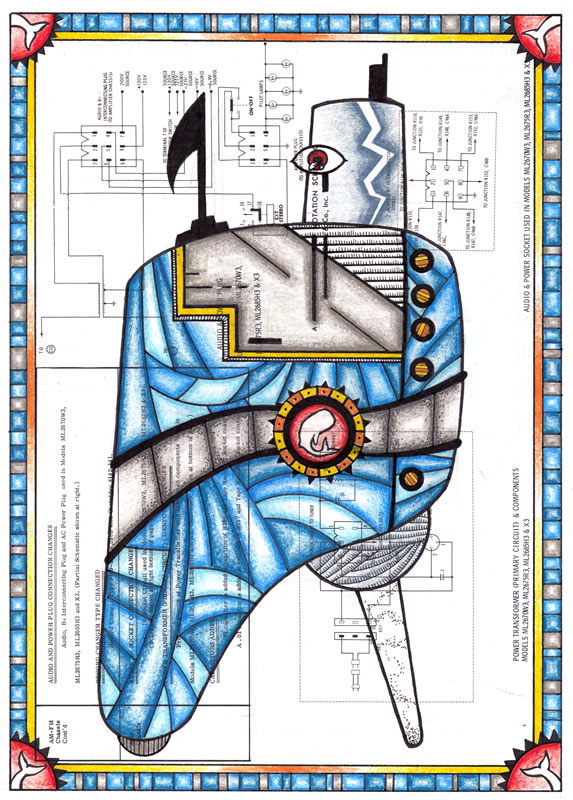
Continuing to explore my own visual vocabulary of imagining these whalemen as ship like constructs themselves, I saw Ahab as some kind of an avatar. The ideal, perfect whaleman. Even here, nearing his own unknown and unexpected death, consumed by hatred and vengeance, he was shrouded in power and glory. His image had to reflect that might and the drawing itself had to show fealty to the man. I knew I would need to spend much much more time than usual, but I felt immediately that an ornate border needed to decorate the drawing, creating the feeling of an icon. In a bit of visual foreshadowing, I decorated the corners of the border with a blood-red quarter circle enclosing the shape of a fleeing white whale-tail presaging Ahab’s deadly pursuit of the unreachable and unconquerable Moby Dick. Also, in keeping with the grotesquely baroque designs of his ship the Pequod, Ahab was decked out like a barbarian king with a great belt, a massive spiked belt buckle depicting (again) the white whale, and a great coat swirling with the colors of the sea. A thick and brutal harpoon jutted from his right shoulder, seemingly encased in his body and ready to be fired forth as if from the cannon of his chest. Finally, Ahab’s great head sat on his body like a turret. I felt that I absolutely had to push the curious and slightly disturbing image of that “lividly whitish” scar to the fore as an outward, obvious symbol of Ahab’s inner maiming…

This first image of Ahab was grand, as suits the man. All perfect lines and curves delicately shaded and lavished with care. But I knew Ahab himself would undergo a drastic transition throughout the novel and once I had settled on how to depict him, I relished the thought of showing his deepening madness and steady unraveling. This I would show in the choice of media and the fury of the brushstrokes delineating him. First, and almost immediately after appearing on “his quarter-deck,” Ahab savagely rebukes Stubb, advancing on him with “overbearing terrors in his aspect.”

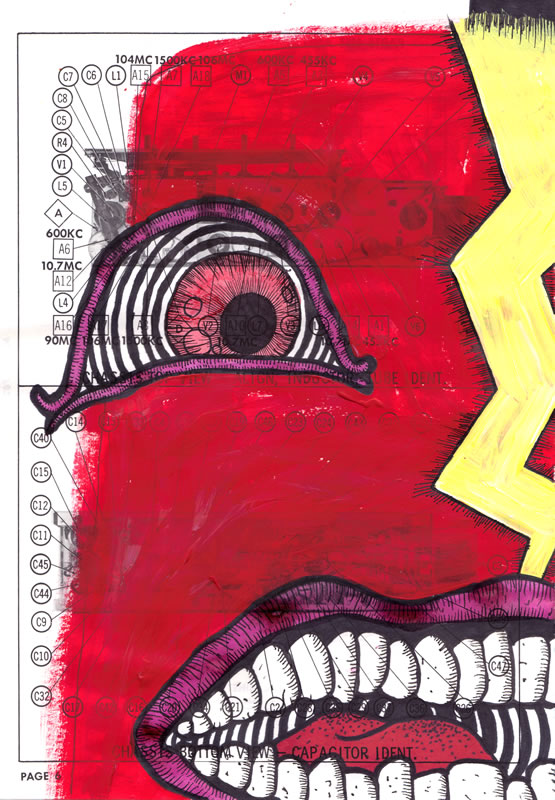
Next, one of the most definitive lines from the novel, Ahab’s cry of “I am madness maddened.” I began to experiment with subtle and not-so-subtle changes in Ahab. His head, somehow, in my mind had become a great scale-armored helmet. The eye, once so perfectly and geometrically rendered now grew and bulged and leered. The head was now riven from above, not by a simple scar but by a great bolt of divine lightning. His unmoored, maddened head seemed to float, sprouting wires and circuits and pipes rather than veins and sinews and blood.

Here, Ahab in an almost reflective moment, scrutinizing his charts and maps, obsessed with the hunt for Moby Dick while the lone lamp in his cabin swings and sways over his head.

Finally, what has come to be not only my favorite image of Ahab, but my favorite of the series of illustrations this far. Ahab, at the gam with the Goney (or Albatross) looking over the side of the ship at schools of small fish which had suddenly darted away from the Pequod and arranged themselves near the Goney. The line illustrated here is “’Swim away from me, do ye?’ murmured Ahab, gazing over into the water. There seemed but little in the words, but the tone conveyed more of deep helpless sadness than the insane old man had ever before evinced.” This is perhaps the only instance in the novel where Ahab’s madness and hateful thirst for vengeance gives way and reveals the agony and pain he labors under. Ahab is heartsick, dying inside, forever removed from joy and numb to any feelings of warmth and kindness. Some part of Ahab truly is aware of his own sickness, of the death inside of him, and at this moment, with this one line and this longing look at the fish fleeing from him, Ahab shows that “deep helpless sadness.”

Jonah

Jonah makes, by name, 85 appearances in Moby-Dick.  There are no doubt other references that recall him obliquely without using his name. And of course some characters in Moby-Dick bear certain resemblances to Jonah, bringing the total reference count up yet further. In chapter 82, Melville puts Jonah together with the likes of St. George, Vishnu, Perseus, and Hercules, and suggests that as the Hebrew texts predated the Greek, so Jonah must be source material for the Hercules myth (if Hercules, why not also Perseus? Melville doesn’t answer). That first whaler (as Melville would have him) shows up by name in the extracts and eight chapters, generally at ten-to-twenty-chapter intervals. Ishmael aside, Jonah is probably the most consistent presence in the text from beginning to end.

Delbanco points to speculation that the chapter containing Father Mapple’s sermon (all about Jonah, recall) was a late addition to the text. If so, then such an addition would seem to suggest that Jonah serves a more important role in the text than merely that of a convenient Biblical reference. The lesson of Father Mapple’s sermon is fairly simple, if eloquently illuminated by that dramatic man. It is “a story of the sin, hard-heartedness, suddenly awakened fears, the swift punishment, repentance, prayers, and finally the deliverance and joy of Jonah.” But that’s the story and not the lesson; the lesson is that willful disobedience of God’s command simply will not do. In addition to declining to obey God, Jonah had the gall to try to flee bodily from that omnipresent, omniscient deity.

Yet in the end, after his sojourn in the belly of the whale, Jonah repents of his hubris. So too, Mapple says, may people repent. “Sin not,” he says, “but if you do, take heed to repent of it like Jonah.”

Now, let’s stand Jonah up for a moment next to Ahab. Both are prone to hubris. Both would meddle with a thing greater than themselves. They both sleep (surprisingly) through calamitous storms. Melville writes at more length than seems necessary about lamps in the cabins of both men. Shipmates come very near to ousting both, though each ultimately ousts himself (Ahab insisting that Starbuck stay aboard the ship; I see this as an echo of Jonah’s allowing himself to be cast away in order to spare the lives of the men he has shipped with). Melville highlights the Biblical detail of weeds wrapped around Jonah’s head, and he kills off Ahab by lashing him to Moby Dick by the hempen line. The ever-present contrast between land and ocean in Moby-Dick is present in the short book of Jonah as well.

But where Jonah flees the infinite, Ahab pursues it. As Jonah (in Father Mapple’s telling) sleeps in his cabin, the whale that will swallow him makes its way toward the ship, while Ahab, in his cabin, plots a course willfully in line with the course of the whale he pursues. Jonah flees his destiny, while Ahab strives to force his destiny.

Is this the lesson of Moby-Dick? That you’re damned if you do and damned if you don’t? Melville surely writes a great deal about fate and predestination, not least of all at the end of the chapter entitled “The Symphony,” worth quoting at length:

What is it, what nameless, inscrutable, unearthly thing is it; what cozening, hidden lord and master, and cruel, remorseless emperor commands me; that against all natural lovings and longings, I so keep pushing, and crowding, and jamming myself on all the time; recklessly making me ready to do what in my own proper, natural heart, I durst not so much as dare? Is Ahab, Ahab? Is it I, God, or who, that lifts this arm? But if the great sun move not of himself; but is as an errand-boy in heaven; nor one single star can revolve, but by some invisible power; how then can this one small heart beat; this one small brain think thoughts; unless God does that beating, does that thinking, does that living, and not I. By heaven, man, we are turned round and round in this world, like yonder windlass, and Fate is the handspike. And all the time, lo! that smiling sky, and this unsounded sea! Look! see yon Albicore! who put it into him to chase and fang that flying-fish? Where do murderers go, man! Who’s to doom, when the judge himself is dragged to the bar? But it is a mild, mild wind, and a mild looking sky; and the air smells now, as if it blew from a far-away meadow; they have been making hay somewhere under the slopes of the Andes, Starbuck, and the mowers are sleeping among the new-mown hay. Sleeping? Aye, toil we how we may, we all sleep at last on the field. Sleep? Aye, and rust amid greenness; as last year’s scythes flung down, and left in the half-cut swaths

Note how the beginning of Ahab’s speech echoes the sense of part of Father Mapple’s sermon:

As with all sinners among men, the sin of [Jonah] was in his wilful disobedience of the command of God — never
mind now what that command was, or how conveyed — which he found a hard command. But all the things that God would have us do are hard for us to do — remember that — and hence, he oftener commands us than endeavors to persuade. And if we obey God, we must disobey ourselves; and it is in this disobeying ourselves, wherein the hardness of obeying God consists.

It is disobedience to yourself that’s hard. Ahab knows not what drives him so. Jonah knows what drives him but disobeys it so that he can be obedient to himself. Both men meet a whale; only the one who repents comes back alive.

It’s interesting to me that Father Mapple leaves off the second half of Jonah’s story. I suppose it’s not especially nautical. Having landed at last in Nineveh, Jonah goes to preach God’s wrath and promise of destruction to the inhabitants of that vile land. To his surprise, they repent. When God decides to spare them, Jonah goes a bit emo and declares that in a world in which God can repent of the evil he had promised, he (Jonah) would rather die than live. He then goes off to pout in the sun. God makes a plant grow to give him shade. Then God sends a worm to kill the plant so that Jonah is miserable again. Jonah once again wants to die. The lesson God seems to want to teach Jonah here is that just as he (Jonah) pitied a plant that grew overnight and was killed (I figured he was just angry because God took away his shade), so God pitied the people (and the cattle) of Nineveh.

Consider this brief passage, as Starbuck seems to be on the verge of convincing Ahab to turn the ship around in “The Symphony”:

But Ahab’s glance was averted; like a blighted fruit tree he shook, and cast his last, cindered apple to the soil.

Like Jonah’s tree, Ahab — on the cusp of a sort of redemption — is blighted at last. The long passage I quote above in which Ahab waxes philosophical on self-knowledge (ahem, apples) and fate immediately follows this simile, just one more entanglement with the story of Jonah.

Melville points out time after time that people are bound together as members in something like a joint-stock company. Even when you think you’re merely following your own nose, you’re so wrapped up within the warp and weave of the fabric of society that you can’t avoid either being touched or touching the lives of others. Trying to run from God? Maybe you’ll get your ship’s crew wrecked. Planning a monomaniacal chase and revenge killing of a storied and apparently malicious whale? Might want to think for a moment about how it’ll affect those who ship with you. Or: Want to enact Manifest Destiny by fighting a war with Mexico? Maybe you should consider the thousands who’ll die in the conquest. (Of the Mexican-American War, Emerson said “The United States will conquer Mexico, but it will be as the man who swallows the arsenic which brings him down in turn. Mexico will poison us.” Melville, Delbanco tells us, harbored similar thoughts.) Or: Figuring on passing a law that would allow slave owners to hunt men down like prey and drag them home? Well, you get the point.

Week 6: Death & The End

I had originally planned to call this “Death and All His Friends” which seemed so clever and eerily appropriate.  And then I realized it was the title of a Coldplay album and decided that all my street cred would be lost (even though I do like the disc).

I was also considering talking about omens in the book, but that has been well covered by Daryl (I do have some specific omens in this post).  And finally I considered revisiting religion since Ahab has the audacity to baptize his harpoon in Satan’s name (and there’s a Starbuck as Jesus motif going on).  But really what could be more right than death?

I had noticed throughout the book that there was very little death (except for the whales of course).  This is despite the opening scene in the church with all of the grave markers and Ishmael slowly reading them all.  In fact, despite Pip’s falling over and Queequeg’s “fatal illness” no one had died at all aboard the Pequod.

Then in this final week’s reading–which was really fantastic.  I can’t get over how gripped I was by the build up and the whole chase sequence–death starts to poke its head out of the waters.

The first death is very cryptic, and possibly not even real (?).  In Chapter 126 (The Life-Buoy) we learn of one of the crew (who, strangely, remains unnamed) who fell overboard:

At sun-rise this man went from his hammock to his mast-head at the fore…he had not been long at his perch, when a cry was heard – a cry and a rushing – and looking up, they saw a falling phantom in the air; and looking down, a little tossed heap of white bubbles in the blue of the sea.

The life-buoy – a long slender cask – was dropped from the stern, where it always hung obedient to a cunning spring; but no hand rose to seize it…and the studded iron- bound cask followed the sailor to the bottom.

And thus the first man of the Pequod that mounted the mast to look out for the White Whale, on the White Whale’s own peculiar ground; that man was swallowed up in the deep (516).

And from that anonymous death, things really escalate.

Of course, there is the obvious omen (I couldn’t resist) of using a coffin as a life-buoy, but the very next encounter is with The Rachel.  Unlike all of the other ships that the Pequod has encountered (all with varying degrees of success) none has suffered a fate as wrenching as this one: the captain’s own 12-year-old boy is lost at sea, and he had to choose his other son’s life over this one.  And the Rachel has been looking for him (and his boat) for a day already…it’s hopeless.  That whole boat’s crew is dead.

This visit is followed by a visit from The Delight.  The Delight has encountered the White Whale and has suffered terribly for it

“I bury but one of five stout men, who were alive only yesterday; but were dead ere night. Only that one I bury; the rest were buried before they died; you sail upon their tomb” (532).

As ships near the white whale, death cannot be far.  (In fact the most successful ship, the Bachelor–which was laden with sperm–didn’t even think the White Whale was real).  Then, just to rub it in a little, as the Pequod sails away from The Delight, she is

not quick enough to escape the sound of the splash that the corpse soon made as it struck the sea; not so quick, indeed, but that some of the flying bubbles might have sprinkled her hull with their ghostly baptism (532).

Given this portent, and the seeming snowball of deaths, the actual Pequod deaths do not come fast and furious.  On the first day of the chase, everyone is spared.  On the second day of the chase, only Fedallah is killed [must…not…mention…prophecies].  This wounds Ahab terribly, but he manages to press on.

Of course, on that third day everyone dies, so I guess the trickle became a gusher.  But it’s fascinating to see how delicately Melville handles this mass death.  Even in that last scene when the Pequod sinks, only a few crewmen are mentioned by name–and Tashtego is still engaged in an activity when the boat goes down: “Tashtego’s mast-head hammer remained suspended in his hand” (563).  No one is said to suffer (Pip suffered far more on the page during his ordeals), and it ends very quickly.

What I found most interesting is that as a reader, I was picking up on all of the omens, the prophecies, the greater and greater deaths, and yet, like Ahab I read nothing into them.  I was sure that the ending…well, what?  I didn’t think it could be a happy ending (whatever that might mean), I wasn’t even sure if I thought Ahab would be victorious (I wasn’t holding my breath for him).  And yet, I never imagined that the whole ship would sink.

And even though this ending happens remarkably quickly (the ending scene is the last three pages of a 469 page book (the Norton edition)), it doesn’t feel like what my friends and I have called The Star Trek ending–[Five minutes till the end of the show, Captain, shall we release the dilithium crystal and huzzah!–we’re all safe (I like Star Trek (especially TNG) but it’s funny how many of their shows end like this)].  Obviously, Moby Dick doesn’t have that ending because in everyone dies, but what I mean is, the ending feels like a natural, almost inevitable end.  I was shocked–completely shocked–when I read that everyone died.  And yet in retrospect it is the only reasonable outcome.

I am still really surprised that Queequeg dies.  I realize there’s no way to save him and have it be believable, but still.  It’s also weird how little is made of Queequeg going down too.  [Can you imagine is he somehow managed to get Ishmael and Queequeg rescued on the coffin together–it’s sequel city baby!].

I mentioned in my other post how beautiful I think the Epilogue is, and I will do so here as well.  It’s tidy and elegant and unlike many epilogues which sort of tidy up loose threads a little too neatly, this one pulls together various ideas (the coffin, The Rachel) and uses them to give Ishmael a fully believable rescue.

When you reach the end, you realize that this story is something of a eulogy;  a whale tale told to someone about the death of his shipmates.  This gives the entire book an angle that didn’t exist before.  Were I the kind of person who did this sort of thing (I’m not) I would re-read the book with this new information in mind to try to see if the book reads differently knowing the outcome.

I am really very pleased for having read this book.  And I’ve more than very pleased to have been able to write these posts here.  I hope they’ve been interesting.  Thanks for reading.

Illustrating ‘Moby-Dick’ – Starbuck, Stubb and Flask

How do you “see” a novel? When you read, are you giving faces, costumes, and audible voices to the characters? Is the narrative played out in your head as your eyes scan the words? Or do you concentrate on the deeper levels of meaning, turning the characters into vehicles that exist only to convey ideas or act as a mouthpiece for the author’s worldview? I think it’s a fascinating line of inquiry, and one which I have long been obsessed with. How do we read?

For me, since the earliest books I can remember reading were lushly illustrated fairy tales, collections of myths, and dinosaur books, the visual elements has been inseparable from the narrative element of reading. When I eventually graduated to books without pictures, I would devour the cover images, looking for any kind of clue as to what the characters might look like. Often, I simply resorted to elaborately visualizing them in my head, creating details where they were lacking and quickly growing frustrated with authors who refused to acknowledge this lust for visual detail in their readers. Which, I know, might make me one in a small minority.

All of these issues were brought to the fore when I began my project to illustrate Moby-Dick. Once I began, I marveled at how inconsistent my own visualizations were but after careful thought, this began to make sense. If I think back to how my wife looked last night walking out of the airport concourse after her trip, I see her complete figure, largely in silhouette, but whole and complete. If I think back to how she looked when I showed her last night’s Moby-Dick illustration, I see the top of her head mostly, her short glossy black hair shining as she peers down at the page, and perhaps I see a bit of hands as she holds the illustration. Gone is just about everything below the torso. It just doesn’t exist because it doesn’t have to.

One of the greatest challenges in illustrating Moby-Dick has been creating images of characters that I knew would appear again and again and again, in drastically different situations, affected in all sorts of ways by what was currently happening in the narrative. In casting these whale men and mates and harpooneers as almost ship-like constructs, this problem became magnified. How to show emotion? How to demonstrate action? How to show them changing? In this sense, relying on the illustrations to be highly symbolic has been crucial.

So, when it came to the three mates, Starbuck, Stubb and Flask, I knew that I wanted to capture something unique, instantly recognizable, and deeply symbolic (at least to me) for each. I knew I would have ample opportunity to revisit them again and again throughout this project, but as is the case with any drama, first appearances mean the most. Fortunately, Melville is generous with his prose, and gives enough descriptive detail to get even the most uninterested reader started on a good visualization. First, Starbuck…

The chief mate of the Pequod was Starbuck, a native of Nantucket, and a Quaker by descent. He was a long, earnest man, and though born on an icy coast, seemed well adapted to endure hot latitudes, his flesh being hard as twice-baked biscuit. Transported to the Indies, his live blood would not spoil like bottled ale. He must have been born in some time of general drought and famine, or upon one of those fast days for which his state is famous. Only some thirty arid summers had he seen; those summers had dried up all his physical superfluousness. But this, his thinness, so to speak, seemed no more the token of wasting anxieties and cares, than it seemed the indication of any bodily blight. It was merely the condensation of the man. He was by no means ill-looking; quite the contrary. His pure tight skin was an excellent fit; and closely wrapped up in it, and embalmed with inner health and strength, like a revivified Egyptian, this Starbuck seemed prepared to endure for long ages to come, and to endure always, as now; for be it Polar snow or torrid sun, like a patent chronometer, his interior vitality was warranted to do well in all climates. Looking into his eyes, you seemed to see there the yet lingering images of those thousand-fold perils he had calmly confronted through life. A staid, steadfast man…

Those who have read the novel before know that Starbuck is the one man most qualified to stand against Ahab, to block his mad, monomaniacal mission and thus save the lives of everyone on board the Pequod, and yet he fails repeatedly to do so. Starbuck is no coward, yet he seems to lack the vision necessary to see beyond his narrow role as first mate, as Ahab’s subordinate, and as a crucial cog in the orderly running of the ship. While Starbuck almost takes that final step, and even contemplates murdering Ahab, he stops short. Not only does he lack the support of the crew, he feels bound by his duty to the ship and to Ahab and sees breaking those obligations as perhaps a crime worse than the mad pursuit of what he feels is a dumb beast. Starbuck was, for me, the easiest to see, and the easiest to illustrate. Beginning with his “long, earnest” lines and his almost perfect subservience to Ahab, I saw Starbuck as Ahab’s sword. A lean blade of a man, there to further the captain’s will. A perfectly forged tool, balanced, lethally effective, and yet lacking in any real independence. I gave Starbuck the sober grays and blues of the stormy New England sea, an odd radio antenna to signify his near total control by Ahab, and two forward looking eyes on his blade-like face to demonstrate his blindness to alternatives.

Stubb was more complex, and more personal. To me, Stubb’s near constant joking seemed something that masks a deep fear, a terror of accepting reality. At his heart, I have always thought of Stubb as little more than a coward. Melville writes…

Stubb was the second mate. He was a native of Cape Cod; and hence, according to local usage, was called a Cape-Cod-man. A happy-go-lucky; neither craven nor valiant; taking perils as they came with an indifferent air; and while engaged in the most imminent crisis of the chase, toiling away, calm and collected as a journeyman joiner engaged for the year. Good-humored, easy, and careless, he presided over his whale-boat as if the most deadly encounter were but a dinner, and his crew all invited guests. He was as particular about the comfortable arrangement of his part of the boat, as an old stage-driver is about the snugness of his box. When close to the whale, in the very death-lock of the fight, he handled his unpitying lance coolly and off-handedly, as a whistling tinker his hammer. He would hum over his old rigadig tunes while flank and flank with the most exasperated monster. Long usage had, for this Stubb, converted the jaws of death into an easy chair. What he thought of death itself, there is no telling. Whether he ever thought of it at all, might be a question; but, if he ever did chance to cast his mind that way after a comfortable dinner, no doubt, like a good sailor, he took it to be a sort of call of the watch to tumble aloft, and bestir themselves there, about something which he would find out when he obeyed the order, and not sooner.

What, perhaps, with other things, made Stubb such an easygoing, unfearing man, so cheerily trudging off with the burden of life in a world full of grave peddlers, all bowed to the ground with their packs; what helped to bring about that almost impious good-humor of his; that thing must have been his pipe. For, like his nose, his short, black little pipe was one of the regular features of his face. You would almost as soon have expected him to turn out of his bunk without his nose as without his pipe.

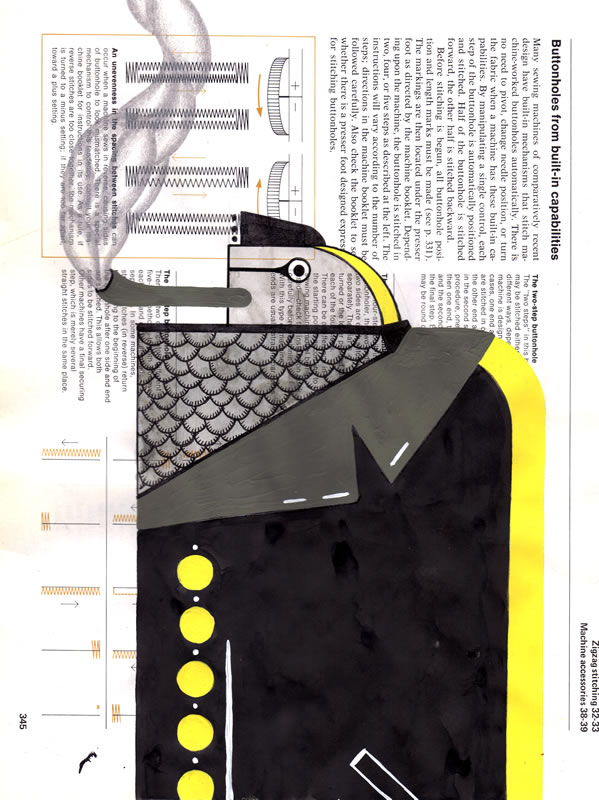
True, there is little there, or even in the remainder of the novel, to paint Stubb as a coward but it is a feeling I have never been able to lose. Stubb’s stubborn refusal to treat matters of life and death as anything other than a joke has never seemed to me to be carefree or valiant. Rather, it is an unwillingness to accept and to engage with the realities of a dangerous life. Nothing communicates cowardice better than the color yellow, so Stubb comes complete with yellow streaks down his head and back. The pipe is there too, of course, as it must be. And it is great fun to draw. But at all times, Stubb hides the yellow cowardice behind him out of sight if he can. He is one-eyed, since he can only see the world in one way, as a joke.

Flask is perhaps the least developed and most one dimensional of the mates. A small, furious man with a monstrous yet hilarious temper. Melville describes him thus…

The third mate was Flask, a native of Tisbury, in Martha’s Vineyard. A short, stout, ruddy young fellow, very pugnacious concerning whales, who somehow seemed to think that the great Leviathans had personally and hereditarily affronted him; and therefore it was a sort of point of honor with him, to destroy them whenever encountered. So utterly lost was he to all sense of reverence for the many marvels of their majestic bulk and mystic ways; and so dead to anything like an apprehension of any possible danger from encountering them; that in his poor opinion, the wondrous whale was but a species of magnified mouse, or at least water-rat, requiring only a little circumvention and some small application of time and trouble in order to kill and boil. This ignorant, unconscious fearlessness of his made him a little waggish in the matter of whales; he followed these fish for the fun of it; and a three years’ voyage round Cape Horn was only a jolly joke that lasted that length of time. As a carpenter’s nails are divided into wrought nails and cut nails; so mankind may be similarly divided. Little Flask was one of the wrought ones; made to clinch tight and last long. They called him King-Post on board of the Pequod; because, in form, he could be well likened to the short, square timber known by that name in Arctic whalers; and which by the means of many radiating side timbers inserted in it, served to brace the ship against the icy concussions of those battering seas.

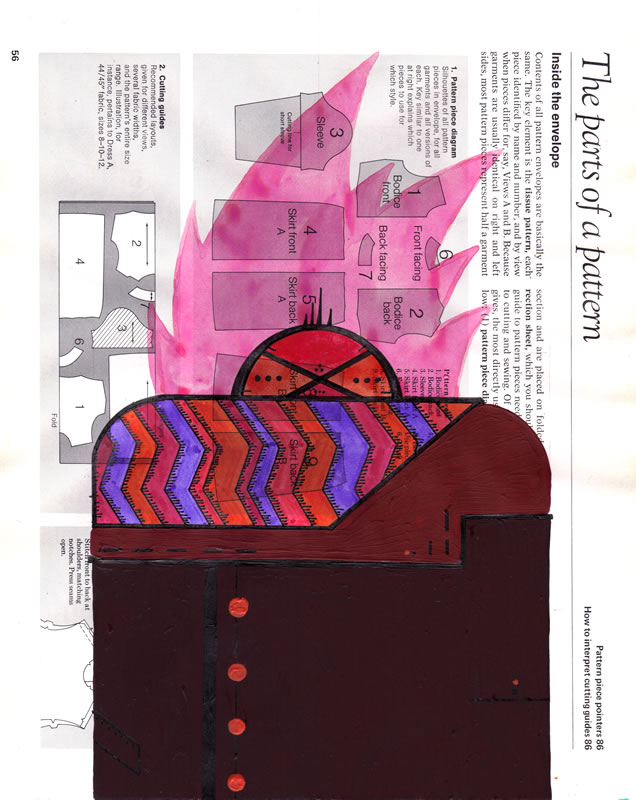
Notice that Flask, too, is shown to be something of a jokester. Yet his temper, his hatred of the whales, his view of the great beasts as something that had “personally and hereditarily affronted him” casts his humor in a vastly different light than Stubb’s. Flask lacks some of the details of the first two mates, being depicted as short, stout, ruddy and pugnacious. To me though, these words conveyed magnitudes and Flask ended up being short, stout, hopefully ruddy, and with great waves of flaming anger radiating from his tiny musket ball-shaped skull…

 Clad in a greatcoat the color of dried blood, Flask’s great eyes stare furiously forward, searching for whales to summarily slaughter. I chose this piece of found paper very careful as well for the heading “The parts of a pattern.” After all, what else are the mates, if not pieces of the pattern of the novel? In spite of their humanity, each functions more as a symbol, almost a set piece, designed to define or contradict Ahab. Their roles, their lives, are unimportant. How they function in the hands of Ahab, whether or not they further his mad schemes or obstruct them in some way, that is all that counts. The pieces are slowly falling into place for the great voyage.

(I had originally meant to post this almost a week and a half ago. Numerous daily life obligations, technical difficulties, and everything else under the sun conspired to keep me away. I hope to remedy that this week with 3 or 4 more posts, if you can tolerate that. Also, Daryl, I owe you an email which will arrive no later than tomorrow. I don’t expect to be home until around 9 this evening, and then I need to finish today’s illustration. As Melville so succinctly put it, “Oh, time, strength, cash and patience!”)