WTF for Gravity’s Rainbow, Week 2

We had two WTFs this week. Read and take a crack at them in the comments if you have any ideas or suggestions.

From Carol:

Are there underlying themes or histories, other than technical texts, that would be helpful in making sense of this? Herero language, European colonialism, the entire war in Britain…it all seems so vast and yet so specific.  And I am saying this as a Joycean.  Somehow I thought that this novel’s being set 40 years later than Ulysses would make the context easier.  Not in the least, even with the companion text.  And I am finding it difficult to just enjoy the ride for the beauty of it.  But stay I will, if only to read again to see what hindsight might bring to the table!  Any thoughts most appreciated!

And from edmondcb:

So at the end of 1.17, Pointsman recalls that Slothrop had been with Darlene, and later a rocket struck only a few blocks away (striking St. Veronica’s hospital). I had assumed that the rockets struck the EXACT location of Slothrop’s sexual encounters, but I tracked back through the book and couldn’t decipher if this was true or if they simply struck in close proximity. Helping justify the latter is the fact that Slothrop has been to Darlene/Ms. Quoad’s before, even tracked her on his map (p. 19), and that exact location was clearly not destroyed. So my assumption was probably just off, though it seems weird that exactitude is such a prominent measure in this book, as with the fact that Slothrop and Mexico’s maps have stickers on the exact same squares, etc.

To muddy the waters even more, the EXACT location the rocket struck is the ward that Slothrop was recently in, being given drugs that caused him to think of shit and history, not of sex. And as far as I know, there was no “hardon” to speak of, which we have been lead to believe would bring a rocket to that exact location.

Am I reading too much into this, or is this supposed to be a shift in the paradigm? I mean, Slothrop did get booted to France…

Difficulty

I keep my eye on tweets mentioning Gravity’s Rainbow and today saw one asking if GR was readable and worth it. The person also asked if his followers had read Infinite Jest, and which of the two books was better. Well, that judgment is awfully hard to make, but it sent me off to think about which was more difficult, since I tend to think Pynchon’s book is a lot harder to read than Wallace’s and so in some ways is less pleasurable and by extension not as good.

As evidence of GR‘s difficulty, I cite the fact that I read IJ for the first time in a 10-day marathon of 15-hour days over a Christmas holiday while in college. I pretty much couldn’t put the book down. As further evidence, I cite the probably half dozen times I read the first half dozen pages of GR before putting it aside. I believe I once read significantly more of the book but put it down again.

So, why was GR so much harder a book for me than IJ was? Part of it has to do, I suppose, with the fact that Pynchon writes about a lot of more or less factual things, and when confronted with so much real-world information that I didn’t know, or knew only very shallowly, I felt stupid and inadequate and didn’t want to feel that way anymore, so I quit. Wallace, on the other hand, writes less with history in mind and about experiences that aren’t so terribly different from my own. I never attended a tennis academy, but I have been a young man in locker rooms, and I’ve been to summer camps and eaten in cafeterias. I’ve never been addicted to drugs or spent time in a halfway house, but the experiences as Wallace presents them are very human experiences, whereas Pynchon so often writes at a greater distance from the people whose trials he’s documenting, and with a much greater emphasis (generally) on the technology and the argot of the fields and histories he writes about.

But there’s something else, too. (Well, there’s lots else, but one something else I’ll write about for now.) For all the guff Wallace took about writing a too-long book, being self-indulgent with the end notes,  needing an editor, etc., it occurred to me tonight that IJ is actually very user friendly in a way that certain important books we’ve read here (or may yet read here) are not.

It all starts with Ulysses, of course. Joyce gave us pretty much unfettered access to the inside of Leopold Bloom’s head and wrote often without much in the way of transition or explicit stage direction. It’s really hard to get oriented within the book, and by the time you settle in to the style of one episode, Joyce goes off and changes the game on you by writing in another mode altogether. In 1973 and 1975 we got Gravity’s Rainbow and Gaddis’s JR. Gaddis too puts you inside the heads of his characters with precious little in the way of landmarks to help you navigate the prose. Written almost wholly in unattributed dialogue, JR requires that you learn how to read it before you can really begin to understand what it’s even saying. It’s fun, but capital-D Difficult. Pynchon’s not as freewheeling as Gaddis, since Pynchon at least breaks his book down into sections and provides exposition. But he also makes those crazy leaps. Miss a “. . . .” in the text as he jumps from one time or place to another and you’ll find yourself suddenly lost. Wait, when the fuck did I start reading about dodo birds? I thought this was a story about Hansel and Gretel.

Infinite Jest covers a lot of people over a period of time that’s kind of hard to pin down as you’re reading. Like Pynchon, Wallace provides landmarks in the form of clear section breaks. But unlike Pynchon, he tends to stay within the boundaries of a defined section. If he’s writing about Mario, you don’t suddenly find an unmarked leap over to Marathe and Steeply at another time and place within the same section. Further, Wallace conveniently puts a lot of the extra, technical, information in end notes. He’s been accused, on the basis of the 100 pages of notes, of being antagonistic to the reader, but it occurs to me that maybe putting the tangential information in end notes is his attempt at something like mercy. Where his forebears just dump the info on you inline, Wallace gives you a little break, slows down the information intake just a touch.

It’s as if Joyce came to the conclusion that he could lay on his readers everything in a character’s head and the postmodernists extended that idea, trying to give their readers not just the contents of their characters’ heads but everything under the sun and doing so in a way that sort of mimicked the awful burden of information-influx after the rise of radio and television and billboards. Wallace, then, says “too much,” or, if not “too much,” something like “slow down; let’s take this in pieces.”

And for me, I think that’s part of what makes Infinite Jest a much easier book than Gravity’s Rainbow. For all the information Wallace’s book contains, its information flow is more modulated than these earlier books, and it’s a relief. One reads that Wallace was also a proponent of a new sincerity, that he rejected the postmodern tendency toward irony as ultimately a non-productive (if not outright toxic) mode to write in. It’s interesting to me to suggest, then, that he sought to throttle information overload as he hoped to throttle irony, that he was pulling back from his smirking, hyper-intelligent forebears in a couple of ways, an après-garde all his own.

Slothrop and Orin

This isn’t likely to make too much sense if you haven’t read Infinite Jest, and it may also contain mild IJ spoilers. I offer it more as a set of idle observations than as any sort of thesis.

In David Foster Wallace’s Infinite Jest, we meet womanizer Orin Incandenza, about whom I wrote the following a few years ago:

A bit more on Orin. His name can be switched around to “iron,” “noir,” and “orni,” which, this last, makes me think of ornithology. He plays football for the Cardinals and is actually made to don fake wings (I think) and like a jetpack and fly down onto the field earlier in the book. Then a bird falls out of the sky into his apartment’s pool (oddly reminiscent of the end of Barton Fink, starring John Turturro, whom I peg as a shoo-in for playing JOI and/or JOI’s father in a movie adaptation of Infinite Jest). Then, on page 294, we have Orin engaging Joelle “entirely through stylized repetitive motions,” making me think of the mating dances of birds.

Orin has a habit of tracing the infinity sign with his finger on the flanks of the girls he has bedded. Like Orin, Slothrop traces a mathematical sign as he sows his oats, though in his case, it’s a Poisson distribution scrawled over a map of London.

And like Orin, Slothrop is frequently associated with birds, especially in the pastoral section 1.4, in which he appears in the company of an owl, girls called Wrens, peacocks, and hummingbirds and in which he sports an erection (his “cock,” if we want to stretch the bird motif a bit) as a rocket explodes. This section also happens to deal pretty heavily in the contrast between the earth and the sky, a dichotomy the sky-bound but (if I recall correctly) acrophobic Orin also contemplates.

Both men sport a very special appendage, and both are subject to paranoia. As Orin begins to fear that he’s being followed and ultimately has his fears confirmed and culminating in his being taken prisoner, so Slothrop begins to feel as if he’s being watched, and as if his cubicle is a trap (early in 1.15). Also probably not significant but certainly attention-getting for me was the reference early in 1.15 to “Enfields” — a name whose singular form will resonate with readers of Wallace’s novel.

Unlike Orin, Slothrop at least writes nice letters home to his mother.

[insert “Angel” song title here]

I didn’t really feel like this was a WTF question, so I wanted to raise a discussion about this, without providing much in the way of analysis.

In this week’s reading there’s a twice mentioned and once explicated sequence in which Basher St. Blaise and his wingman see an Angel.  Basher doesn’t ever say anything about it, but Cherrycoke learns details by examining artifacts that were on basher’s person at the time.

I’m not going to focus on the Cherrycoke part (which is cool in and of itself) but on the Angel part.  There are several other mentions of the word Angel in this week’s reading alone.  They cover a wide range of ideas as well, and I’m curious if there is any connection, implied or direct between what Basher saw and any of the other uses of the word angel.

Here’s Basher’s scene (a big block quote for context):

Basher St. Blaise’s angel, miles beyond designating, rising over
Lübeck that Palm Sunday with the poison-green domes underneath its feet, an obsessive crossflow of red tiles rushing up and down a thousand peaked roofs as the bombers banked and dived, the Baltic already lost in a pall of incendiary smoke behind, here was the Angel: ice crystals swept hissing away from the back edges of wings perilously deep, opening as they were moved into new white
abyss. . . . For half a minute radio silence broke apart. The traffic being:

St. Blaise: Freakshow Two, did you see that, over.

Wingman: This is Freakshow Two—affirmative.

St. Blaise: Good.

No one else on the mission seemed to’ve had radio communication. After the raid, St. Blaise checked over the equipment of those who got back to base and found nothing wrong: all the crystals on frequency, the power supplies rippleless as could be expected—but others remembered how, for the few
moments the visitation lasted, even static vanished from the earphones. Some may have heard a high singing, like wind among masts, shrouds, bedspring or dish antennas of winter fleets down in the dockyards . . . but only Basher and his wingman saw it, droning across in front of the fiery leagues of face, the eyes, which went towering for miles, shifting to follow their flight, the irises red as embers fairing through yellow to white, as they jettisoned all their bombs in no particular pattern, the fussy Norden device, sweat drops in the air all around its rolling eyepiece, bewildered at their unannounced need to climb, to give up a strike at earth for a strike at heaven… (151).

So the key here is that St. Blaise saw an angel.  Here are the other instances of the word Angel (just in this week’s reading).  Most of them come before the above quote and I can’t help but wonder if they are meant to make us question what Basher saw.

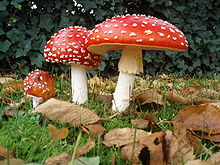
The first comes with Osbie Feel and his mushroom (and while I don’t make any connection on this one, it is interesting that he chose this particular species, which is really called Destroying Angel):

Now and then the geometry of her restlessness brings her to glance in a doorway at his boyish fussing with the Amanita muscaria (for it is this peculiar relative of the poisonous Destroying Angel that claims Osbie’s attention, or what passes with him for attention) (93).

The second, and more prominent one is with Pirate and Katje.  It would be crazy of Basher was talking about a windmill instead of a real Angel, but again, it’s an interesting name choice (and also makes me think of Don Quixote):

an enormous sky all sea-clouds in full march, all and plum, behind her, detects danger in her loneliness, realizes he’s never heard her name, not till the meeting by the windmill known as ‘The Angel'” (106).

The third is about starlings (I think).  It starts bout birds, at any rate.  And I couldn’t help wondering if there is meant to be some kind of connection between the birds and what Basher saw.  But this novel is so much about the “Psi” that perhaps these birds are a red herring to the skeptical.

the more distant shapes among the threads or sheets of smoke now perfect ash ruins of themselves, nearer windows, struck a moment by the sun, not reflecting at all but containing the same destroying light, this intense fading in which there is no promise of return, light that rusts the government cars at the curbsides, varnishes the last faces hurrying past the shops in the cold as if a vast siren had finally sounded, light that makes chilled untraveled canals of many streets, and that fills with the starlings of London, converging by millions to hazy stone pedestals, to emptying squares and a great collective sleep. They flow in rings, concentric rings on the radar screens. The operators call them ‘angels” (112).

The fourth also references birds, but then it switches to a more Spiritual sense of angels:

Up across the downs, past the spotlights where the migrant birds in autumn choked the beams night after night, fatally held till they dropped exhausted out of the sky, a shower of dead birds, the compline worshipers sit in the un-heated church, shivering, voiceless as the choir asks: where are the joys? Where else but there where the Angels sing new songs and the bells ring out in the court of the King.(134)

The fifth references bombs, but I think is about much more than that:

Lower in the sky the flying bombs are out too, roaring like the Adversary, seeking whom they may devour. It’s a long walk home tonight.  Listen to this mock-angel singing, let your communion be at least in listening, even if they are not spokesmen for your exact hopes, your exact, darkest terror, listen (135).

And the sixth and final is from Pointsman’s point of view about Slothrop

But now with Slothrop in it—sudden angel, thermodynamic surprise, whatever he is … will it change now? (143).

So there you have it seven different uses of the word angel, creating several different possibilities of what Basher saw.  Or, perhaps Basher’s vision just adds to the whole picture of a book about death, ghosts, angels and the afterlife.

And the WTFs Come Rolling In!

A couple of WTFs have come in today, which was nice, as I wasn’t sure the whole WTF thing would be of interest to anybody. I think what I’d like to try doing with these is maybe a weekly roundup in which I post or summarize the WTFs, provide any answers I may have, and of course let the conversation take its course in the comments. I’ll figure tentatively on posting these on Thursdays. This gives people time to wrap up the week’s reading if they’re a little behind, to digest any posts that come early in the week, and then to track any discussion through the end of the week. So, if you’ve got any WTFs, send ’em in and look for a roundup this Thursday.

Temptation

I may be dim, but both times I’ve read this far into Gravity’s Rainbow, I’ve been puzzled by the scene in which, chasing tail after his discharge from the abreaction ward, Slothrop lands himself in an old lady’s flat eating nasty candy. It’s a funny enough scene, but it always seemed sort of out of place amid the pretty serious stuff surrounding it.

It took a return to exercise after a lapse and the subsequent temptation of a box of Girl Scout cookies to open my eyes to what’s going on here. There it lay on the dresser, not even my favorite kind (Samoas win that title), but open, by gar, and all but leaping into my mouth as I dismounted the exercise machine and wiped away my sweat. Heart still pounding from exertion, I casually inspected the nutritional information printed on the box of cookies. Seven grams of fat and 170 calories in a serving; one cookie would cost me 2.3 grams of fat and 57 calories. As I did a little cost-benefit analysis, the connection struck me.

Blicero and Katje and Gottfried enact over and over again a fetishized game of Hansel and Gretel, and just a few pages later, Slothrop finds himself invited into an old crone’s house to feast on candy. Slothrop’s little confectionary adventure is a light-hearted callback to and dramatization of the folktale that Blicero appropriates. And the lesson in that folktale (bad parenting exemplum aside) and in Pynchon’s dual retelling of it has to do with temptation and its payoffs.

Blicero succumbs to the temptation of bedding a woman he suspects may be working for the British. Although he knows he’ll finally be given a push from behind into some oven or another, he’s certain it won’t come in the form of an air raid thanks to betrayal by Katje. But then she does leave, and he prepares for the worst, paying for his temptation in two, somewhat paradoxical, ways — he is, first, convinced that he was wrong to trust Katje after all and, second, denied the consummation of the betrayal he fears. Accustomed to controlling his playthings, he is now stripped altogether of control, and even of the illusion of making of his fate a sort of gift (a form of control in its own right, if what one reads about the rules in a sadomasochistic partnership is accurate — ie, that control of a situation is always just a single safe word away for the person being subjugated).

Slothrop’s temptation too comes at a cost, for we learn in 1.17 that the abreaction ward from which he has just been discharged has been bombed, and with it poor Spectro, who back in 1.8 shared a tense moment with Pointsman in which he tried to steer the behaviorist away from the temptation to try to experiment on Slothrop. Dipping his wick after entering that candy-strewn apartment costs lives, including that of a rare ally. (Of course, it’s not at all clear whether coitus is the cause or the effect here; still, I think the point is worth considering.)

Pointsman too confronts a great temptation. He’s tired of collecting the spit of dogs and isn’t terribly interested in studying the octopus Grigori, no matter how big and smart he is. He wants a man to poke and prod, and he wants in particular the man whose secret all the scientists paranormal and otherwise also covet. As 1.17 closes, we find Pointsman constructing rationalizations for designing an experiment around Slothrop, suffering be damned (“the man will suffer — perhaps, in some clinical way, be destroyed”), and he has his eye on the Nobel. It’s not just the shiny trophy he has his eye on, though; there’s something Faustian about Pointsman, and the connection Pynchon makes between his quest for knowledge and Theseus’s triumph in the labyrinth seems telling, for like Theseus, in order to win, Pointsman must destroy the creature that lies at the center of the labyrinth once he’s wended his way through it. Pointsman’s fall to temptation comes at the ultimate cost, in other words, of what scrap of humanity he may have left.

(It also occurs to me that like Theseus with his yarn, Hansel and Gretel leave breadcrumbs behind to help find their way out of their peril.)

Candy. Quim. Fame. Knowledge. Girl Scout cookies seem pretty insignificant as I ladder up that list, but it’s still hard not to feel a little satisfaction at having resisted.

Chew on This

I had an idea that I might try just straight-up asking questions about some things that I have questions about. Think of it as a front-pager’s-privileged version of a WTF. (Or, for the more traditionally inclined among us, a discussion question.) I even made up a fancy new tag for them, in the hope that they will in fact provoke conversation. So here’s one:

It seems to me that literature about World War II is qualitatively different from literature about World War I. I don’t say that as a judgment of merit, but as a position on the distinctive elements of each. Consider, for example, “Dulce et Decorum Est” and Im Westen nichts Neues versus Gravity’s Rainbow and Catch-22. It seems like there’s a transformation, from the one literature to the next, of straight-up horror to horror inflected with ironic, absurdist, or even nihilist laughter. But I don’t know that I feel well-enough informed to be able to call this a fact. On the understanding that this entire effect may just be an artifact of my specific reading experiences and lacks—in which case, please tell me so I can fill them in—why do you think this is? Was there a particular change in the ways of war that caused it (nuclear weaponry, maybe)? Is it a function of the time lag between the wars and their respective literatures? (If so, what kind of function?) Is it just a matter of changing literary fashions that happened to coincide with the passage of time between the wars? I’m all ears.

Nodding, shrugging, smirking

Because this is the beginning, and the beginning is a very good place to start, I’m going to quickly dispense with some inane observations. I will then progress into less inane observations. I will not mark the transition between the two, and if you feel all of the following are painfully inane, why then just pretend the transition happens somewhere at a later date. Like Paul, I’m flying completely blind here. No background research, no previous reading, no exposure to this novel at all.

Okay.

I hate bananas. I have always gagged at the smell of bananas. I hold my breath when I give my children bananas. If I mistakenly drink a smoothie with banana or eat a so-called bread made of banana, I try very hard not to vomit.

Pirate Prentice, therefore, is already in the running for my least favorite character.

Seriously, though, the banana-seeking trip to the roof and the banana-laden and overripely unctuous kitchen scene brought me immediately to a pleasant, early conclusion about this text. This author can write. Not just because he goes on and on in nauseating detail about bananas. Any monkey could do that. My immense gratitude for the vacillations of physical space between narrow and expansive in this section begins when the cold, murky, drowning scene of those on the train (and those left behind) wedges us tightly, claustrophobically into a depot that becomes Pirate’s private quarters, and then the banana nonsense opens the whole text away from that sepulcher-like scene into a luxurious (especially since illicitly undertaken under rationing) sensory extravaganza. I thoroughly enjoyed this scary into safe, skeletal into gluttonous transition, and lodged stylistic ebbing and flowing as a point very much in Pynchon’s favor.

At the recommendation of several re-readers, including a fabulous comment a few days ago by DCN, I am letting this text wash me along its course. I am not trying to understand it. I have experience with Faulkner and Joyce and Wallace and Bolaño, and I will willingly follow stream of consciousness wherever it leads. I don’t need transitions, don’t ask for clarifications, and quite enjoy being driven by a good author. Heck, we’re already suspending disbelief to read a novel, so why not suspend all expectations of realism. I meant that sincerely and without facetiousness. But just so Mr. Pynchon knows, I can’t comment intelligently about such writing until I’ve finished and reread, so I hope he’s not visiting our group read anytime soon.

The style, however, both hides and highlights a central point of this first section: the terrible upheaval of war. Just as Roger Mexico vacillates between “don’t make me out some cold fanatical man of science” (47) and “his morality always goading ” to keep the “psychical” distinct from science (47), I sense already that we’re going to go back and forth with the characters between “I need to dissociate from the horrors of war and pretend life is normal” and “nothing can be normal in this hell.” Already we see Tyrone Slothrop a barely controlled panic about his obsession “with the idea of a rocket with his name written on it” (29). Genetic  PTSD about the fire or not, Slothrop is on the edge and I don’t blame him. One wrenching reality of the first section is that it’s nigh impossible to explain to people not living a war what it feels like to be terrified and resigned and depressed and morbidly hopeful. The long section (relatively) between Jessica and Roger nurtures the paranoia and frustrations both feel, repeating the ineffectual literary protests of war. The “perfectly black rectangle of night” (59) taking men, the reduction of woman to child (62), the  suggestion that “the Home Front is something of a fiction and a lie, designed, not too subtly, to draw them apart” (48). Unfortunate, though, that the wounded girls asking for gum and rockets screaming  through this text are plot movers and therefore not terrifying but exciting for the reader. Well written voyeurism of people in war is Schadenfreude of the worst kind.

And speaking of deplorable literary styles (nice way out of the intense discomfort afforded readers of a surreal war novel, no?) is anyone shocked that it took a postmodern writer 31 pages before talking about a penis? One of the things I most loathe about the other Pynchon books I’ve read is the latent, creepy, old-man sex fetish in which a woman can’t just throw a dart without “breasts bobbing marvelously” (36). We have several cocks and hardons and a map of sexual conquests “Never to rank a single one—how can he?” For titillation’s sake, Pirate climbs a tall ladder to a hot house, “holding up the skirt of his robe to drop [bananas] in. Allowing himself only to count bananas, moving bare-legged among the pendulous bunches” (8) there hasn’t been a dystopic writer this obsessed with sex since Robert Heinlein. I counted at least one sexual innuendo or reference every 8 pages, and I’m usually pretty daft about such things.

Look, I get that the easiest way to counter the humanity effacing effects of war is writing long, intense sexual romp scenes. But bawdy jokes are different than constantly grabbing at it.

But I will hold off my frustration with the constant phallic status updates (noted in my paperback as I.P.R.s [infantile penis reference] for now. Because Variable Slothrop might be the best name in all literature *and* an essentialism for Gravity’s Rainbow itself. (Jeff and I have more in common than I thought, because I debated, before I read his post, whether Variable or Constant had the better name. Slothrops are no fun if they’re predictable, though, so I went with Variable.)

I absolutely will not discuss Mr. Pointsman now. I’m hoping he just goes away and is a character role of disgusting soulless pig placed carefully as juxtaposition to Jessica and Roger’s desperate clinging to humanity. If he turns out to best Randy Lenz as my least favorite character in a novel EVER, I will not be surprised.  But for now, honor the spoiler line and let me pretend this rat scurries away before we find out what The Book is and who the other six owners are.

In the tradition I began for Infinite Jest and continued on for 2666, I will offer a quote of the week from Gravity’s Rainbow. Please, by all means, share your favorite (or least favorite or most iconic or least intelligible) below. We’ve read approximately 85 pages, I just adore this line:

“An elderly air-raid warden, starchy and frail as organdy, stands on tiptoe to relight the sensitive flame.” The pun of the sensitive flame, beaten to death on an earlier page actually pays handsomely in this line. I assumed in reading and typing that line that the warden was a woman. Rather daft of me, I thought, until I did some research and found that there were, in fact, women serving as air raid wardens. So now I love the line all the more*: as history lesson, as gender-bending prose, as ethereal image.

*I’m going to pretend to not have a preconceived prejudice about Pynchon specifically and postmodern writers generally as ragingly misogynistic, and will thereby allow that he might describe a man as frail as organdy. And on tiptoe. I’m guessing by Week 6 I will retract that generosity, but for now I’m feeling quite generous indeed. Probably from the equally magnanimous helping of bananas.
On the Third Hand…

So I was telling my mom about this go-round here at IZ, and she’s unfamiliar with Gravity’s Rainbow. I started trying to describe it to her, and after hitting the main points (WWII, a star-sticker map of sexual encounters, the desperate kitchen-sink response to the Nazis including even mysticism, lots of bananas) I ended up with almost a whine: “It’s hard.” Not a complaint, really, because I like a challenge in my reading—obviously you all understand, or you wouldn’t be here. But I don’t often even describe a book as difficult. That feels like a value judgment of the work involved in reading, and I just don’t ordinarily think to characterize reading effort in positive or negative terms. It’s reading and understanding, so it’s work worth doing, duh. My point is that GR is taking a lot more work than I—a serial Infinite Jest rereader and Gene Wolfe fan—am accustomed to, and I’m not sure yet that I feel like I’m accomplishing that work successfully.

Some things seem pretty clear to me, though, like Roger Mexico and Jessica Swanlake. (Quick note: Good god do I love the names in this book. Joaquin Stick took me a few minutes, but then I cracked up, and I think Constant Slothrop’s naming his son Variable is one of the funniest onomastic jokes I’ve ever read.) Their relationship lets Pynchon set up a kind of three-sided opposition (although we know what happens to opposites in the transmarginal state) of the war, love, and…what to call it? Math? Truth? Order? I think “order.”

Start with war. It’s Roger’s mother in section 1.6, which is an odd description, and then it’s a laboratory for Pointsman and Spectro in 1.8, but the most striking characterization of it is the political literalization of the “state of war.” In 1.12, Pointsman feels that he’s become a citizen of the war, and Brigadier Pudding thinks of “other named areas of the War, colonies of that Mother City mapped wherever the enterprise is systematic death.” There’s probably a very interesting line of inquiry here involving colonialism and the prosecution of World War II—which would apparently also manage to draw in Südwestafrika and the Herero, chronology be damned, along with whatever the Schwarzkommando turns out to be, and now I’m wishing I’d had this idea soon enough to research it in time for a post—but: the state of war. Although Pointsman and Pudding enlarge the image for us, with the outlands of war and the uncertainty of its successor state, it’s actually Jessica and Roger who introduce it. End of 1.6: “If they have not quite seceded from war’s state, at least they’ve found the beginnings of gentle withdrawal.”

That last stretch of 1.6 is also where we get the second term in this opposites relation I’m spelling out. Roger and Jessica’s not-quite-secession is in the form of their huddled little place together outside of town. The whole section convincingly shows a couple who care for each other. It gets the details right; the ending—“They are in love. Fuck the war.”—feels both earned and disarmingly direct. Its clarity and sincerity make quite a contrast with the bewilderment in every other setting so far. (I’m a little concerned about how the inevitable appearance of Jessica’s Beaver will complicate this situation.) Note that Jessica and Roger understand what they’re doing as, among other things, a kind of protest against the disruptions of the war and its attempt to claim even people’s internal lives as materiel to be mobilized and spent: “Both know, clearly … that, indeed, the Home Front is something of a fiction and lie, designed, not too subtly, to draw them apart, to subvert love in favor of work, abstraction, required pain, bitter death.” The text is pretty specific about the opposition here.

In section 1.9 we find a longer, more intimate bit about the couple. Among other things, it has Jessica but not once Roger succumbing to lovely domestic fantasy. (Could be characterization just as plausibly as sexism, so I’ll move on.) But after one of those phantasmic shifts of scene that help make this such a tough book comes the third term I’m interested in: Roger’s unbending commitment to scientifically or mathematically verifiable phenomena. This is what I’m calling “order.” Roger has no patience for his coworkers at “The White Visitation” and their mysticism. Where the Psi Section people see him as a prophet, he sees himself just plugging numbers into an equation that describes reality. I understand strategies of literary structuring well enough to know that, at least so far in the book, no one of the three oppositional terms I’m pointing out is supposed to be dominant—but I sure do like Roger’s side in all this (as well as his and Jessica’s, I mean). I feel a bit like everyone can see my underwear hanging out in his contretemps with Pointsman, since I’m the one who’s twice insisted “It must mean something,” like Pointsman does here. But he’s being histrionic when he panics that the end of history and even of cause and effect might lie germinating in the simple recognition that independent events…are independent. I’m reasonably certain the rest of the book will give us a remarkable number of wholly contingent events, so Dr. Pointsman should be able to rest secure.

What remains is to show that this order term is actually placed in opposition to both war and love. I suppose it’s obvious enough with regard to war—the absurdism of living in the state of war comes through every page of this book, loud and clear. But also, Jessica understands in 1.9 that she can’t protect Roger “from what may come out of the sky”—for me, a recognition from her (if not yet from him) that his idea of order can’t stand in the random path of war and not be flattened. And as for love vs. order, check Roger in 1.6: “In a life he has cursed, again and again, for its need to believe so much in the trans-observable [possibly spurious hyphen], here is the first, the very first real magic: data he can’t argue away.” Combined with his and Jessica’s mind-to-mind communication in 1.9, I think this shows what’s really a fairly standard depiction of love as transcendent, the great battering ram that overthrows reason.

Looking ahead, I kind of feel like order will be the biggest loser. Anybody else have any predictions?

Pirate Prentice and Buck Mulligan: Ulysses’ Rainbow?

Hi,

Paul here.  Daryl gave me the go-ahead to throw a post of my own here (and since no one else was writing about it…here goes).

I’m going to start this post with this admission: Not only have I not read Gravity’s Rainbow before, I don’t even know what it’s about (aside from what I have read for this week).  I haven’t read any commentary or criticism, I didn’t even read the back cover.  So I’m flying blind.

I mention that because I’m going to talk about Ulysses; however, I have literally no idea how this plays out in the rest of the story, or if it plays out at all.  I’m also going to refrain from looking up secondary sources for this post because I don’t want to create be an academic treatise, it’s more of a reader’s casual observations.

Ulysses is probably the most influential 20th century novel (and you can read plenty about Ulysses on this site too).  This is especially true for “modern” writers looking to push the envelope–of which it seems clear Pynchon is one.  Stylistically, I don’t think Gravity’s Rainbow could have existed if Ulysses hadn’t been published.  But at the same time, it’s not like Pynchon is mapping Gravity’s Rainbow to Ulysses (right?  I didn’t actually count chapters or anything.)

Ulysses opens with the famous words, “Stately plump Buck Mulligan came from the stairhead bearing a bowl of lather on which a mirror and a razor lay crossed.”

Gravity’s Rainbow opens with an equally impressive (although admittedly unrelated to Ulysses) opening salvo: “A screaming comes across the sky.”  The very beginning of Gravity’s Rainbow has nothing to do with UlyssesUlysses, a book about one day in the life of two men pales in scope when compared to Gravity’s Rainbow, a book (so far) about German bombs falling on England in World War II and the members of the possibly secret organizations that are tracking the bombs (or something–bear with me if it eventually becomes about fairies and rainbows).

So, the opening of the books are quite different.  The first three pages of GR are about an evacuation (I’m not going to go in that direction about evacuation, even if Joyce did) from the screaming across the sky.  But then Pynchon introduces us to the first two men in the story: Captain Geoffrey “Pirate’ Prentice and Teddy Bloat.

As Ulysses opens Buck Mulligan and Stephen Dedalus wake up after a night of drinking.  And so do Pirate and Teddy.  Indeed, Teddy falls off of a balcony in a drunken sleep; Pirate gets a cot under him to break his fall just in time.  Then Pirate proceeds up to the roof and we get a little Ulysses-lite.

We have established Buck Mulligan on the roof.  His appearance: “A yellow dressinggown, ungirdled, was sustained behind him on the mild morning air” and his action: “he peered down the dark winding stairs.”

Pynchon is more verbose than Joyce (at least this chapter of Joyce) but we can see that Pirate is in a similar structure with similar dress:

Then he threads himself into a wool robe he wears inside out so as to keep his cigarette pocket hidden, not that this works too well, and circling the warm bodies of friends makes his way to French windows, slides outside into the cold, groans as it hits the fillings in his teeth, climbs a spiral ladder ringing to the roof garden and stands for a bit, watching the river.

Of course, instead of the open razor that Mulligan carries, Pirate is carrying bananas (I won’t speculate about the meaning of potential violence inherent in the razor vs the utterly non violent nature of the banana or how it compares to a novel that is ultimately about war and death).

Obviously very different things are happening in the two books: Buck Mulligan and Stephen Dedalus discuss death on the tower, while Pirate is by himself watching as death streams across the sky.  But when both parties return down the spiral staircase it is time for breakfast.  Mulligan and Dedalus eat sugared toast while Pirate and his crew eat what sounds like a rather delicious broiled banana sandwich.  And from there things diverge quite drastically.

I don’t want to belabor the point or look for similarities that aren’t there, I was simply struck by these coincidences in the opening of these two apparently unrelated books.  However, just to prove to myself I was on to something, I checked online to see if anyone had made anything of this.  Evidently there are ample connections between the two books, but there’s one article in particular that I like to think confirms my suspicions:  McCarron, William. “The Openings of Ulysses and Gravity’s Rainbow.” Conference of College Teachers of English of Texas 53 (1988): 34-41.  Sadly it is not online anywhere that I can find.

What’s the point of this?  Well, none really, but it might be fun to keep an eye out for more allusions to Joyce while enjoying the book.

Oh and that picture above, it’s from a T-shirt that you can buy here.