The Kenosha Kid

As episode ten of part one of Gravity’s Rainbow opens, Tyrone Slothrop — injected with sodium amytal to induce a sort of trance wherein his psyche will be probed — is chewing on the line “Bet you never did the Kenosha Kid” in much the same way that I remember trying many years ago as a would-be poet to bend the repeating lines of a villanelle to my will by hanging on them different meanings and syntax. Is the Kenosha a dance? Or is the Kenosha Kid a person? If so, is he from the town Kenosha? And what does all this tomfoolery mean anyway? Weisenburger calls this interlude “one of the outstanding enigmas of GR,” and I certainly remember being baffled by it when I first read the book a few years ago.

But this time through, with the syntactic chicanery involved in the obsessive construction of a villanelle on my mind and tromping through the prose a bit better oriented than last time, I began to make a strange sort of sense of the Kenosha Kid bit.

Episode 1.10 is in some ways about discovering the pure. Consider for example Slothrop’s race anxiety, which certainly calls to mind period concerns with matters of miscegenation, race inequality, and so on. The appearance of Malcolm X (and particularly the fact that he appears pre-enlightenment) seems telling enough. The reference to the song “Cherokee” and Pynchon’s line “one more lie about white crimes” and several other references to Indians made me think of America’s treatment of its aborigines, which may resonate with certain other grisly race marginalization that World War II reeks of.

Weisenburger posits that this episode introduces some of the most important opposites in the novel (e.g. north/south, black/white). He also mentions the at first (to me) unintelligible pairing of “shit” and “the word.” Well, the episode is surely full of shit. But what’s this business about “the word?” Maybe it’s a typographical error in my older edition of the companion. Thinking of Slothrop’s descent into the sewer, I remembered that episode 1.4 dealt pretty extensively with another pairing: sky vs. earth. And flipping back, I reencountered the following: “Shit, money, and the Word, the three American truths, powering the American mobility, claimed the Slothrops, clasped them for good to the country’s fate.”

That capital W makes a big difference. Slothrop’s turpitude generally and our trip through the sewer of his uncomfortably unfettered subsconscious looks back to his family’s history and its granite-chiseled concern for squaring matters with that hand reaching down from the sky. Near the end of 1.10, we even return briefly to a churchyard scene:

Then for another moment it seems that all the Christmas bells in the creation are about to join in chorus — that all their random pealing will be, tis one time, coordinated, in harmony, present with tidings of explicit comfort, feasible joy.

But then we go right back to Slothrop’s fantasy of the Roxbury slum, sine-waving from relief, hope, and redemption back to the gutter and his fear of all those black folk with their prying fingers, and back to those ehisshehwle Hahvaad boys who ought to know better than to think the sorts of things we encounter while rummaging through Slothrop’s mind. All this back and forth, from grime to righteousness and so on, begins to seem to correspond roughly with that pesky pairing that big books tend to touch on: right and wrong.

In 2005, a Pynchon reader discovered a pulp western story titled “The Kenosha Kid” that itself takes up moral ambiguities. The eponymous hero is described early on as a sort of Robin Hood. A gambler who makes his living taking other people’s money but who has a large capacity for both guilt and generosity, the Kenosha Kid struggles over the course of the story with how he can best reason which of the people he encounters are and are not scoundrels and how he should conduct himself. For example, he cheats at cards to beat a man he believes had pulled a prior stick-up, but then he begins to feel sympathy for the character. When the stick-up-artist lands in jail due to circumstances resulting directly from the loss of his money, the Kid endures something of a moral crisis. He feels bad for the bad guy. Published in 1931, the story is of about the right vintage for Slothrop to have read as a youngster. And of course we all know that we dredge up the weirdest things in dreams, presumably also when in drug-induced trances.

So to me, the Kenosha Kid bits that frame 1.10 begin to make sense as snatches from Slothrop’s memory that bubble up as he works through matters of judging people based not on the color of their skin but on the content of their character (reasoned judgment of character being something the Kid prides himself on). It’s especially relevant given the content of Slothrop’s hallucination and our discovery in 1.12 that the whole point of his participation in these experiments is “to help illuminate racial problems in his own country.” In other words, maybe all this poking at Slothrop ostensibly to get at racial issues in America is pushing buttons in his head that make him ping-pong back and forth between reprehensible racist thoughts and a more noble and enlightened impulse he’ll recall from having read “The Kenosha Kid.” None of this is to say that I think Pynchon is trying to show us a man fighting a morality war with himself; but it does seem as if he’s maybe showing us a way in which he thinks the brain might operate when left untended.

Slothrop’s wordplay, then, becomes for me a sort of emblem of his subconscious brain at work. In the same way that I twiddled lo these many years ago with the syntax and enjambment of my repeating lines of doggerel until I felt like I had worked out a scheme that felt right, Slothrop’s tranced-out brain here is trying to piece together a coherent sense of the moral right, and as so often happens in dreams, a minor detail becomes the focus of a riff, is imbued with greater significance than it really merits on its own.
Your Intrepid Bloggers

During the Gravity’s Rainbow group read, you’ll be hearing with some regularity from three bloggers, all probably familiar voices if you’ve been following since the original Infinite Summer program a few years ago. Others may (or may not) peek in from time to time. The core cast will run as follows:

JEFF ANDERSON is a writer and copy editor; he’s also a quilter, an incessant reader, a sometime musical ambassador to Cuba, and a member of that very exclusive elite: the 150 Jeopardy! contestants who lost to Ken Jennings. He’s excited to once again join the shambling horde of Zombies for a big tough book. He lives in Los Angeles with his husband.

CHRISTINE HARKIN is an editor, writer, branding consultant, and former English professor who has avoided Gravity’s Rainbow long enough. She can’t promise to be insightful or erudite during this group blog, but she’s grateful for the opportunity to move her literary ramblings off the sidelines of http://naptimewriting.com (where she spent Infinite Jest and 2666) to a classy joint like Infinite Zombies.

DARYL L.L. HOUSTON signed on to blog Infinite Jest for the original installment of Infinite Summer and had so much fun doing it that he decided to stick around and blog Dracula and 2666 as well. He later kicked off a group read one of his all-time favorites, Moby Dick, and went on to subject IZ followers to his frequent confusion about and frustration with Ulysses. He has worked as a pig farmer, roller coaster driver, and copy editor and now pulls levers and knobs as a computer programmer in Knoxville, Tenn.

Paul Debraski has also faithfully blogged about all the Infinite Summer line of books, sometimes here and sometimes at his own site, where he’ll be writing his not-to-be-missed impressions of Gravity’s Rainbow.

If you’re going to be writing about your read, leave a link in the comments!

WTF?

I’ve begun reading Gravity’s Rainbow and am sort of paralyzed by how much there is going to be to write about. It’s a problem with any of the books of the sort we tend to cover here, but this one seems so much more complex in some ways, and so much more in need of very deep dives on many topics (e.g. WWII history, psychology, the paranormal, narrative approach) than some of our other books have seemed to me. The book covers such wide ground in the first week’s sections that there’s going to be lots left undiscussed here. I don’t think I can do anything resembling justice to the book in my posts and still keep my day job and my family. Even with a couple of bloggers joining me (more on that soon), there’ll be huge gaps.

So I’m trying something a little different for this read. I’ve added a WTF page that you can use to propose ideas for the bloggers here to cover or to ask questions about things that baffle you in the book that you think may merit some attention. If anybody even fills the form out, it’s entirely possible that we’ll have neither expertise nor inclination to address the questions, but we’ll at least consider them. This is basically a way to have a chance at starting a new topic without derailing the comment threads on another post.

If we get a fair number of questions/requests and no bloggers pick up the topics, maybe I’ll do an occasional roundup that includes a listing of untouched topics with an invitation to take them up in the comments. If the thing just generates spam, I’ll turn it off.

So, throughout this read, if you want to ask a question or suggest a topic, head on over to the WTF page and get in touch.

An Interview with Zak Smith

In a post outlining my approach to reading Gravity’s Rainbow this time around, I mentioned artist Zak Smith’s picture book, Pictures Showing What Happens on Each Page of Pynchon’s Gravity’s Rainbow. Zak has published a couple of other books, Pictures of Girls and We Did Porn, a memoir interspersed with several bundles of drawings and paintings. He’s got a web site at zaxart.com, he tweets as zaksmithsabbath, and he also has an online sketchbook here. He’s also done some work on a project with six other artists to illustrate Blood Meridian and did some drawings for a neat game/art project called Road of Knives. His story is pretty interesting. The GR illustration project led oddly enough to his introduction to the world of alt-porn, in which he performs under the name Zak Sabbath. When I asked if he’d be willing to do an interview, he was game and lightning-fast with (and gracious in) his response.

Infinite Zombies: In the introduction to Pictures Showing…, you write that you worked on the project over nine months of 14-hour days. Can you say a little something about your process, if you had a more or less standard process? Ie, did you read a few pages and meditate on them, then narrow down to an image and begin doing drafts of the work? Or something else altogether?

Zak Smith: Well I’d already read the book twice, then I started doing them in order, but after about 20 pages I decided it wasn’t working, so instead I just started sketching and whenever I started getting something I knew was in the book like “Hey, this looks kind of like a hog!” then I’d look up “hog” in the on-line index and re-read those passages and either start from scratch using what I already sketched as a guide or just finished the drawing so it fit the passage.

Then when I had done like 600 of those I went and finished the rest.

IZ: Pynchon was writing his WWII book at around the time (presumably) of the Vietnam War. You’re drawing pictures of the book during the war in Iraq, just a few years after the World Trade Center came down. Can you comment on art and war, Pynchon’s art and war, and your art and war, and what, if anything, it was like to be making art depicting (in part) a vulnerable city in wartime while living in a newly vulnerable city in a different wartime?

ZS: I know it’s terribly gauche to say this, but I didn’t feel particularly scared or vulnerable after 9/11 and neither did anybody I knew personally who wasn’t already some sort of neurotic. We were like “Ok, that sucked, but life goes on, y’know, more people die of the flu every year.” Anyone in Europe will tell you that terrorists don’t like make one successful attack and then suddenly go “Holy hell, it worked! Now we can do the same thing every day!!”

I did notice we had an oil war, a transparently criminal president and everybody was terrified and listening to extremely bad dance music so, for all intents and purposes it was 1972.

IZ: I believe I’ve read in an interview that you don’t think art ought to just be for rich people to hang on their walls. That you’ve made your illustrations available for free online and in a mass-produced book would seem to support such a position. Another author who comes up often alongside Pynchon is WIlliam Gaddis (whose JR we may take up at Infinite Zombies sometime), and one of his central concerns was mechanization and art, and reproduction of art. I wonder, tangentially, if you’ve read Gaddis or would care to articulate any thoughts about art as a mass-produced and populist concern vs. art as the domain of its privileged owners.

ZS: I read Gaddis’ The Recognitions. It was ok.

The non-populist way art is sold is the reason the art world is so conservative–in film or music or even literature you can make money and live by producing a movie for people who don’t like all the other movies out there, or music for the people who don’t like the other music out there, etc. But the art world is about selling one piece to one collector. But it has to be a “good” collector or your prices never go up to a living wage. And a “good” collector is defined as someone who liked the old art–like you become a good collector by having Felix Gonzales Torreses or Andy Warhols. So it’s very hard to make something new and make money selling it. And of course these good collectors are kinda not exactly young people, so it’s often you’re trying to sell a cultural product to someone who likes terrible old people things like jazz and West Side Story.

In like 1949 Sartre was bemoaning the fact that avant-garde music was not for the masses, not too long after that, Alan Freed had his radio show and now pretty much our whole culture has been bathed in the power of avant garde popular music thanks to the magic of mechanical reproduction and it would be so nice if art could finally advance to the point music’s been at for 60 years where the people get exposed to the new stuff and it’s all available and it all costs the same.

IZ: I know you had been involved in a project with several other artists to illustrate Blood Meridian (essentially another war book, by the way). As far as I can tell, it appears to be stalled. Is it in fact stalled or do you think it’ll pick back up?

ZS: Hard to be sure, we all had shows and things right after it went up so it kinda got back-burnered.

IZ: Although they’re both very morbid, dark books, GR and Blood Meridian are also very different stylistically. Does that influence the way you approach the books differently as a visual artist?

ZS: Yeah, I mean Pynchon–I only realized this after I was done–was well-suited to the project I did. His work is full of these hallucinatory hard-to-pin-down sentences. Try that with other authors? What are you going to draw–Humbert talking to Charlotte for the ninth page in a row? It’d look like a storyboard.

So when I got to Blood Meridian I didn’t want to just endlessly do Cowboy In Landscape, so unlike GR–which I did as literally as possible–I did a kind of did a time change and sex change–I made all the marauders female space pirates. Each of the 6 people on that project did it in a different way. Some went literal, some went abstract, some went surreal.

IZ: Thinking of GR and Blood Meridian and also of much of the porn you describe in We Did Porn, it seems pretty clear that artistically, you’re drawn to grit. Have you done or considered doing work that wasn’t so full of grit, and if not, why? Too easy? Too hard? Just not interesting? Can we look forward to a Zak Smith rendering of The Velveteen Rabbit?

ZS: I like cute things. But grit just…it’s just real to me, I guess. I make pictures the way I do because they’re realer, visceral.

I mean, if you have kids, your house is a fucking mess. If you are heterosexual and male and single, your house is a fucking mess. But if you turn on Full House, it’s immaculate. Things which feel faked have less impact–and they seem condescending. Like we know life isn’t like that. Turn on a Wong-Kar Wai movie and you see all the actual chaos of human life there and it’s extremely affecting.

IZ: Can you comment on the relationship between porn and art? You write a bit in We Did Porn about good, innovative art and bad art that makes people hate art, and you draw a line connecting bad art and bad porn. Like you, I bristle at the sort of bad art you describe (e.g. a quote written in ketchup across a photo of a starlet), but I also don’t know enough about porn (pretty vanilla over here) to understand what makes, say, a movie in which people have sex on the hood of a car non-art porn and a similar movie but with goat’s blood and tattoos art-porn. You get a triple gold star if you can relate this back to Gravity’s Rainbow, quadruple if you can do it without introducing any plot spoilers. (This is a serious question. I worry that it sounds like trolling, but I’m not in any way trolling; I just don’t grok the distinction.)

ZS: I can’t. I don’t think there is “good porn”–it’s subjective.  Incidentally, I never claimed any of the movies I am in are any good. Though sometimes the directors are ambitious–and that means the same in porn as any other medium–they were trying hard to get a specific thing. Maybe they did, maybe they didn’t. I don’t care, I don’t watch much porn. I just like having sex.

IZ: Many who will participate in the GR read first became acquainted with the site through a group read of Infinite Jest a few years ago. You’ve expressed admiration for Wallace. In We Did Porn, you wrote a bit about the Adult Video News awards. What’s your take on Wallace’s essay on the event and the broader topic?

ZS: One of the reasons I got inspired to write We Did Porn is because two of my favorite authors–Martin Amis and DFW–had written about it and seemed to completely ignore the central issues. Martin Amis because–bless him–his fiction-writer modus operandi is to make very simple characters but then explore their simplicity in depth and he kinda transfers that to his nonfiction (which I loooooove reading but I don’t trust for a second), Wallace because he has this sort of creepy, probably religious, possibly midwestern lacuna about sex. (Made pretty clear in his Kenyon College speech). Like in one review he calls John Updike out:

It’s that he persists in the bizarre, adolescent belief that getting to have sex with whomever one wants whenever one wants to is a cure for human despair.

And I think: Whomever–and put that “ever” in italics. Whenever? That is completely a cure for human despair. Entirely. All the Dallas Cowboys cheerleaders right now. Then after that Marilyn Monroe and Jayne Mansfield at the same time and then Helen of Troy and every SI swimsuit issue model and anyone not cured of human despair after that is just being a spoiled brat.

So these are my favorite writers in English–aside from Pynchon–and they have taken on this subject and they each made a witty weekend of it without talking about the grit: the fact that fucking is really good and, at least for most male heterosexuals, it is pretty much the gravitational center of our entire lives (something Amis is usually not so timid about) and how really porn is not just a terrible, funny, sad, frightening industry but also this place full of women who actually do act exactly the way you always wished women acted, sometimes, often when the cameras aren’t even running. And how that is unbelievably strange. So I had to write it.

An Approach to Reading Gravity’s Rainbow

I picked up Gravity’s Rainbow many times and never got past the first handful of pages before finally plowing through the whole thing a few years ago. As has always been the case when reading Pynchon, much of it was a horrible slog for me. I’ve read all the novels except for Mason & Dixon, and I’ve read a fair amount of that one. I’ve felt about nearly all of them pretty much the way I feel about going out of my way to do exercise, which is that I really sort of hate it the whole way through, but afterward I feel as if I’ve done something that was good for me.

When I brute-forced my way through Gravity’s Rainbow last time, I did so with no reading aids, and I know that a lot of the historical specificity and cultural texture of the book were lost on me. So for this read, I’ve equipped myself with Steven C. Weisenburger’s A Gravity’s Rainbow Companion: Sources and Contexts for Pynchon’s Novel. For those who participated in the Infinite Jest read, Weisenburger’s book does for Gravity’s Rainbow essentially what Greg Carlisle’s Elegant Complexity does for Wallace’s novel (but perhaps not as obsessively — which I mean as a compliment to Carlisle and not as an affront to Weisenburger).

My approach to reading Pynchon’s book this time around is to read Weisenburger’s notes for a section before reading the section itself. I mark up the companion book to note things that interest me or that seem especially important given what I remember from my last time through GR. Then I read the section of the novel, referring back to the notes where needed (my memory is a sieve), taking my own copious notes in the margins and, the margins in my copy of the book being pretty small, in a notebook. Then I glance over Weisenburger’s notes one more time, paying particular attention to the things I’ve circled and added my own notes to.

Of particular interest in the Companion are the explanations of the book’s structure, which is loosely outlined at the outset and which I presume we’ll find ongoing notes about as we push forward in the book. If you want to do a serious, deep read of GR, I think Weisenburger’s book is a must.

I’ve picked up another hitchhiker for this read as well. Several years ago, artist Zak Smith took on the huge project of drawing an illustration for every page of GR. I’m a big fan of art that accompanies big novels (if you were with us for Moby-Dick, you’ll surely remember Matt Kish’s work, and if you joined in for Ulysses, you’ll recall Ulysses Seen), so I’m excited to be turning the pages of Smith’s Pictures Showing What Happens on Each Page of Pynchon’s Novel Gravity’s Rainbow. You can see the pictures online here, but to me, there’s nothing like holding the fat brick of a book in my hand and seeing the art on the page. The intro is also a good read, and you miss out on that if you settle for the online version. Although I’ve casually flipped through the book, I’m taking my time and moving through it as I move through Pynchon’s novel, savoring the images alongside the text.

I’ve added a few links in the sidebar that may be of interest to those wanting supplemental material. Especially interesting to me were the character concordance (an .ods file) and back issues of Pynchon Notes, both of which I hope to find time to dip into. If I recall correctly, the wallace-l discussion list spun off of the pynchon-l list, which may be more relevant for this read (though I’m personally too intimidated to chime in there). And finally, there’s ThomasPynchon.com, which looks as if, with some digging, it might contain some pretty interesting stuff.

So, that’s my approach. If you’re new to Gravity’s Rainbow, you should very strongly consider picking up Weisenburger’s book. Smith’s is a nice bonus if you’re into art, and a deep dive into some of these other links might be of use if you’ve got  more time than I do.

Dividing and Conquering Gravity’s Rainbow

Date Part.Section
Feb. 27 1.12
March 5 1.18
March 12 2.3
March 19 2.8
March 26 3.5
April 2 3.10
April 9 3.15
April 16 3.24
April 23 3.32
April 30 4.6
May 7 4.12

I’ve added to the sidebar the schedule for the Gravity’s Rainbow read, which I’ll post here for posterity too.

The novel is divided up into four large parts or books, and each book is composed of several sections, which in my edition (and I suspect most editions) are separated by a series of seven squares in a row, somewhat reminiscent of the edge of a reel of film (which for the whippersnappers among us is what they used to put the moving pictures on). The schedule notation lists the large part and the smaller section, separated by a dot. This keeps us from having to wrangle page numbers. In my edition, at this pace, I’ll be reading 80 – 90 pages a week, which seems entirely doable, though I can tell you from past experience that getting through the nightly slate of on average 12 pages at a time is occasionally a real chore.

When working out when to have a batch of pages read, look at the date and make sure you’ve read through the listed section by that date, as spoilers may ensue. Look for the first post about the text itself sometime during the week of the 27th.

Update: Any who have managed to get a copy of Gravity’s Rainbow on the Kindle may find this useful.

Gravity’s Rainbow

A little over a year ago, I posted a call for interest to see if anybody was interested in doing a group read of Gravity’s Rainbow. There was a fair amount of interest, but life got pretty crazy for me shortly thereafter, and I called off the group read. I’ve been doing my own quiet reading and writing ever since but am suddenly taken once again with the urge to read the book. I’ve started the thing a half a dozen times or so and finally made my way through the whole thing in fits and starts and with varying degrees of comprehension (tending toward “limited”) a few years ago. So for me, this would be a revisit of the book.

I’ve got in mind a nice slow pace of 80 – 90 pages per week spanning about 11 weeks. As noted above, my prior reading was pretty slipshod, and I’m not a very informed reader of the work. I’ll be following along in a reader’s guide as I go, but I’d still be really pleased if someone with real knowledge of the book were to join me in blogging the thing. If you are such a person, or know such a person, please speak up (infinitezombies at gmail if you’re shy). Else you’ll be stuck with me and any other amateurs who sign up  to blog along with me. We’ve usually had three to five bloggers total, so if you’d like to play, speak up about that too.

Barring crazy life interference in the mean time, figure on having the first twelve sections of Gravity’s Rainbow under your belt by February 27. I’ll try to post a few things in advance to get us started.

Moby-Dick in Pictures

Those who followed along for the Moby-Dick read last year will remember Matt Kish, the artist behind an art project with the book as its subject. Matt was kind enough to contribute a few fascinating posts to InfiniteZombies, in fact. So taken was I with the art when I first ran across it that I don’t think it’s any great surprise that the project turned into something big, and it was a pleasure to watch from the sidelines as it all unfolded (Matt kept his blog up to date throughout the process).

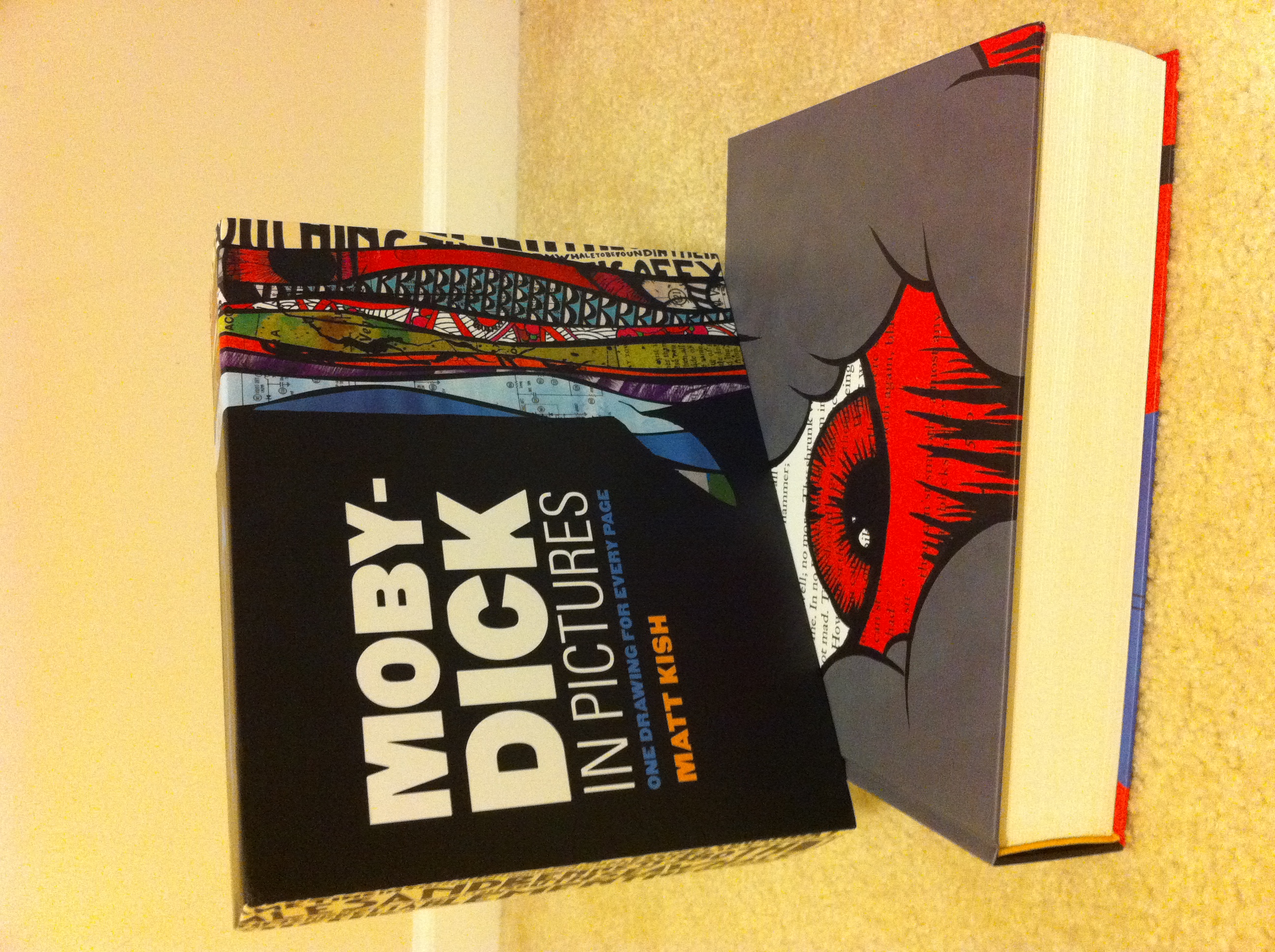
Today, nearly a month before I expected it, my copy of Moby-Dick in Pictures, the book his project turned into, arrived, and it is gorgeous. Although there is a paperback copy, I opted for the hard-back copy. It’s a few bricks worth of book and it comes sheathed in a lovely and sturdy box. Matt gives us a beauty of a foreword outlining the life of the project and then steps back and lets us look at the art. It’s mesmerizing to flip through the book, and I can’t wait to find the time to read Moby-Dick again with Matt’s complete series as a page-by-page companion.

If you’re a student or fan of Moby-Dick and ephemera, do yourself a favor and get your hands on a copy of this book.

The book and its box.
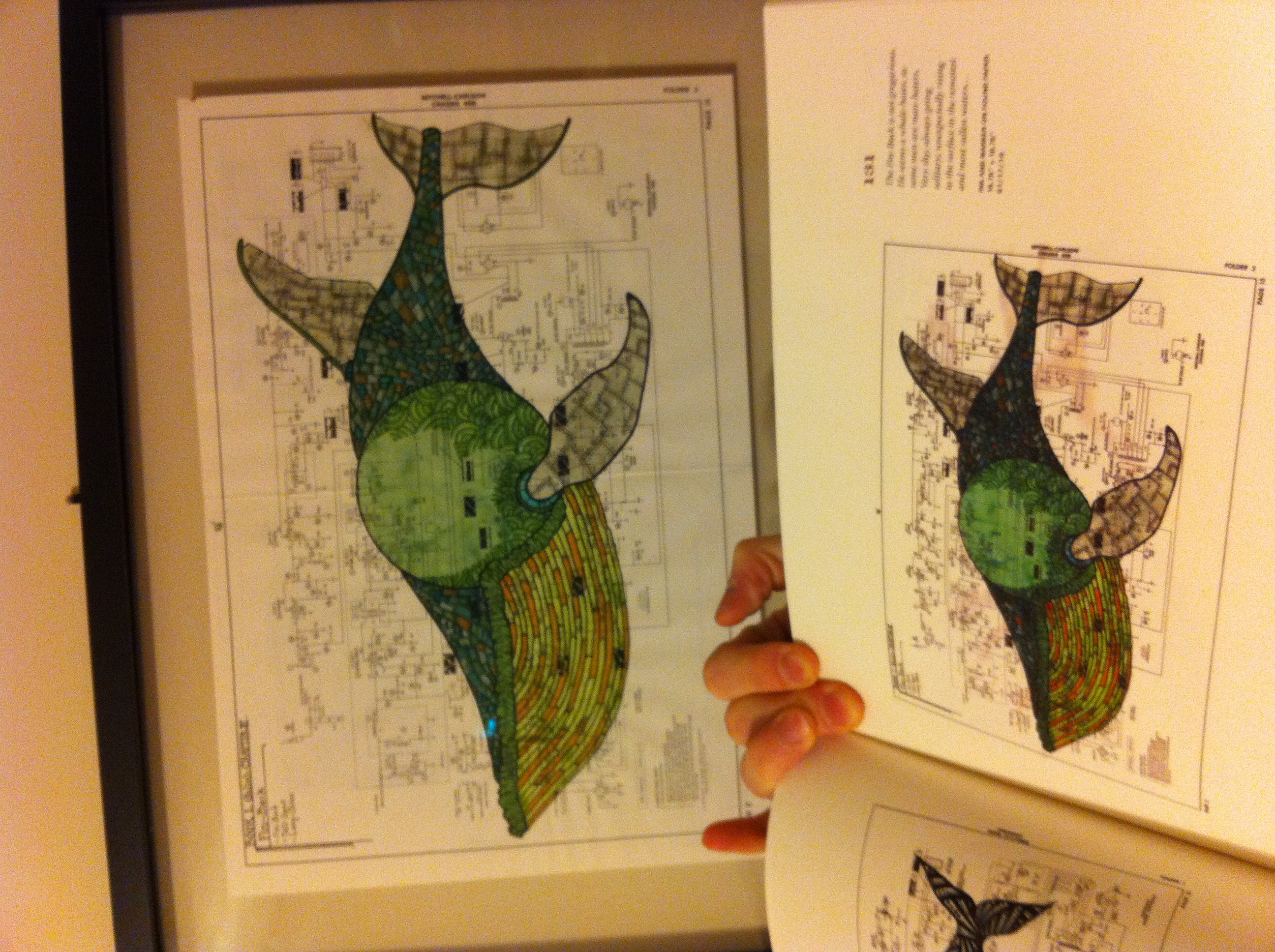
I bought the Fin Back whale drawing months ago. Here's the reproduction next to the original.

Te occidere possunt sed te edere non possunt nefas est

Unit #4, more or less equidistant from both the hospital parking lot and the steep ravine, is a repository for Alzheimer’s patients with VA pensions. #4’s residents wear jammies 24/7, the diapers underneath giving them a lumpy and toddlerish aspect. The patients are frequently visible at #4’s windows, in jammies, splayed and open-mouthed, sometimes shrieking, sometimes just mutely open-mouthed, splayed against the windows. They give everybody at Ennet House the howling fantods. One ancient retired Air Force nurse does nothing but scream ‘Help!’ for hours at a time from a second-story window. Since the Ennet House residents are drilled in a Boston-AA recovery program that places great emphasis on ‘Asking for Help,’ the retired shrieking Air Force nurse is the object of a certain grim amusement, sometimes. Not six weeks ago, a huge stolen HELP WANTED sign was found attached to #4’s siding right below the retired shrieking nurse’s window, and #4’s director was less than amused, and demanded that Pat Montesian determine and punish the Ennet House residents responsible, and Pat had delegated the investigation to Don Gately, and though Gately had a pretty good idea who the perps were he didn’t have the heart to really press and kick ass over something so much like what he’d done himself, when new and cynical, and so the whole thing pretty much blew over.

‘d been a confarmed bowl-splatterer for yars b’yond contin’. ‘d been barred from t’facilities at o’t’ troock stops twixt hair’n Nork for yars. T’wallpaper in de loo a t’ome hoong in t’ese carled sheets froom t’wall, ay till yo. But now woon dey . . . ay’ll remaember’t’always. T’were a wake to t’day ofter ay stewed oop for me ninety-day chip. Ay were tray moents sobber. Ay were thar on t’throne a’t’ome, you new. No’t’put too fain a point’on it, ay prodooced as er uzhal and … and ay war soo amazed as to no’t’belaven’ me yairs. ‘Twas a sone so wonefamiliar at t’first ay tought ay’d droped me wallet in t’loo, do you new. Ay tought ay’d droped me wallet in t’loo as Good is me wetness. So doan ay bend twixt m’knays and’ad a luke in t’dim o’t’loo, and codn’t belave me’yize. So gud paple ay do then ay drope to m’knays by t’loo an’t’ad a rail luke. A loaver’s luke, d’yo new. And friends t’were loavely past me pur poewers t’say. T’were a tard in t’loo. A rail tard. T’were farm an’ teppered an’ aiver so jaintly aitched. T’luked … constroocted instaid’ve sprayed. T’luked as ay fel’t’in me ‘eart Good ‘imsailf maint a tard t’luke. Me friends, this tard’o’mine practically had a poolse. Ay sted doan on m’knays and tanked me Har Par, which ay choose t’call me Har Par Good, an’ ay been tankin me Har Par own m’knays aiver sin, marnin and natetime an in t’loo’s’well, aiver sin.

It kind of enrages Lenz to like somebody. There would be no way to say any of this out loud to Green. As it gets past 2200h. and the meatloaf in his pocket’s baggie’s gotten dark and hard from disuse the pressure to exploit the c. 2216 interval for resolution builds to a terrible pitch, but Lenz still can’t yet quite get it up to ask Green to walk back some other way at least once in a while. How does he do it and still have Green know that he thinks he’s OK? But you don’t come right out there and let somebody hear you say you think they’re OK. When it’s a girl you’re just trying to X it’s a different thing, straightforwarder; but like for instance where do you look with your eyes when you tell somebody you like them and mean what you say? You can’t look right at them, because then what if their eyes look at you as your eyes look at them and you lock eyes as you’re saying it, and then there’d be some awful like voltage or energy there, hanging between you. But you can’t look away like you’re nervous, like some nervous kid asking for a date or something. You can’t go around giving that kind of thing of yourself away.

And a lot of the people in the different brick houses are damaged or askew and lean hard to one side or are twisted into themselves, through the windows, and he can feel his heart going out into the world through them, which is good for insomnia. A woman’s voice, calling for help without any real urgency — not like the screams that signify the Moms laughing or screaming at night — sounds from a darkened upper window. And across the little street that’s crammed with cars everybody has to move at 0000h. is Ennet’s House, where the Headmistress has a disability and had had a wheelchair ramp installed and has twice invited Mario in during the day for a Caffeine-Free Millennial Fizzy, and Mario likes the place: it’s crowded and noisy and none of the furniture has protective plastic wrap, but nobody notices anybody else or comments on a disability and the Headmistress is kind to the people and the people cry in fron tof each other. The inside of it smells like an ashtray, but Mario’s felt good both times in Ennet’s House because it’s very real; people are crying and making noise and getting less unhappy, and once he heard somebody say God with a straight face and nobody looked at them or looked down or smiled in any sort of way where you could tell they were worried inside.

I wish for my death but have not the courage to make actions to cause death. I twice try to roll over the side of a tall Swiss hill but cannot bring myself. I curse myself for cowardice and inutile. I roll about, hoping to be hit by a vehicle of someone else, but at the last minute rolling out of the path of vehicles on Autoroutes, for I am unable to will my death. The more pain in my self, the more I am inside the self and cannot will my death, I think. I feel I am chained in a cage of the self, from the pain. Unable to care or choose anything outside it. Unable to see anything or feel anything outside my pain.

Sometimes Gately would come out of a Demerol-nod and look at pale passive Pamela lying there sleeping beautifully and undergo a time-lapse clairvoyant thing where he could almost visibly watch her losing her looks through her twenties and her face starting to slide over off her skull onto the pillow she held like a stuffed toy, becoming a lounge-hag right before his eyes. The vision aroused more compassion than horror, which Gately never even considered might qualify him as a decent person.

And when he came back to, he was flat on his back on the beach in the freezing sand, and it was raining out of a low sky, and the tide was way out.