And the Stream of Consciousness Rolls Ever On

All right, so I know that in 1922 the stream of consciousness was the very Rubicon that marked the border with the future of literature; but lo these 88 years later, we’re reasonably familiar with the trick. I have a well-loved Mrs Dalloway in one of my boxes of books, and we most of us had to read The Sound and the Fury in high school, or repeatedly for pleasure, right? (And let’s not forget Ken Erdedy and Clenette Henderson.) It’s not a new game. But I’m surprised at how disorienting it is in Ulysses. I may just be rusty, but Joyce’s use of the technique—especially in “Proteus,” although of course that’s no accident—is more thorough and defamiliarizing than I expected.

I caught the switch between third person and first person that Judd notes, so it’s mostly clear when we’re dealing with “the narrator” and when we’re reading a character’s mind. What trips me up sometimes is the comprehensiveness of the stream-of-consciousness bits: In the same way that your thoughts to yourself generally don’t actually narrate your situation and actions, but only your impressions of them, conscious reactions to them, and mental processes that merely happen to take place among them, Stephen doesn’t tell us what he’s doing, only what he’s thinking about as he does it. This makes it difficult sometimes to keep up with the stage business of the story. Among other things, I think this is what makes “Proteus” such a challenge on the first try. Stephen is so wrapped up in his own head that he only notices some of what occurs around him, and what “the narrator” doesn’t explain for us, we often have to riddle out. For instance (to backtrack to “Telemachus”), that seal’s head is Malachi Mulligan, plump double dactyl, ’s, right? Instead of an actual seal’s, I mean.

Then again, it’s Stephen’s imagination and rambling associativeness that drives the most beautiful passages in the first three episodes. His memories that never happened of the milkwoman (1.397ff.) and of Mrs. Sargent’s mother-love (2.139ff.) are magical bits of imaginative creation, and the water-songs (1.242ff., 3.55ff., and 3.456ff.) are gorgeous poetry. I think the most impressive stretch of these first 40-ish pages is Stephen’s remembered dream of his mother at 1.102ff. For sheer psychological condensation, it rivals “My mother is a fish.”

The Ulysses “Seen” page for this passage does a fine job of showing the horror that Stephen attaches to the details of his dream’s dead mother—the smells, the physical wasting, the breath coming out of her mouth. The text then begins a remarkable layering process that demonstrates how overdetermined Stephen’s thoughts are, how everything reminds him of other things. He’s looking at his cuff, and remembers (among other things) his mother’s graveclothes; then, as he thinks of the “wetted ashes” smell of his mother’s breath, he sees beyond his cuff the sea, which Buck, quoting Swinburne, has called a mother. (Wetted ashes and the water and horrid breath congeal again at 3.150: “Unwholesome sandflats waited to suck his treading soles, breathing upward sewage breath, a pocket of seaweed smouldered in seafire under a midden of man’s ashes.”) “Clothes” and “wet” and “mother” lead from his own mother to the sea, where the bay is the edge of a bowl holding a “dull green mass of liquid” just like the white china bowl his mother hacked her bile into on her deathbed, and then “Buck Mulligan wiped again his razorblade,” which reactivates the bowl association to include the first sentence of the book, in which Buck’s shaving bowl parodies a solemn religious accoutrement (I don’t know Catholicism well enough to say which one) so that we remember again what we learned 15 lines ago, that Stephen refused to pray for his own dying mother.

As densely associative as this passage is—and I’m sure I’ve missed some of the connections; at the very least, I suspect there’s something in it of Stephen’s penury (the edge of his cuff is both “fraying” and “threadbare”) and of the contrast between Buck’s “wellfed” voice and the mother’s “loud groaning vomiting”—that’s how Stephen’s mind works. It’s a foretaste of the “Proteus” to come, in miniature and with context, to demonstrate how far we’re going to roam in this book from what we’re accustomed to. Yet it will seem familiar all the same, once we can learn the motions of it, because its abandonment of traditional technique is in the service of a psychological realism in which we can recognize some of the ways our minds work.

Fabled by the Daughters of Memory

At the end of my last post, I was discussing the question of who paid the rent for the tower (and I should have given credit to my friend Nick Fargnoli, who first pointed this issue out to me), and I invoked the biographical record of Joyce’s actual life. Now, I understand the risks of the biographical fallacy (which is especially prevalent in Joyce-studies, for obvious reasons, especially after Ellmann): however, the relationship between “life” and “art” is a crucial one in Ulysses, and one which is particularly foregrounded in the second episode, for which Joyce specified the art of “History” in his schema; but he could just as well have said “memory,” or “fiction.”

The second episode begins with a history lesson, regarding the empire-building battles of ancient Rome. Memory is evoked from the outset:

Fabled by the daughters of memory. And yet it was in some way if not as memory fabled it. A phrase, then, of some impatience, thud of Blake’s wings of excess. I hear the ruin of all space, shattered glass and toppling masonry, and time one livid final flame. What’s left us then? (2.7-10)

The allusion to Blake in the first sentence (which, for once, Stephen is kind enough to tell us from whom he’s quoting) sets up an interesting dualism by which to consider Joyce’s craft: Fable vs. Memory. Ulysses is fiction (fable), but it was born from memory, as the Muses were born of Zeus and Mnemosyne. And yet, it is not memory: it is “in some way… not as memory fabled it.” What is the relationship of the memory to the fiction? For that matter, what is the relationship of memory to history (which is really just another form of fiction, as historiographers such as Hayden White [certainly not the first to say so] like to tell us)? “History [is] a tale like any other too often heard” (2.46-7).

Memory is fallible, as the first page of this episode goes to great lengths to establish: the students “forget the place,” which Stephen is only able to remind them of by glancing at his “gorescarred book”: writing, of course, is just a form of “mnemotechnic” (a favorite word of Bloom’s), and evolutionary psychologists point out with the rise of writing a concomitant decline of  memory: see the difference between oral and written cultures (a difference especially pertinent in this book of all books, where a great oral epic provides the “basis” for a very written epic).

And why is the book “gorescarred”? This word cuts several ways. We can consider the abuse a school textbook is likely to suffer leaving it stained and marked; but perhaps the “gore” is the gore of the battles being described on the page. Consider, also, the circumstances under which the book we are reading was written. Ulysses (whenever Joyce mentions a book, one can assume, narcissist that he is, he is talking about his own), written in a Europe in the grip of the First World War: the compositional circumstances of this book leave it more than a little “gorescarred” itself. Granted, the scene is set before the war, but Joyce licenses a collapse of time, of writing and memory, in the above-quoted paragraph: “I hear the ruin of all space, shattered glass and toppling masonry, and time one livid final flame.”   Note the subtle sliding of tenses, “shattered glass” (past) and “toppling masonry” (present), calling to mind images not of the ancient battle of Tarentum, but the more contemporary vision of Europe in flames. (I owe this observation to a lecture of Eddie Epstein’s).

Joyce possibly gives us a clue to his use of history in the address of one of Stephen’s students: “Vico Road, Dalkey” (2.25). While certainly a reference to a rather prosperous suburb of Dublin, the name Vico evokes for any fan of Finnegans Wake  the Italian philosopher Giambattista Vico, whose circular theory of history dominates Joyce’s final work. History, like memory, is a repetition: we don’t “member” something, we “REmember” something. Memory is always a coming-again. The argument of this passage seems to be that history is, as well. (For an interesting reading of Joyce’s sense of history in this episode, see this brief post by my fellow Wakean, David Auerbach). 

The sense of repetition is crucial here: the students ask Stephen to tell them a ghoststory, a tale of the dead coming back again. And Ulysses is certainly haunted: we have already seen how Stephen is pursued by the wraith of his mother, and he’s not the only one dealing with ghosts in this book. Instead of the requested story, Stephen has them turn to “Lycidas,” a memorial elegy to Milton’s late friend: so, perhaps a sort of ghoststory after all. But the student reading aloud doesn’t turn the page, instead repeating the lines he just read. These kinds of repetitions riddle the chapter: another student is instructed to copy problems from the board, but is unable to do them for himself. Later he dries his page with blotting paper, creating another copy-trace. (I’m tempted to go all poststructuralist here, with “traces” and “iterability” and all that floating around, but I will restrain myself [for the time being]).  “Futility,” thinks Stephen, in the face of these repetitions. 

His subsequent meeting with Mr. Deasy only reinforces this sense: “As it was in the beginning, is now” (2.200-1); “The same room and hour, the same wisdom: and I the same.” (2.232-3). Stephen fingers shells, traces of life; Deasy gives him money, traces of labor and value, and lectures him on history and memory:

I saw three generations since O’Connell’s time. I remember the famine in ’46. Do you know that the orange lodges agitated for repeal of the union twenty years before O’Connell did or before the prelates of your communion denounced him as a demagogue? You fenians forget some things. (2.268-72)

The same words from the first page recur: “remember,” “forget”: we also add “repeal” to our list of “re-” words, giving a political valence to our repetitions. Deasy is playing in Irish politics, writing letters: Stephen has to wait while he makes copies, transferring from manuscript to typescript, erasing errors (again, one thinks of Joyce’s own struggles to get his text together). In contrast to Stephen’s Blakean/Viconian vision of the timeless reiterations of history, Deasy presents the orthodox teleological Christian vision: “All human history moves towards one great goal, the manifestation of God” (2.379-80). One can guess what Joyce thought of that idea by Stephen’s response: “That is God […] A shout in the street.”

All these reflections on the endless repetitions of history lead Stephen to utter his famous remark, “History is a nightmare from which I am trying to awake” (2.377). I can’t help but think of Freud, whose Beyond the Pleasure Principle was published a mere two years before Ulysses, so it is unlikely that Joyce would have read it. But in this episode he provides us with his own, fully realized vision of the repetition compulsion made famous in Freud’s essay.

Ulysses–I’m not really here.

Hello all.  It’s Paul from Moby Dick.  I would have loved to be posting here for Ulysses, but I assumed my work load would be too crazy for the summer, so I deferred).  But since I had the Zombies spotlight, I couldn’t give up without saying a few things here.

I’ve been wanting to comment on everyone’s posts thus far, but I have in fact been quite busy.  So, I’m incorporating some thoughts here (the rest of this is crossposted on my site too), and I hope to go back and re-read what everyone else has said too.

Begin crosspost:

This is my third time reading Ulysses.  The first time I was a freshman or sophomore in college and I signed up for a James Joyce class because, get this, the Canadian band Triumph had released a CD called Thunder 7 which was supposedly based on the 100-letter words in Joyce’s Finnegans Wake(which I had bought and found impenetrable).  Our teacher was intense and tried to scare everyone off (which worked for some, but not me).  The class was hard (first asignment : read The Odyssey over the weekend for a quiz on Monday).  I enjoyed Dubliners and Portrait of an Artist as a Young Man, but I thought Ulysses was pretty daunting.

I read it again when I re-took the class with the same teacher (not for credit this time, but because I wanted to, imagine that).  And that time I learned to really appreciate what Ulysses had going on for it.  I was also inspired by it to try and write challenging fiction, paying careful attention to every single word, and even possibly using different writing styles in the same book.  (The world appreciates that that never panned out).

But so the careful attention thing: Joyce spent seven years working onUlysses.  Every single word was charged with meaning.  He even made up his own words.  And it’s very apparent that he was the inspiration for countless modern authors (for beter or worse).

I’m excited to pick the book up again.  In part, because it was ranked number 1 on the MLA list of books, but also because for twenty-some years I’ve felt the book was fantastic.  And I wanted to see if I would enjoy it without guided instruction.

I was curious about which edition to read.   Since my class, when there was only really one edition available, many many editions have been published.  There’s a great discussion about this at Infinite Zombies, and I considered getting the third one Judd mentions.  But when I consulted with my old professor, he said the Gabler edition is still the best, so I went with that one.  And that edition is littered with all the notes I took from class and from the supplemental resources.

I decided not to read the supplemental resources this time (although I can;t help but look at my notes), to see what I can get from the story AS A STORY.

I remember a bunch from the class, but one thing that I distinctly remember is that to get everything out of Ulysses, you need to understand Catholicism (the mass in particular), The Odyssey, European history–especially Irish history, and popular Irish culture circa 1920.  It also helps to know Latin.  And these are all things that Joyce would have known and his audience probably would have known.  Every year we move away from its publication, means we know less about what he was writing about.  But that’s all the little details and jokes and blashpehmies.  I wanted to see (with some background, which certainly gives me an advantage) if I could enjoy the story without all the help.

My proper post begins at my site.  Click here for more.  And thanks for reading.

First Word; First Person

I’d like to start out small here, looking at two words from the first chapter: the first word of the novel, “Stately,” and the first-personal pronoun, “I” (as well as its objective-case, “me”). Obviously, this isn’t a lot, but  for me the richness of Joyce has always been how much you can do with a little of what he gives you. 

“Stately” has always intrigued  me as an opening word. Much has been made of it, of course, from the fact that it contains the novel’s final word (spoiler alert: “Yes”) backwards (thanks to M. Thomas Gammarino over at Ulysses “Seen” for reminding me of this in his excellent post about opening lines), to the possibility that it was chosen (at least in part) for its first letter: Gifford points out the the first letters of each of the novel’s three sections (S-M-P) could represent the initials of the three main characters (Stephen, Molly, and Poldy), or perhaps the three parts of a syllogism (Subject, Middle, and Predicate), thus “suggest[ing] a logical and narrative structure, which the reader can grasp but of which the characters in the fiction are essentially unaware.”

All this playing with letters as codes is well and good, but what about the word? Why “stately”? I like the way its grammatical sense is ambiguous: is it an adjective or an adverb? Initially I read it as the former: Buck Mulligan is both stately and plump. This is the way it is generally taken, I think. But what if you read it as an adverb, describing the manner in which Buck “came from the stairhead”? Does that make any less sense? On a certain level it actually adds something: the earliest definition in the OED of “stately” as an adverb reads “With splendid ceremonial or surroundings; in state.” Given that the first thing we see Buck do is intone the opening of a Mass, “splendid ceremonial” doesn’t seem too far off. Also, the use of adverbs is part of the narratorial style of this chapter, as one of our commentors noted, which Bernard Benstock attributes to the focalization of the narrative through Buck Mulligan’s point-of-view (in Hart and Hayman, James Joyce’s Ulysses: Critical Essays [U of California P, 1974]). Does it make a big difference which way you read it? No, I suppose not. But I like that Joyce gives us a little taste of verbal ambiguity right out of the gate. There’s more where that came from.

(As an aside, here are the opening words of an early French translation [Auguste Morel with Stuart Gilbert and Valerie Larbaud, assisted by Joyce]: “Majestueux et dodu…” Nice, right? Though [and I know too little French to be sure of this] I think it loses the adverbial possibility. And in German [Georg Goyert, again with the author’s assistance]: “Gravitätisch kam de dicke…” Which sounds like just the kind of polyglottal pun that Joyce would have relished [another opening-line word to watch out for, “relish”]). 

Now what about the use of the first-person? This is one of the most fascinating aspects of Ulysses: the use of various narrative modes (third-person omniscient, free indirect discourse, internal monologue) leaves the reader with the challenge of trying to figure out where various words and statements are coming from (like the oft-discussed “Chrysostomos” on the first page). This first chapter has two main modes: “objective” narration (perhaps focalized though Buck, for the most part) and Stephen’s internal monologue. It is the slide between the two that can be tough to keep up with. (A good rule of thumb for this episode: if it’s gorgeous, confusing, or both, we’re probably in Stephen’s head.) We first hear Stephen’s inner voice (with the possible exception of “Chrysostomos”) on page 5 (line 100 in Gifford):

Stephen, an elbow rested on the jagged granite, leaned his palm against his brow and gazed at the fraying edge of his shiny black coatsleeve. Pain, that was not yet the pain of love, fretted his heart. Silently, in a dream she had come to him after her death, her wasted body within its loose brown graveclothes giving off an odour of wax and rosewood, her breath, that had bent upon him, mute, reproachful, a faint odour of wetted ashes. Across the threadbare cuffedge he saw the sea hailed as a great sweet mother by the wellfed voice beside him. The ring of bay and skyline held a dull green mass of liquid. A bowl of white china had stood beside her deathbed holding the green sluggish bile which she had torn up from her rotting liver by fits of loud groaning vomiting.   

We aren’t yet in true internal monologue: the pronouns are all still “he,” not “I.” We’re sort of toeing the line between focalized narration and free indirect discourse. It makes sense: Joyce starts us out slow. We have to learn how to read Ulysses, and while he won’t necessarily make it easy, he is here to teach us. However we label it, this paragraph jumps out of the page: clearly we are in a different mode. And we learn right away to associate this mode with memory (not a very pleasant one, in this case).

But we haven’t hit first-person yet, and that’s what I claimed to be talking about here. (I just wanted to lead up to it with a little narratology, sorry about that). On the very next page we get our first bit of true internal monologue, which interestingly enough comes with our first description of Stephen’s appearance:

Stephen bent forward and peered at the mirror held out to him, cleft by a crooked crack. Hair on end. As he and others see me. Who chose this face for me? This dogsbody to read of vermin. It asks me too. (1.135-8)

 This paragraph, like so many in these early chapters, starts out in the third person with a character doing something before slipping inside to show us what they are thinking. Here we have our first (narrative, at least, as opposed to spoken) use of the first-person: “As he and others see me. Who chose this face for me? This dogsbody to read of vermin. It asks me too.” It seems important that the passage is about identity: throughout the book we will see both Stephen and Bloom (and perhaps Molly and others) struggling with identity and its relationship to memory, and we are seeing these themes invoked in very strategic ways right from the start. Gifford tells us that “As he and others see me” alludes to Robert Burns poem, “To A Louse”:

O wad some Power the giftie gie us
To see oursels as ithers see us!
It wad frae monie a blunder free us
An foolish notion:
What airs in dress an gait wad lea’es us,
An ev’n devotion!

So, crucially, even Stephen’s first bit of internal monologue, a reflection on identity, is relying on the words of others. We will see this throughout: Stephen’s thoughts, however self-absorbed, are presented through allusion and academic philosophical argument, rather than anything direct and, well, human (as opposed to the very human thoughts of Bloom).  The choice of a poem about a louse is fitting, of course, as Stephen hasn’t washed his “dogsbody” in some time.

But what about “It asks me too”? What asks him? Asks him what?

Stephen’s next reveries are triggered by Buck: first he mentions Clive Kempthorpe, causing Stephen to imagine a scene at Oxford, and then, cruelly, he sings some lines from Yeats’ “Who Goes With Fergus?” (a poem so important to Ulysses that William York Tindall used to make his Joyce students memorize it before they even began the novel). At that moment a cloud passes over the sun (watch out for the same event in chapter 4) and Stephen’s thoughts return to his mother:

Fergus’ song: I sang it alone in the house, holding down the long dark chords. Her door was open: she wanted to hear my music. Silent with awe and pity I went to her bedside. She was crying in her wretched bed. For those words, Stephen: love’s bitter mystery. (1.249-253).

Love: another word to watch out for. (Remember Stephen’s first thoughts of his mother: “Pain, that was not yet the pain of love” (1.102): what’s that supposed to mean?)

This is our first encounter with “I”: but Joyce wants the word to trouble us, as it troubles Stephen. In his next reverie he thinks of his school days: “So I carried the bowl of incense at Clongowes. I am another now and yet the same.”(1.310-12). Throughout the book we will be asked to wonder, with Stephen and Bloom: was “I” then the same as “me now”?

And sometimes it’s just not clear who the “I” refers to:

He walked on, waiting to be spoken to, trailing his ashplant by his side. Its ferrule followed lightly on the path, squealing at his heels. My familiar, after me, calling, Steeeeeeeeeeeephen! A wavering line along the path. They will walk it tonight, coming here in the dark. He wants that key. It is mine. I paid the rent. Now I eat his salt bread. Give him the key too. All. He will ask for it. That was in his eyes. (1.627-32).

Here we are in Stephen’s mind: so who paid the rent? Stephen, right? Well, maybe. Historically we know that it was in fact Oliver Gogarty, the basis for Buck Mulligan, who paid the rent. But that’s not conclusive: obviously this is a work of fiction, and Joyce is free to change whatever details he wants (especially if it serves to make him [as Stephen] appear more persecuted). But what about “Now I eat his salt bread”? Gifford tells us this is an allusion to Dante, in Paradiso, where his great-great-grandfather predicts Dante’s future exile: “Thou shalt make trial of how salt doth taste another’s bread,” e.g. you will see how hard it is to live in a home that is not your own. This allusion seems to indicate that Stephen is already an exile. So who pays the rent? One way to read it is that within Stephen’s interior monologue, he is imagining the direct discourse of Buck: “He wants that key. ‘It is mine,’ [he will say]. ‘I paid the rent.’ Now I eat his salt bread.” But there’s really no way to know for sure.

Complicated? Yes. Beyond what Joyce expects of his readers? By no means.

Poetry

In the first three episodes of Ulysses, I found several striking things that speak to Stephen Dedalus’s sense of himself as an artist. To suggest that Joyce was concerned with such matter is hardly a stretch. He whittled a much longer work down into A Portrait of the Artist as a Young Man for the purpose of having that shorter work operate as a sort of preface to Ulysses. Or so I understand it. There is much in these early episodes pertaining to art and artists that I missed (e.g. Buck Mulligan wanting to ride Stephen’s coattails and somehow create in Ireland a Hellenic center of the arts), and it took the annotations at UlyssesSeen to make them apparent to me. Armed with the perspective that site provided, I reread the first three episodes and found other things I hadn’t noticed before. I am no doubt scratching just the surface of the surface here, but the examples that most resonated with me follow.

On page 11, Stephen thinks back to some memories and to a dream he had of his mother. As the UlyssesSeen folk point out (see the panel here), there are some nice crisp details in his recollection. It’s pretty easy to imagine this burst of detail as the work of a poetic mind in action, the artist chewing over details of a hard event (emotion recollected in tranquility, anyone?), maybe even preparing them for insertion into his next poem. Then we have the line “Ghoul! Chewer of corpses!” and what appears to be an answer to it: “No mother. Let me be and let me live.” I take the ghoul exclamation to be a projection of Stephen’s of what he figures his mother might say if she knew he were noodling over the facts of her death with his art in mind. I may think this simply because I had a very similar experience when trying to write my way through my own mother’s death a few years ago. I wanted to capture the attendant details and emotions, but I felt like a buzzard picking at her corpose for something I might one day polish up and send in to a magazine for publication. This all brings up the interesting question of where the boundary (if there is one) lies between personal, private expression and consumable, public art.

On page 15, Stephen winces at the sting of the milk woman’s awe of Buck Mulligan. She listens to the man who could take care of her worthless living body and slights the man who could lend her immortality. Self-important much?

As the first episode closes, Stephen is noodling around with the Latin prayer that came to mind as he was thinking about his mother before, and he actually edits it, converting it into verses complete with eye-rhyme. He has to carve out a couple of phrases to make it work. The best I can tell, his rendering changes “May the glittering throng of confessors, bright as lilies, gather about you. May the glorious choir of virgins receive you” to something like the following:

bright as lilies
gather around you
glorious virgins

He basically removes the holy and keeps the earthly, retains the image fit for poetry. I’m reminded here, as often, of Pound’s “In a Station of the Metro.” That the prayer Stephen is editing appears previously in a section in which I take him to be considering images from the memory of his mother’s life and awful death for use in his art seems to me to tie that section to this and to confirm my suspicion that the ghoul comment pertains to his mining her death for his poems.

Catalectic meter is poetic meter that’s missing a syllable in the last foot. Chances are very good that if you’re reading Ulysses, you’ll remember from high school literature (at least) what a poetic foot is. But just in case: it’s a grouping of syllables. An iamb is an unstressed followed by a stressed syllable. A trochee is the reverse. A spondee is two stressed syllables. A dactyl is one stressed syllable followed by two unstressed syllables. So to take Joyce’s example here (and really forcing the recitation of the stresses in the line), we have “WON’T you COME to SANdy MOUNT” — it’s three trochees followed by an orphaned stressed syllable. This is a line of catalectic tetrameter (tetra = 4 feet). Why Stephen talks of iambs I’m not sure. Maybe the lines in question come to mind and register to him as catalectic but he’s searching for (or seeking to write) catalectic iambic tetrameter. At any rate, this is a very self-conscious intrusion of Stephen’s consideration of poetic technique into the text.

About ten pages later (47), he recites (presumably in his head) an old song composed of lines of catalectic trochaic tetrameter. Repeating a fragment of one of the lines, he then follows it with a rhyming sentence that scans more or less with the same meter: “Language no whit worse than his.” It’s not quite right because you don’t in natural speech hit the “no” quite as hard as a stressed syllable demands, and you hit the “whit” a bit harder (but not quite fully stressed). Still, it’s hard not to hear poetry in the resulting implied couplet:

And thy quarrons dainty is.
Language no whit worse than his.

But then go on and read the next two sentences, which I’ll present as an unrhymed couplet:

Monkwords, marybeads jabber on their girdles:
roguewords, tough nuggets patter in their pockets

There’s all kinds of stuff going on here. First, there’s the internal eye-rhyme of “words.” Then there are these weird compound words that Hopkins would have been jealous of. Each line ends on a trochaic utilitarian piece of attire, so while there’s not a phonemic rhyme, there’s a sort of rhyme of category and of rhythm. You have alliteration in “patter in their pockets,” a sort of visual rhyme of double letters in “jabber,” “nuggets” and “patter,” assonance in the adjacent “tough” and “nuggets,” more mid-line assonance in “jabber” and “patter.” There’s even something very nearly onomatopoeic about the beads jabbering on the girdles. But wait, there’s more. These two lines are almost identical rhythmically; take a liberty with the stress on “nuggets” and it’s exact. Finish all that off with the figurative language — “marybeads” for a rosary, “nuggets” for coins — and you’ve got basically a beginner’s guide to prosody and poetics here.

The last example I’ll pull out appears on page 40, and it’s another that resonates very much with my own experience. A brief quote:

Someone was to read them there after a few thousand years, a mahamanvantara. Pico della Mirandola like. Ay, very like a whale. When one reads these strange pages of one long gone one feels that one is at one with one who once . . .”

The ellipsis is Joyce’s and not mine. I take this to be a funny little jab at the self-absorbed young writer’s tendency to try to sound lofty. I would have real trouble counting the number of pages of journals I kept years ago on which I attempted this sort of syntactic jugglery in order to distance myself in a way from what I was writing. The idea is that you want to write as if, looking back once you’re famous (which is what Stephen is imagining here — the thems of his sentence are the books he fancies himself having written in the future), you had an inkling that you might wind up being famous one day. And yet you want to do so in a sort of modest or off-hand way. So you throw in goofy references and uncited quotes that betoken the breadth and depth of your knowledge of literature and then you write as if looking back on your youthful writing with sort of a wink and a nod. It’s all very silly. Stephen is attempting such a thing here, and he gets tripped up on his distancing techniques and loses his trail. It’s very funny, if my reading of it fits at all.

The Odyssey

Contrary to Judd’s advice, I’m reading The Odyssey in tandem with Ulysses (well, partially contrary to Judd’s advice — he suggests familiarity but also figures that a simplified version suffices). I’m vaguely familiar with a lot of the stories and have read quite a bit of Greek mythology to my daughter in the last year (this is a great book to read with little kids, by the way), but I’ve never read The Odyssey through from start to finish. Ten or eleven years ago, I think I checked it out of the library to read on an airplane, but I got distracted and never finished. It’s high time I read the thing, and what better timing could there be?

I’ve already documented how I’ve found Ulysses so far to be anything but transparent. To augment my reading, I worked my way through both the illustrations and the annotations for the UlyssesSeen project, and it was all very illuminating. The fine folk over there note that Joyce is very money-conscious throughout the book, and they bring to the foreground how Mulligan is leaning on Dedalus for money — a striking fact given that Mulligan has more elevated social status than Dedalus, so that you’d think he’d have more money too. Mulligan shamelessly pumps him for rent, for milk money, and for booze money, and he finally asks for the very key to the lodging. Mulligan is quite simply a parasite.

Parasitism turns out to be a major theme of the first two books of The Odyssey. I wonder, in fact, if a simplified or child’s version such as what Judd suggests would highlight the theme. The basic storyline for the opening of the poem is that Odysseus has been away from home (fighting the long battle of Troy and then waylaid on his home journey) for ages. His son, Telemachus, was a youngster when he left but is now coming into adulthood. Penelope (Mom) has been fighting off suitors for several years now. They all figure that Odysseus is dead, and Penelope is apparently pretty hot stuff. What I had never thought of before reading the epic is that it’s not as if the suitors are swinging by one at a time to take her out to The Olive Garden and have her home by midnight. No, all these guys are lounging about drinking Odysseus’s wine, killing and eating his animals, and generally wreaking havoc and making themselves at home on Odysseus’s/Telemachus’s dime. For years and years. After a helpful visit from Athena, Telemachus decides he’s not going to take it anymore, and he tries to give the suitors the boot. Several times he mentions how they’re mooching off of him (this is emerging as a rhetorical device in the epic, by the way, the repetition — often in the same words — of an anecdote or notion) and how he wants them gone.

It takes the visit from Athena to give Telemachus a kick in the pants. Similarly, maybe it takes a visit from the milk woman (credit to UlyssesSeen for the idea) to give Dedalus a kick. The counting out of money must serve as a bitter reminder to Dedalus of what a moocher Mulligan has been. And the first episode of Ulysses ends, apparently, with Dedalus effectively wiping his hands of the tower and of Mulligan.

All this to say that so far, I’m finding a parallel reading of The Odyssey to be of more value than I might have expected given Judd’s comments. It’s certainly not indispensable companion reading, but I’m finding it interesting. It also happens to be pretty entertaining and sort of anthropologically fascinating on its own.

An Interview with Robert Berry, of Ulysses “Seen”

It’s been a busy year for Ulysses-fans, with the book getting a lot of attention on the internet through reading groups like our own, Twitter members posting quotes and page summaries, but especially through the ambitious adaptation being undertaken at Ulysses “Seen,” which has received a bonanza of media attention due to a recent controversy with Apple over the iPad version. Robert Berry, the artist heading the Ulysses “Seen” team, was gracious enough to take some time away from the drawing board to answer a few questions about his project.

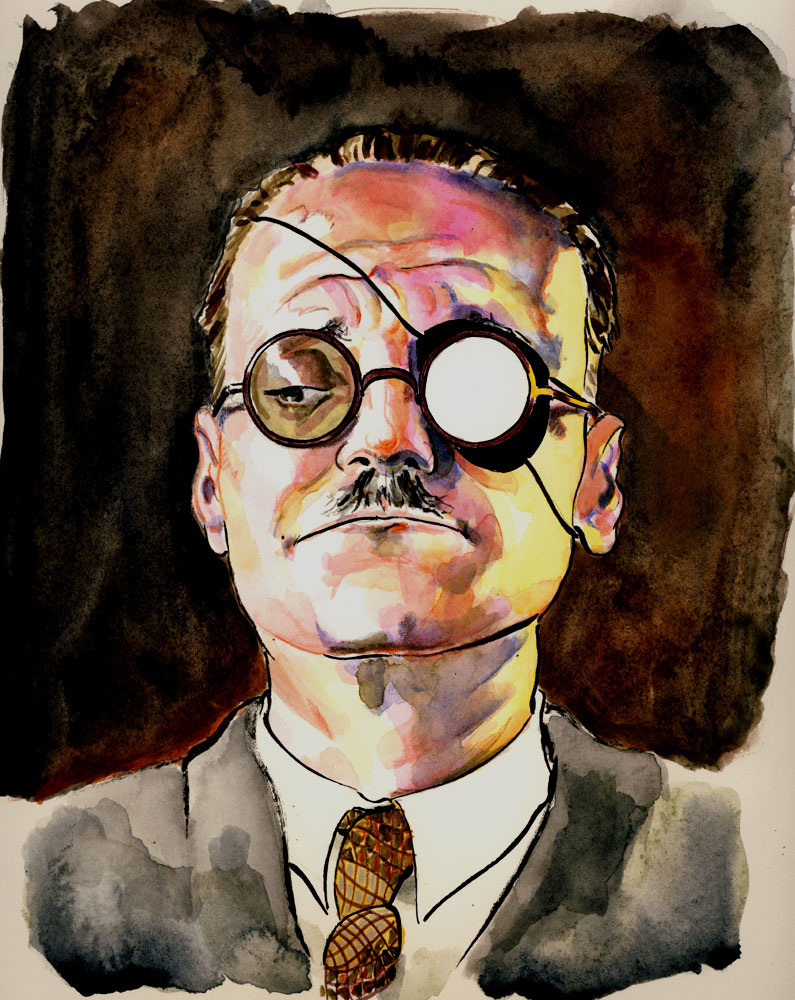
Berry’s portrait of a “Disapproving Joyce”:
JS: Let’s start with some general stuff (I realize you’ve discussed this elsewhere, including on your own blog at the site, but it’s worth rehashing for people who might not know about your project): Why Ulysses? Is there something about this novel in particular that you think lends itself to the kind of adaptation you’re doing? 

RB: Some years back, while first noodling around with the idea of working in comics and graphic novels, another cartoonist and I attended a BloomsDay reading here in Philadelphia. I’d read the novel before then of course, so I was there more as a celebrant than a novice, but this was first time I’d been to something like this.  Hearing passages from novel read aloud, particularly to a crowd, is a completely different experience than tackling it on your own. When it’s good, when the reader is really getting it, you can see it on the faces of everyone in the crowd and you can see that they’re getting it too. It’s like theatre and everyone’s just standing around in the twisting turning halls of Joyce’s language and wit.

But it’s not theatre, of course. It’s novel, an intentionally very complex novel, with a very bad reputation as being “difficult”. Unlike theatre, novels have a very one-on-one relationship with the reader; they’re something you can carry with you, pause to think about and unravel at your own pace. Something to stage in your own imagination.

I wanted to make a comic that could give people that same kind of one-on-one relationship with the text but could also give them that same kind of stage direction you get out of the theatre combined with an easy reference guide to what’s going on. A way to “see” the novel as you’re reading or hearing it.

 JS: Speaking of which: Why a comic book? (Is that the term we’re using?: certainly Joyce considered his work a “comedy,” in the old, Dantean sense of the word, but what you’re doing isn’t exactly a book, is it?) And why publish online, panel-by-panel?

RB: Over a few pints of Guinness at the pub on that same BloomsDay, my friend and I got into a discussion of how comics was the only media that could do a faithful adaptation of Joyce’s novel. Theatre and film don’t work because they happen in the real time of the audience. The reading experience works in a completely different way with comics and text. Comics have a linear flow, one image following another, but that line has more freedom, more plasticity, in how it relates to time.

Comics on-line, or on the iPad, have an even greater plasticity than they do in print. What we’re able to do on-line is use a comic panel to freeze a moment in reading Ulysses and allow the reader to jump “behind the page” to look at annotations from the novel or ask questions about what is going on and who some of the characters are. The comic itself serves as a kind of guide for all the external materials, discussions and concepts one might get from reading the novel in a classroom environment.

And Joyce is just waaaay funnier than Dante was.

JS: I don’t know, I bet the Inferno was pretty friggin’ hilarious when it first came out…

RB: It definitely raised more than a few laughs at the time, but it’s a bit more of a “had to be there” kinda humor I think…

JS: Tell me a little bit about your process: how do you go about deciding what a given “page” is going to look like, and then how do you achieve your vision? What’s the timeframe like: how long does a given page take, start-to-finish?

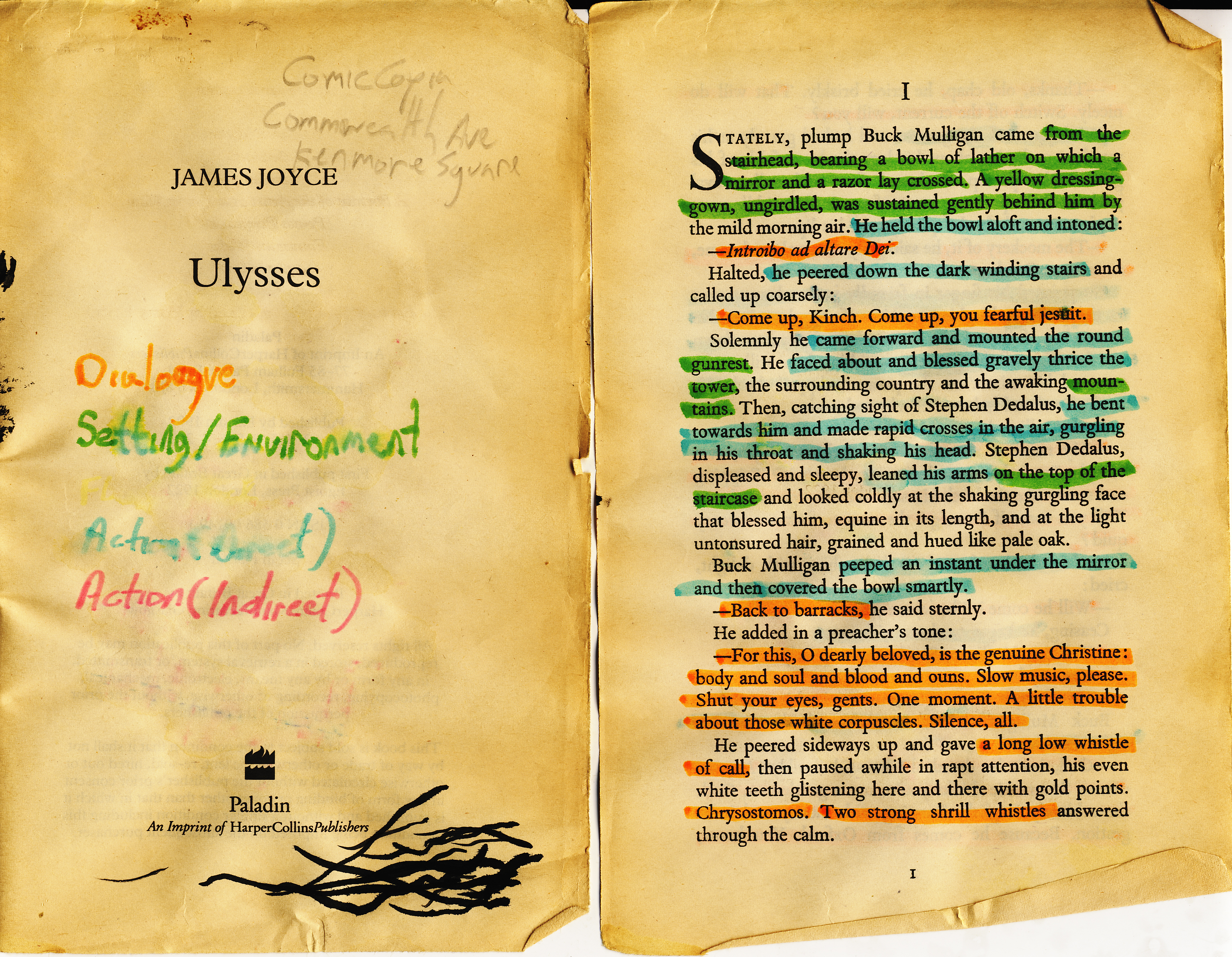
RB: The process is pretty unique in that I’ve never encountered anyone working on something like this, so we sort of took a little time to figure out the method. It all begins with the novel, of course. I have a replica of the 1922 edition, our sole source for the text, that I’ve color-coded with about six different highlighter markers to indicate the differences between action, spoken dialogue, internal monologue, etc.

The first page of Berry’s working copy of Ulysses:
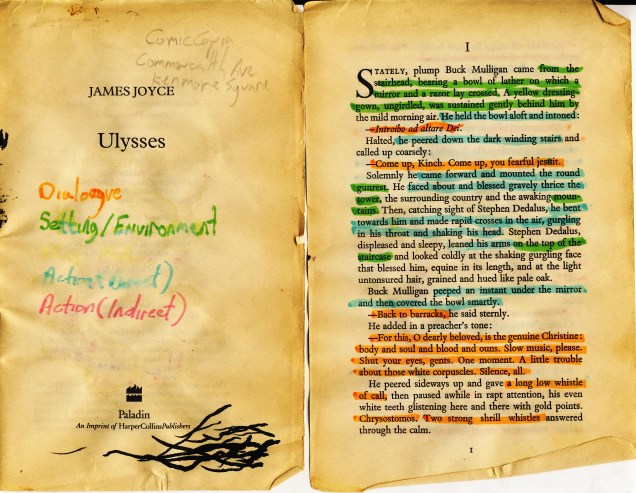
Since each episode (or chapter) of Joyce’s novel presents new viewpoints and narrative styles, my four partners and I get together and talk over beers about the episode we’re doing next. Right now, that’s “Calypso”. This helps give me a set of guidelines to follow, a kind of a plan of what other people look for in a specific chapter. After that, I step away from the group for a while and make a set of storyboards, a rough comic, that includes all the original text. The goal at this stage is to pace and stage the flow of words as a director of a film might, looking for the beats implied by the language and giving just enough information so that readers can see who’s speaking as well as their relationship in space. This is a particularly complex stage, particularly when dealing with work as complex as Ulysses, so I tend to do this part on my own and don’t let anyone see it until I know I’ve made the right choices. It’s the guts of the comic.

After that is done, the storyboards go back to my partners for edits and a bit more discussion. It’s often surprising to see how differently each of us view the novel once it’s been drawn and there are occasional important changes that occur during this stage. From here, the work goes back to myself and our production designer Josh Levitas. Josh hand-letters and sets up the page files into what we call “floorplans”. This allows me to make drawings on hand-lettered pages around the text in accordance with my original storyboards. I think it keeps a freshness and a liveliness to the drawing that was lost in earlier versions in which we lettered with the computer over existing drawings. For the next chapter Josh is doing a lot of the set design as well, making drawings of objects in Mr Bloom’s house that we’ll see again much later in the novel.

In the meantime Mike Barsanti, our resident Joycehead, starts working on the Readers’ Guide entries for each page. He explains some of the major themes and issues in the novel, gives some Joycean anecdotes and tries to show links to other related topics and discussions. It’s an area of the project that I have very little to do with but am probably most proud of.

The goal here in all of our work is open up the world of the novel using comics and the internet, to make it a bit less daunting and to show how it connects to today’s readers as something more than just an English Literature merit badge. It’s a complex novel, certainly, but that complexity, once they’ve started to crack it, brings readers back again and again. It’s what makes it the most difficult book you’ll want to read many times.

JS: I see you’re doing the “Calypso” episode second, rather than “Nestor”: that makes sense to me, but would you care to comment on the decision?

RB: I decided pretty early on that I wanted to go chronologically through the first six episodes of the novel. They’ll still be sorted and numbered according to their original order, so “Calypso”, though it appears next, will still be called episode number 4. I made the decision when I was first thinking about how the web and the iPad are much more flexible platforms for annotation. It seems to me that the comparison between these two chapters is a useful learning guide for first time readers so we wanted to step up that process just a bit. But the main reason for it is that I’m going to do “Nestor” and “Lotus Eaters” simultaneously next year, shuffling their pages together to show the chronological relationship between Stephen’s day and Mr Bloom’s. I’ve already laid that chronology out and, believe me, it’s a great example of comics is such a good format for adapting Joyce.

Plus, I was a bit anxious to get to draw Bloom. If I’d have gone with the strict order of the novel that wouldn’t be happening for another year or two.

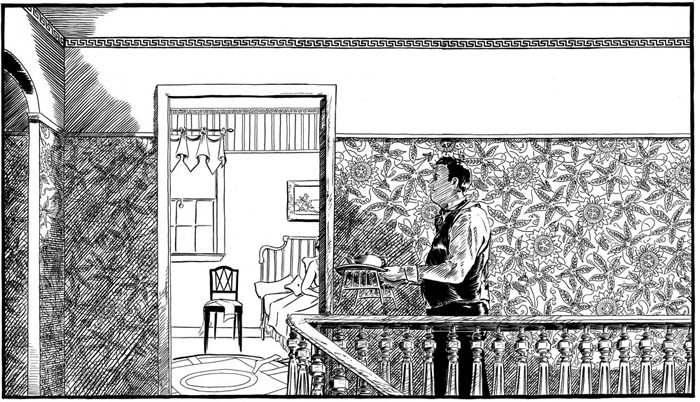
A sample of the forthcoming adaptation of “Calypso”:
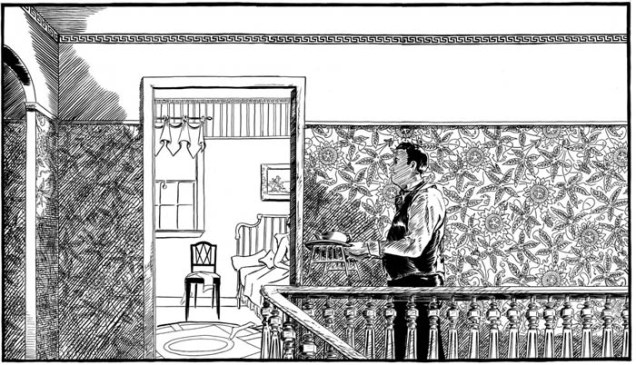
JS:  Are there any moments/panels that gave you particular trouble, in terms of interpretation/adaptation? 

RB: All of the internal monologue presents problems when you start it. As an illustrator you need to separate out a certain voice for each character and how they see the world. Mr Bloom’s inner mind can’t rely on the same visual devices as Stephen’s does and both have to be distinctly separate from the voice of the omniscient narrator. I could’ve cheated a bit, used different font styles to represent this, but I think that’s kind of a cheap parlor trick in comics and, with so many distinct voices in Ulysses, bound to be confusing later.

But establishing an order for how to slip into the imagination of each character is probably the hardest bit. I think you’ll notice it quite a bit in “Calypso” that Bloom doesn’t dream about the world in the same hard imagery and weight of words that Stephen does.

 JS: What are you looking forward to most, in terms of the coming chapters? Is there any particular moment/line that you can’t wait to illustrate?

RB: Off the top of my head it’s that scene in “Lestrygonians” when Bloom has the memory of the seedcake being passed into his mouth and notices the two flies, buzzing, stuck on the window. To me, that’s a very poetic combination of imagery and text, all of what comics can do better than most other narrative mediums.

JS: Wow… that’s pretty much my favorite moment in the whole book.

A big thank you to Rob and his collaborators at Ulysses “Seen.” Rob will be joining us on our reading, and will post his thoughts about the episodes that he has adapted so far in the coming weeks.

Ulysses on the Web

In my last post I discussed many of the “old-fashioned” (e.g. print) resources that are available for the struggling reader of Ulysses (and we’re all struggling readers when it comes to Joyce). But these resources have largely been supplanted in the Internet Age– the web has proven to be a very hospitable place for Joyce-studies. The man who is credited with inventing the term “weblog” was a Joyce-fanatic, to give you some idea (more on that in a moment).

I’ve referred you here before, but I think it’s a good place to start so I’ll mention it again: the Joyce page at the Modern Word has a lot of great background information and introductory essays (their Pynchon page is excellent as well, FYI). Here is their page introducing Ulysses in particular. They also have a page of links, but many of them are broken: the site does not appear to have been updated since 2004. (If anyone out there knows what happened to the site, I’d love to hear: I tried contacting them, but their email is out of service as well.)

A couple of commenters have mentioned Jorn Barger (the aforementioned coiner of the term “weblog”) and his incredible Robot Wisdom site. This is an incredibly extensive resource, but it is sometimes daunting: Barger is a lifelong Joycean, and his readings are often intricate and polemical. So, proceed with caution. (But do proceed!) The site is no longer being updated, but you can keep up with Jorn here.

More useful for the first-time reader are Michael Groden’s notes. Created to aid his students, Groden provides extensive background and though-provoking analysis of each episode (navigating the site takes some getting used to, though). It’s sort of like really smart Cliff’s Notes.

One of the most captivating (and distracting) sites is JoyceImages, which collects period images for all sorts of references throughout Ulysses. It is truly amazing, and was praised by Rob Berry at Ulysses “Seen” as “my favorite, most inspirational and most commonly used Joyce site. For a visual understanding of the world ULYSSES works in this is as seminal a text as Gifford’s.”

And, oh yeah, there’s also Ulysses “Seen” and their amazing Reader’s Guide. A work in progress, this site will get you through the first chapter, and leave you wanting more. (And more about that will be forthcoming, here, soon). 

These are the sites I’ve found most useful, but there are many, many more: not to mention the fact that people are writing about Joyce on blogs and Twitter every day (here’s a nice post from the past Bloomsday). Feel free to post links in the comments to any relevant sites I’ve failed to mention: I’m always looking for new distractions.

How much “other stuff” do I have to read in order to understand Ulysses?

The short answer to this question is: none. No ancillary reading is necessary to enjoy Ulysses, and I tend to tell first-time readers to actually avoid all the guides and reference books: I think it’s best to just let Joyce’s prose carry you along, and enjoy the ride. You can try to figure out “what it all means” later.

However, I do recognize that this approach isn’t satisfying to everyone, and some people prefer to have some of the more difficult aspects of the text cleared up for them as they go. (This seems an appropriate thing to acknowledge in the light of Daryl’s post earlier today). So here are some of the things that you might like to take a look at, as we read.

1. In addition to a good dictionary, the one indispensible resource is Don Gifford’s Ulysses Annotated. This hefty tome will elucidate the vast majority of Joyce’s references, from literary allusions to local Dublin “street furniture.” Some people like to read with this open alongside, checking out Gifford’s commentary as they go. I did this, in fact, my second time through: it’s enlightening, but as you might imagine it really slows down the reading, and takes a lot away from the rhythm of Joyce’s writing, so I’m not crazy about it as an approach. Instead, I’d suggest marking words and passages you are curious about as you read, and then after you finish a chapter go to Gifford and look them up. But everyone reads differently, and you’ll have to find a method that works for you.

2. There are any number of guides to Ulysses, which provide plot summary and explain various allusions and parallels. There are two that are particularly worth mentioning. One was written by Joyce’s friend Stuart Gilbert, with Joyce’s guidance, and so it has the authorial imprimatur: it’s sort of the “official” guide to Ulysses. It is an excellent book. It’s rather heavy on the summary and quotation of the novel, but when you consider that it was published while Ulysses was still banned in most of the English-speaking world, that makes a lot of sense. Gilbert spends a lot of time on the Homeric parallels, cementing that mode of reading for a generation of Joyceans. His introduction to the book is fascinating (and almost as dense as Ulysses itself, at times), so I’d suggest looking at that at some point (preferably after you’ve finished your first reading of the novel), even if you don’t want read his summary/analysis of each individual chapter.

More recent than Gilbert, and rather more popular among contemporary readers, is Harry Blamires’ The Bloomsday Book. This is a lot less inflated than Gilbert’s book, and provides a sort of walk-through of the text, pointing out various connections that might escape the casual reader. It’s very helpful, but I often find myself questioning his conclusions. (I believe I’ve spotted a few outright errors, in fact.) But really, I think my problem is that I just find his reading a little too cut-and-dried, whereas I find Ulysses is more ambiguous.     

Then there is a more recent guide, which I’ve heard was actually a best-seller in Ireland (though I have not confirmed this to be true): Declan Kiberd’s Ulysses and Us: The Art of Everyday Living. As the title suggests, this is less a guide to the plot of the book or exegesis of its literary depths than a discussion of what the book has to tell us about being human. In that regard, it’s maybe a little touchy-feely for some, but it’s really quite good, and it’s interesting to see how Ulysses is regarded “today.” (Well, last year, anyway.)

3. Moving up the scale from “notes” to “guides” to “studies,” there are any number of great introductions to Ulysses that take a more whole-cloth approach, rather than walking the reader from chapter to chapter. One I particularly like is by Hugh Kenner, probably the greatest modernist scholar of his generation, and just a really good stylist in his own right. His book on Ulysses  is brief, but full of interesting observations. There are others, but this is my favorite.

4. Then there’s the literature that Joyce was drawing on for background. I don’t think reading the Odyssey is very important for understanding Ulysses: a grasp of its basic plot (a hero trying to get home, a son trying to reunite with his father) and major characters and mythological monsters (Cyclops, Sirens, etc.) is sufficient, and can be gained from reading a children’s “stories from the Odyssey” (which is, I believe, essentially what Joyce was drawing on). But if you have the time, of course, there’s no harm in reading the Great Poem of the Western Tradition (I like the Fagles translation). 

The other big canonical text referred to throughout Ulysses is Hamlet. I’d imagine everyone reading this has read Hamlet at some point, but if you have a free couple hours, it’s worth revisiting it: there’s a whole chapter (the ninth) that centers on it, so it’s good to have it fresh in your mind. But not necessary, by any means. (As a matter of fact, the discussion of Hamlet in the book strays pretty far from the play itself, looking more towards Shakespeare’s life for material. But you’ll see.)

The most important precursor to Ulysses is Joyce’s previous novel, A Portrait of the Artist as a Young Man. This you probably should read before you start. Ulysses picks up the story of Stephen Dedalus where Portrait left off, and a number of other characters carry over as well. Again, you’ll totally be able to get into Ulysses without it, but it provides useful context. There are also a number of characters from Dubliners, Joyce’s collection of short stories, that crop up, but it’s not necessary to have read that one first either.

5. And of course, like all his books, Joyce drew much of Ulysses from his own life, so Richard Ellmann’s magisterial biography provides a lot of useful background.

Of course, there’s also a lot of stuff online (for example, the annotations at Ulysses “Seen”): my next post will explore Ulysses on the web. And I’d like to invite comments on secondary sources from you, as well: I’m sure there’s a lot of stuff I didn’t mention, and probably people have their own ideas on how to best approach the book: please share.

Ultimately I’d like to reiterate, even though I’ve listed a semester’s-worth of reading here, absolutely none of it is necessary, and I strongly encourage first-time readers to just jump into the book without all this excess baggage holding you down. The book more than stands on its own.

It All Comes Back to Me

I’ve mentioned before that I’ve started and stopped Ulysses a number of times. The first was maybe a decade ago, when I checked it out from the library, read a few pages, and decided it wasn’t for me. Several years ago, I decided to buy my own copy of the book, and I’ve tried to start a couple of times since. I think I once got maybe 100 pages in before deciding it wasn’t for me. The experience is similar to my experience with Gravity’s Rainbow, another one I started who knows how many times before finishing. I think I once got some 300 pages into that one before being distracted by a shiny object and putting it down. I did finish GR at last a few years ago, and I was left feeling like it was a great book but not so terribly enjoyable a book on the whole. It was a bit like taking medicine.

Having started (and restarted, and restarted) Ulysses again, I begin to feel history repeating itself. I’ve read the first ten pages three or four times in the last few days. I’ve gotten only so far partially because it’s a busy time for me and I can’t ever seem to find more than a few minutes to read. And even then, I’m reading a page (or a part of a page) at a time before being interrupted. So I can’t place all blame on the text for my slow start so far.

But I think I am going to blame the text some. Or I am going to blame Modernism, which I now remember, not having read much from that camp in the last decade, I fucking hate. Before it occurred to me to affix that dread label to Ulysses this morning, I found myself trying to enumerate the reasons I was having difficulty slipping into the book. The best I could come up with was that it is obnoxiously allusive and meandering. Some meandering I’m ok with. I suppose I like meandering that is entertaining. But in the opening of Ulysses, I find little so far that entertains (or engages) me. There are words I don’t know and references that apparently even the scholars can’t agree upon the referents for. There are still others that I simply can’t make sense of (a gardener masked with Matthew Arnold’s face?). There are phrases in at least two foreign languages I don’t understand. And there’s stagnation. So far, a fop and a wet blanket are standing on a tower shaving and talking briefly but ornately about things as varied as death and money and clothes and dreams. There’s nothing so far to really hold my interest. I’m not dazzled by the prose, and I’m actually a bit put off by the allusiveness and meandering.

These seem to be the hallmarks of Modernism, at least as I understand it. Take “The Wasteland.” Take Pound. (Please!) One of the problems I have with this sort of literature is that it often seems like a big in-joke. Modernists seem to be intentionally obscure and to wink at and nudge one another about their smartness. It’s not an inviting sort of literature. It makes me feel not only like I’m not one of the cool kids but also like I’m not even one of the smart kids.

I don’t expect (or want) a book to be easy. Most of the books I read, I read because they have reputations as hard, worthwhile books. I enjoy working to grok a book. Sometimes, I even enjoy working hard to grok how to grok a book (I’m thinking in particular of Gaddis’s JR). But boy am I worried about my ability to hang on for this one. I will. I will, even if I just stare at every word on every page without really getting what Joyce is saying. But if the opening — which I must have read a dozen times in my life by now — is any indication, this is going to be a slog and a half.