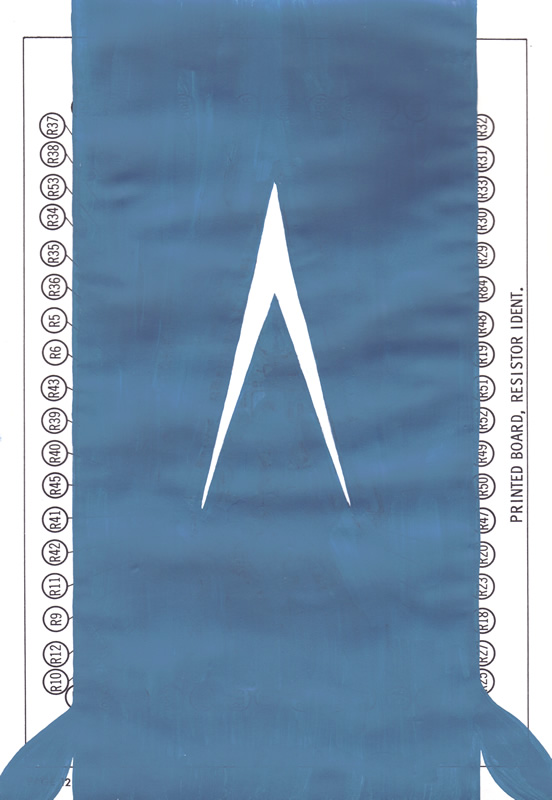
Illustrating ‘Moby-Dick’ – page 030

And now we come to it. My first whale. I suppose, for good or ill, I have never outgrown some of my childhood. Even now, at the decrepit age of 41 (!) I am still fascinated by monsters. More specifically, drawings of monsters. Monster art. Anything visual that’s monster related. As I’ve grown older, my tastes have broadened quite a bit and now it takes far more than a simple Godzilla film or drug store comic book to thrill my eye. Still, for me, it’s generally still all about the monsters, and I mean that in the simplest, purest, truest, and most genuine way.

I think that the idea of monsters is still a part, at least, of what draws many of us to Moby-Dick. Certainly the novel is far more complex, yes, but at its heart, the duel of whale and man, Ahab and Moby Dick, is a part of what starts our hearts pounding and our minds racing. So for me, an aficionado of the leviathans of air, land and sea, the prospect of embarking on an illustration project where I would be able to draw monster after monster after monster was one I found almost irresistible.

Once again, I knew I didn’t want to do the expected. There have already been enough staggeringly brilliant artists such as Rockwell Kent and Barry Moser, to name just two, who have lent a soberly powerful realism to this yarn of men and monsters. To me, the fact that these artists were able to depict the whales, men and ships of the story in much the way as they actually appear in reality while still creating thrilling and fabulous images is nothing short of miraculous. I have very real doubts about my ability to depict anything realistically, and on the few occasions when I have tried to do so, the results have been dull at best and positively banal at worst.

This freed me to cut loose the moorings and let my mind explode. I could draw any whale in any medium any way that I wanted. The mythical and Biblical underpinnings of the novel were enough, I thought, to give me some credibility in sailing the seas of fable and fantasy to dredge up these ideas. So again, a lifetime of comic books, videogames, fantasy art, cartoons, science fiction and colored pencils would swirl together and from that alchemical brew provide a bestiary I hoped would thrill me to the end of my days. The excitement was growing. My first whale!

The line I chose was from page 30 of the Signet Classics paperback edition, and I specifically looked for this opportunity so that I could practice a bit before tackling Moby Dick himself. This line would give me an opportunity to start working out some of my ideas and building my bestiary of leviathans. The line comes as Ishmael lounges in the Spouter Inn eating breakfast and staring about him at the panoply of seasoned salts, sailors and harpooneers. He, like me, seems to marvel at these men and the deeds that they are capable of, curiously contrasted by their almost meek silence at dining in the company of strangers. Ishmael remarks “Yes, here were a set of sea-dogs, many of whom without the slightest bashfulness had boarded great whales on the high seas—entire strangers to them—and duelled them dead without winking…” That was more than enough to fire my imagination. The bravery, the martial spirit in that line! These men had “boarded great whales on the high seas!” I’ve had a hard time stepping out of a secured canoe onto a pebbly but very stable shore, so I can’t imagine the skill and dexterity it took to “board” a great whale writhing in its death throes on the crashing waves! And then these men had “duelled them dead without winking.” Again, the courage! Or insanity? Probably both, but isn’t that paradox almost always a quality of the best heroes, from Gilgamesh to Theseus to O.M.A.C.? I liked also how that line alludes to the honor and dignity of whaling. These sea battles were not murder, they were duels. There were rules to be followed. Codes of conduct to be honored. The whale was a terrifying and murderous foe, but one to be treated with respect and dignity.
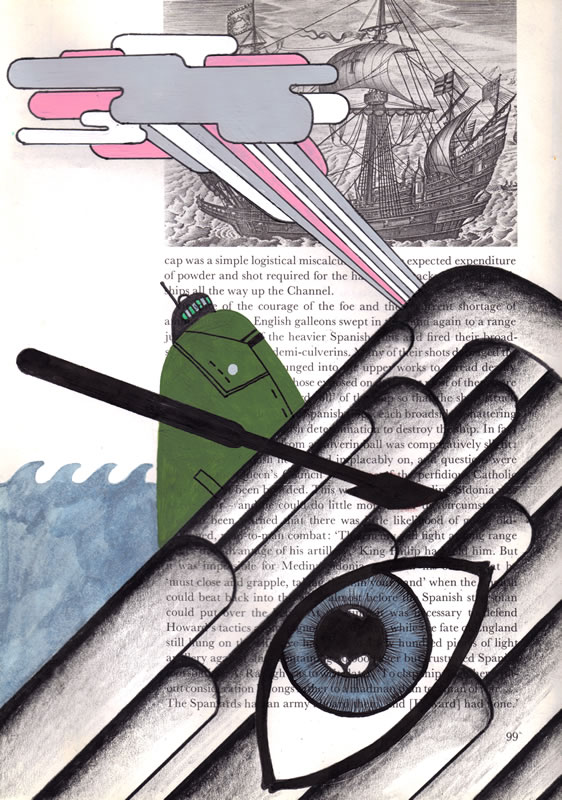
With all that in mind, the image I finally depicted leapt to mind almost immediately. That giant, rolling, baleful eye, preposterously bigger than the harpooneer himself. I wanted the harpoon to look like the death dealer that I knew it to be, so rather than attempt something realistic I remembered the scalpels we used to eviscerate the fetal pigs I studied in biology. The harpoon became a smoldering black scalpel poised menacingly over that fragile eye. The injury to the eye motif! The harpooneer I was especially fond of, towering implacably on the head of the leviathan, unbowed, unmoving, frozen in that single moment of time before delivering the deathblow. Careful viewers will notice the pink froth from the whale’s spout, showing the beast to be already gravely wounded and fighting to its last breath.

Sometimes, with these Moby-Dick illustrations, there are layers of meaning. Hidden symbols, personal and otherwise. But sometimes, it’s just men and monsters, sailors and whales. And those are often the most fun to make. I hope you like this one as much as I do.
Homeric Simile, Fate, and Will

We all know from ninth-grade English that a simile is a comparison of two things joined by the word “like.” But what about a Homeric (or epic) simile? Harmon and Holman define the epic simile in The Handbook to Literature as follows:

An elaborated comparison. The epic simile differs from an ordinary simile in being more involved and ornate, in a conscious imitation of the Homeric manner. The vehicle is developed into an independent aesthetic object, an image that for the moment upstages the tenor with which it is compared.

(The weird terms “tenor” and “vehicle” are basically fancy words for the two parts of the comparison.)

Moby-Dick is full of these suckers, or something like them. In the lengthy example following, I suppose Melville doesn’t use the word “like,” but it’s surely a protracted comparison:

I was the attendant or page of Queequeg, while busy at the mat. As I kept passing and repassing the filling or woof of marline between the long yarns of the warp, using my own hand for the shuttle, and as Queequeg, standing sideways, ever and anon slid his heavy oaken sword between the threads, and idly looking off upon the water, carelessly and unthinkingly drove home every yarn: I say so strange a dreaminess did there then reign all over the ship and all over the sea, only broken by the intermitting dull sound of the sword, that it seemed as if this were the Loom of Time, and I myself were a shuttle mechanically weaving and weaving away at the Fates. There lay the fixed threads of the warp subject to but one single, ever returning, unchanging vibration, and that vibration merely enough to admit of the crosswise interblending of other threads with its own. This warp seemed necessity; and here, thought I, with my own hand I ply my own shuttle and weave my own destiny into these unalterable threads. Meantime, Queequeg’s impulsive, indifferent sword, sometimes hitting the woof slantingly, or crookedly, or strongly, or weakly, as the case might be; and by this difference in the concluding blow producing a corresponding contrast in the final aspect of the completed fabric; this savage’s sword, thought I, which thus finally shapes and fashions both warp and woof; this easy, indifferent sword must be chance–aye, chance, free will, and necessity–nowise incompatible–all interweavingly working together. The straight warp of necessity, not to be swerved from its ultimate course–its every alternating vibration, indeed, only tending to that; free will still free to ply her shuttle between given threads; and chance, though restrained in its play within the right lines of necessity, and sideways in its motions directed by free will, though thus prescribed to by both, chance by turns rules either, and has the last featuring blow at events.

I wonder if this is one of those passages that tends to sort of fall through the cracks as people are reading. It’s a short one that, as Paul points out (he’s doing double-duty, posting commentary here and summaries plus brief commentary at his own blog — dude must have a deal with the devil to make time for all he reads and writes), leads into the action-packed first lowering for a whale. But however lost it may be in the transition from peaceful, dreamy work to frenzied action, it weaves together (har har) a number of references in this week’s reading to free will and fate.

Consider Ishmael’s affidavit, given to us after “The Chart,” in which we learn that Ahab is plotting methodically to hunt down Moby Dick (“threading a maze of currents and eddies,” as it turns out). Ahab defies fate, will have his way or else: “therefore it must have been that, in Ahab’s case, yielding up all his thoughts and fancies to his one supreme purpose; that purpose, by its own sheer inveteracy of will forced itself against gods and devils into a kind of self-assumed, independent being of its own.” The whale himself, Ishmael would have us believe, doesn’t merely strike out at whatever’s in front of it, but has been known to exhibit a sort of will and intelligence.

Later, we read of Ahab’s “precise agency,” but then there’s the hyena chapter, in which something like fate is represented as an “unaccountable old joker.” Radney is described as a predestinated mate, and that Town-Ho chapter seems very much to be about taking your fate (I don’t mean here to equivocate) into your own hands vs. being thrall to the whim of others. Melville makes several Christ references in this same chapter, calling to mind the free-will question, not only in terms of the fact that Christ is said to have been sent to redeem us for original sin (the product of free will) but also because he had to make the choice himself to be brutally crucified. And then of course there is Steelkit’s premeditation to murder Radney, which is taken out of his hands by the very whale that haunts Ahab. Of the events that took place on the Town-Ho, Ishmael says this:

Gentlemen, a strange fatality pervades the whole career of these events, as if verily mapped out before the world itself was charted

We opened this week’s reading with charts, recall, as Melville, also a victim of Moby Dick, charted and planned to impose his will on the whale that dismasted him.

As I’ve encountered a few ornate bits of prose such as this and other epic similes, I’ve found myself wondering why writers include such things when, sometimes, they seem gratuitous. Can it be that the great authors are all self-indulgent? I’ve had cause a time or two to think about the description of Achilles’s shield in The Illiad. Homer takes a long time to describe how the warrior’s shield has been specially decked out by Hephaestus, and it always seemed a bit much, description of ornament merely for the sake of ornament and not so much to move the story along or to enhance the story in some other larger way. (It is by coincidence that Melville himself mentions the shield in this week’s reading, though that coincidence is what makes me bring up the topic of ornament here.)

I’ve wondered if Melville’s not often guilty of the same gratuitous ornamentation. Why so many pictures of whales? Why the silly classification? Why the long bit about chowder? Why the big todo about a woven mat? This last is a lovely conceit, I’ll own, but it has always seemed just kind of dropped in, as do many of the sort of philosophical asides in Moby-Dick. It has taken me many reads culminating in this, apparently closer, read to see how well the mat passage fits within its context, a context that itself fits in very well with much of what is central to the book the book (ie, “meaning”), which I wrote about last week. So the mat episode is in a way a perfect little embellishment perfectly placed, an implicit simile expanded to an epic simile right in the middle of a larger series of events pertaining to the matter the simile addresses, within a book that is very much about that simile’s concern.

Week 3: Others

This week’s reading made me think a lot about Others.

The first chapter (The Whiteness of the Whale) sets up some very broad (and, yes, some offensive) dichotomies: “though this pre-eminence in it applies to the human race itself, giving the white man ideal mastership over every dusky tribe” (185). And yet, it also sets the tone for dealing with Others.

It seems like this section of the book shows more encounters with Others than any area of the book (aside from the opening scenes, of course).  And in this section we learn how to deal with Others.  In fact, the entire chapter The Gam discusses the protocol for when two ships encounter each other.  He even defines this alien word for us:

GAM. Noun – A social meeting of two (or more) Whale-ships, generally on a cruising- ground; when, after exchanging hails, they exchange visits by boats’ crews: the two captains remaining, for the time, on board of one ship, and the two chief mates on the other (239).

And he uses a wonderful metaphor for us lubbers.

If two strangers crossing the Pine Barrens in New York State, or the equally desolate Salisbury Plain in England; if casually encountering each other in such inhospitable wilds, these twain, for the life of them, cannot well avoid a mutual salutation; and stopping for a moment to interchange the news; and, perhaps, sitting down for a while and resting in concert: then, how much more natural that upon the illimitable Pine Barrens and Salisbury Plains of the sea, two whaling vessels descrying each other at the ends of the earth… should not only interchange hails, but come into still closer, more friendly and sociable contact (237).

In fact, even ships from different countries welcome each other provided they can communicate:

Nor would difference of country make any very essential difference; that is, so long as both parties speak one language, as is the case with Americans and English. (237).

Of course, according to Ishmael, it is the whalers who are the sociable ones; that other ships are somewhat less gregarious:

So, then, we see that of all ships separately sailing the sea, the whalers have most reason to be sociable – and they are so. Whereas, some merchant ships crossing each other’s wake in the mid-Atlantic, will oftentimes pass on without so much as a single word of recognition, mutually cutting each other on the high seas, like a brace of dandies in Broadway; and all the time indulging, perhaps, in finical criticism upon each other’s rig. As for Men-of-War, when they chance to meet at sea, they first go through such a string of silly bowings and scrapings, such a ducking of ensigns, that there does not seem to be much right-down hearty good-will and brotherly love about it at all. As touching Slave-ships meeting, why, they are in such a prodigious hurry, they run away from each other as soon as possible. And as for Pirates, when they chance to cross each other’s cross-bones, the first hail is – “How many skulls?” – the same way that whalers hail – “How many barrels?” And that question once answered, pirates straightway steer apart, for they are infernal villains on both sides, and don’t like to see overmuch of each other’s villanous likenesses. (238).

Given this basis, we then see that Ahab himself acts unlike other whalers.  His desire on this trip is only for information about the white whale. Ahab

cared not to consort, even for five minutes, with any stranger captain, except he could contribute some of that information he so absorbingly sought (237).

This becomes most evident with The Goney.  When the Pequod comes across the Goney, Ahab shouts, “Ship ahoy! Have ye seen the White Whale?” (235).  Atmospheric conditions prevent any reasonable communication, but without any news of the Whale, Ahab is unwilling to pursue the matter much further.

Contrast this with The Town-Ho.  They have news about the White Whale and so, “in the short gam that ensued she gave us strong news of Moby Dick” (241).  Of course, this leads to a very lengthy story (which Ahab is not privy to) about a mutiny on board (and the death by Moby Dick of one of the men involved in a scuffle).  We aren’t told just how long the gam lasts (although it is “short”), but during it a very lengthy story is related.

Interestingly though, Otherness does not seem to apply to race specifically.  The crew is a motley assortment of men from all nations.  And aside from casual comments, there appears to be nothing but trust among all of the men.  The only sign of negative racial categorization comes when Fedallah and his men, who the crew had not met and were deemed stowaways, finally come aboard: “Now the advent of these outlandish strangers at such a critical instant as the lowering of the boats from the deck, this had not unreasonably awakened a sort of superstitious amazement in some of the ship’s company” (218).

But it’s clear contextually that the outrage is more about the fact that they are not known to the crew (and clearly had not participated in any of the workload–not that they are of a different race.  Although there is some concern that they are from “a race notorious for a certain diabolism of subtilty, and by some honest white mariners supposed to be the paid spies and secret confidential agents on the water of the devil, their lord, whose counting-room they suppose to be elsewhere” (215).

And yet, as we saw with Queequeg the cannibal acceptance is not hard to gain if you prove yourself worthy of it: “the subordinate phantoms soon found their place among the crew, though still as it were somehow distinct from them” (229).

The only one who doesn’t fit is Fedallah: “that hair-turbaned Fedallah remained a muffled mystery to the last” (229).  [Of course, what exactly he means by hair-turbaned is still something of a mystery.  He’s described that way initially: “crowning his ebonness was a glistening white plaited turban, the living hair braided and coiled round and round upon his head” (215).  The crew’s disapproval of Fedallah seems to be his absolute Otherness.  Not just a different race or even a different ship, he seems to be a different species:

He was such a creature as civilized, domestic people in the temperate zone only see in their dreams…when the memory of the first man was a distinct recollection, and all men his descendants, unknowing whence he came, eyed each other as real phantoms…[when] the angels indeed consorted with the daughters of men, the devils also, add the uncanonical Rabbins, indulged in mundane amours. (230)

Will he ever be embraced by the crew?  Is that even a concern of the book?  Or will his Otherness prove too insurmountable.

The book so far gives plenty of evidence that racism was alive and well, even if only because of a profound lack of understanding among people.  And yet, once the whalers head out to sea, Otherness seems to slip away altogether, provided you have joined the crew (or any crew) under proper circumstances.  I have to wonder if this all-inclusiveness was seen as shocking to 19th-century readers.

Water on the Brain

This week I’ve seen Moby-Dick everywhere I turn. (I’m way behind in the reading.)

• I forgot that I had a Captain Ahab t-shirt and found that at the bottom of the laundry pile.

• I picked up a book in the library because it had a cool cover (The Secret of Lost Things by Sheridan Hay) and it turns out to be a novel about a woman searching for a lost Melville manuscript.

• A lunch companion happens to be a specialist in 19th Century American fiction and he recounts the anecdote that Melville was so obscure upon his death that one of his obituaries referred to him (Melville) as “Sherman” Melville.

• The great whale seems to be stalking my salt shaker.

• I come across this tidbit about the original Infinite Jest manuscript: it began with quotes and definitions about addiction. Wallace cut this Moby-Dick-like opening and decided to let Hal summarize his findings: “The original sense of addiction involved being bound over, dedicated, either legally or spiritually. To devote one’s life, plunge in. I had researched this” (IJ 900).

So yes, the novel pervades. It feels as if its influence has never been greater. The canon wars seem powerless against Moby-Dick’s timeless postmodernism. I keep trying to pinpoint what makes Moby-Dick feel so accessible and relevant. Clearly, it’s a combination of things: a linear narrative, first-person narration, vivid characters, empathy, theory of everything, and others. Or maybe not. I don’t know.

The first 40 or so chapters, with all the scene-setting, describing the characters, their jobs, the specific rooms on the Pequod, in some way this all reminds me of parts of The Life Aquatic, with the cutaway ship visuals and the straightforward introductions of the crewmembers. I know the influence is going the other direction, but sometimes your memory does not move chronologically. However, once we’re past chapter 50 and we’re into the complexities of whaling, the details of the characters’ lives, and the interspersed calm days on the water, I find myself thinking of another relatively contemporary work: Stanley Crawford’s Log of the S.S. The Mrs. Unguentine. In a way, Stanley’s book is Moby-Dick‘s polar opposite: only 100 pages, narrated by a woman, a madman in search of nothing, two people alone on a massive ship. And yet, since I’ve read Crawford’s book lately, I see the source of his inspiration in new light (really, you should check out Unguentine). Jeff expertly shows how the narration of Moby-Dick is constructed, and thinking about Stanley Crawford’s novel and Wes Anderson’s film leads me to think that maybe Moby-Dick is (also) a novel about “the narrator” and narration.

I cannot let this week pass without quoting one of my favorite passages :

All men live enveloped in whale-lines. All are born with halters round their necks; but it is only when caught in the swift, sudden turn of death, that mortals realize the silent, subtle, ever-present perils of life. And if you be a philosopher, though seated in the whale-boat, you would not at heart feel one whit more of terror, than though seated before your evening fire with a poker, and not a harpoon, by your side.

Of Course You Can’t Trust Him—He’s Narrating

“Art, whose honesty must work through artifice, cannot avoid cheating truth.”

Adrienne Rich.

It’s funny the way this book works on me: It spends 35 chapters deferring any revelations on the plot, and just as it finally establishes what’s really at stake, I go haring off after the narrator. Specifically, I want to look at the way our whole second section of the book communicates the extent to which the story is mediated through Ishmael’s narration.

Obviously, I’m not saying anything controversial when I note that no narration can be taken at face value. For all that some literature tries to pretend otherwise, there is no such thing as pure, direct truth in any narration; narration is always the result of choices and omissions that inevitably shape it. (Like I said, not controversial.) But that doesn’t mean there’s nothing interesting in the ways a narration differs from The Truth. And in Ishmael’s case, we get such a self-consciously artificial narration that I think it fairly makes the case for meaning as mostly constructed, rather than transcendentally existent.

Paul carefully traces the buildup of suspense about Ahab, and I agree with him, but I think it’s also important to recognize it as part of Ishmael’s narrative strategy. Melville foregrounds the mediated nature of the book by beginning with a narrator who refuses to vouch for the name he gives us. This is explicitly going to be Ishmael’s arrangement of events and his conclusions on their import. Paul describes Ahab as Melville’s “master creation,” which is true, but Ahab is only ever depicted as Ishmael’s creation. The whole book is Ishmael’s telling, the whole story Ishmael’s dramaturgy.

And I use the word “dramaturgy” advisedly—chapters 36 through 40 are all explicitly theatrical. “The Quarter-Deck” (ch. 36), which is by far the most eventful and dramatic chapter up to that point, begins with a stage direction. Then we get three monologues and an unwelcome premonition of Ulysses‘s interminable “Circe” episode, fully formatted as a play. At first I found this chunk of text almost inexplicably strange. I went along for the ride and enjoyed it, but I didn’t know where it came from. Then I looked back and saw that Ishmael had been patiently laying his groundwork for a couple dozen pages at least. Chapter 29 is the first with a stage direction (“Enter Ahab; to him, Stubb”), and as a title, no less. Two pages later comes the “Cetology” chapter (of which more anon)—which truthfully doesn’t much advance my dramaturgy argument, although it does foreground the artificiality of the narrative (that wasn’t the anon I was talking about)—and then at the end of chapter 33, “The Specksynder,” Ishmael gives us a straight-up statement of his mission:

Nor, will the tragic dramatist who would depict mortal indomitableness in its fullest sweep and direst swing, ever forget a hint, incidentally so important in his art, as the one now alluded to.

But Ahab, my Captain, still moves before me in all his Nantucket grimness and shagginess; and in this episode touching Emperors and Kings, I must not conceal that I have only to do with a poor old whale-hunter like him; and, therefore, all outward majestical trappings and housings are denied me. Oh, Ahab! what shall be grand in thee, it must needs be plucked at from the skies, and dived for in the deep, and featured in the unbodied air!

“I will invent what I have to,” Ishmael says, “to tell the story I want.”

And then a whole chapter that he must have invented! “The Cabin-Table” (ch. 34) describes a whole scene that Ishmael is forbidden to attend. He gives himself a possible out with a throwaway line about “peep[ing] at Flask through the cabin sky-light,” but I’m not convinced. (Chapter 35, “The Mast-Head,” avails me nothing in the line I’m taking, so I have nothing to say about it outside these parentheses.) After all that preparation for the dramaturgical angle Ishmael intends to approach on, I shouldn’t really have been surprised to see overt drama.

Now: “Cetology.” I love this chapter, because it’s so assured and almost absurd at the same time, and because it’s so obsessively detailed, and because it’s so delightfully bibliophilically artificial. The man categorizes whales by size like paper, and breaks his categorization down by books and chapters. The note on the classification scheme is a pure pleasure: “Why this [Octavo] book of whales is not denominated the Quarto is very plain. Because, while the whales of this order, though smaller than those of the former order, nevertheless retain a proportionate likeness to them in figure, yet the bookbinder’s Quarto volume in its diminished form does not preserve the shape of the Folio volume, but the Octavo volume does.” The whole scheme is arbitrary; Ishmael announces a definition of “whale,” then proceeds to lay down a division without any express authority. It’s pure ipse dixit, presented as science. This cetological plan is only barely more organized or sensible than the classification in the Celestial Emporium of Benevolent Knowledge. If Moby-Dick, as I’ve asserted before, wants to be about everything, within that ambition is an anti-totalizing recognition that meaning is always constructed, no matter how comprehensive it aims to be. The “Cetology” chapter stands as a perfect symbol of that tension, which is why it’s always meant so much more to me than just a dry taxonomy.

Insurgent Summer (and Ulysses)

Those who have been following (or playing) along since this blog started up as a splinter of Infinite Summer will no doubt remember another splinter blog, Infinite Tasks. Its author (Jeff) was at times eerily on the mark when writing about his first read of Infinite Jest, and I’ve looked forward to his return to lit blogging since the end of that inaugural summer project. At last he’s back, this time leading a summer read of his own. See his announcement below.

What is this summer’s most radical online project? Insurgent Summer is an online book reading and cooperative blog discussion of Fredy Perlman’s 1976 book Letters of Insurgents. This is a 800+ page book of fictional letters between two Eastern European workers, Yarostan Vochek and Sophia Nachalo, separated by twenty-five years and two continents. As they reconnect through an exchange of letters, we learn about the battles they have fought – physical, political, emotional, and moral – and eventually the ones they have left to fight.

Your reading of Letters will begin on June 11, 2010, with the first of the ten exchanges between Yarostan and Sophia. Each week, three “Guides” (DeAnna, Artnoose, and Andrej) will post discussion pieces, reflections and analysis, preparing the terrain for an engaging discussion to which everyone is invited! We will conclude on August 20, in honor of Fredy Perlman’s birthday!

Though copies of the book are limited, we are happy announce that we have both audio and full-text downloads of Letters of Insurgents available. Insurgent Summer is an opportunity to read one of the most important books of anarchist fiction and morality of all time. Please visit http://insurgentsummer.org/ for more information, and let us know that you’re going to participate!

It’s sure to be an enlightening and fulfilling group read. In fact, I have only two reservations about suggesting that you sign right up. Of course, there’s some overlap with the last half of Moby-Dick, so by advertising this, I’m inviting defection. But I think (hope) people are finding Melville’s book not to be the slog they expected it to be. And if you’re not more or less committed to Moby-Dick by the midpoint, you’re a defection candidate anyway, and I can think of no better endpoint for your defection than Jeff’s reading project. The second reservation pertains to the next Infinite Zombies read, which I’ve been planning but had not announced officially. That read will be Ulysses, starting around July 12, right in the middle (not by design) of Insurgent Summer. I don’t think I have the wherewithal to read both at once, but Jeff says he plans to. Maybe you can too! At any rate, one way or the other, you can go ahead make firm plans to dig into something heavier than Cosmo as we wrap up Moby-Dick.

Illustrating ‘Moby-Dick’ – page 020

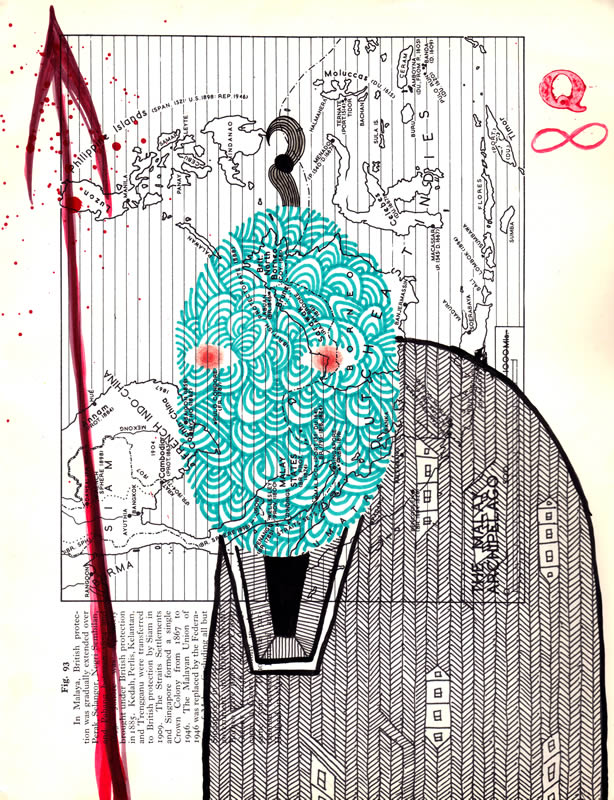
Queequeg stressed me out. A lot. I was enormously surprised, and continue to be so, at how much attention the Moby-Dick illustration project got very early on. It has generally been pretty wonderful to share the art with so many people, many of whom are total strangers. But something that I think even the most disciplined and focused artists experience is the weight of other’s expectations. While I think very few readers are likely to form a specific visual impression of Ishmael, which freed me to create that strange whale-like mask as his totem, many readers are either familiar with how Queequeg has been depicted in the various illustrated editions and films, or have in mind some kind of strange amalgam of a South Sea islander, tattoos, and shrunken heads. When trying to visualize Queequeg, I kept running aground on my fear of others expectations, and that froze me up for days. True artist block, for the first time on this project and one of the first times in my life.

In keeping with my initial focus on a reductionist approach to the art, I began stripping away what I knew I wouldn’t need. The body, the lean and athletic anatomy of a professional harpooneer was not important. Queequeg could just be a shape, like all of the other characters thus far. I had begun developing a sort of visual vocabulary that functioned as an easily readable catalog of symbols, each of which reflected a character’s role. The non-sailors, which I affectionately termed “landlubbers” on the blog, were all almost perfectly cylindrical, beak-nosed, wide-eyed toy-like shapes. The seamen and captains were all to resemble ships in some way, although, anachronistically, they generally looked more metallic and robotic. These forms have held up throughout the project so far. The harpooneers, of which Queequeg was the first, were different though. I’ve always thought of them as predators, or living weapons, beings frightfully perfect in their ability to battle and destroy monsters. For some time I thought of giving them all bird heads, but that seemed too obvious and, in a strange way, too consistent. Queequeg, Tashtego, and Daggoo are so alike and yet so vastly different and I didn’t want to be confined to a certain character type for each one of them. So for the harpooneers, the only consistency I wanted was inconsistency.

That didn’t get me much farther though in figuring just how I wanted Queequeg, that terrifying tattooed savage, to look. Back to the act of reducing, after discarding anatomy, clothing and accoutrements were next. I kept coming back to what I think each of us remembers when it comes to Queequeg. His friendliness and his tattoos. I quickly decided that rendering them too realistically would be pointless. We remember what our impressions of things are, not what they really are. Queequeg, like Ishmael, and like the captains and landlubbers, needed to be a living symbol. A mask that came to stand in for him, represent him, epitomize him.

Thoughts of his South Sea island home called to mind the bright turquoise blue of the ocean water in what I imagined would be his lagoons and beaches, so I began with that. A simple scalloped pattern, repeated over and over, built itself into a lushly but simply patterned face. For his eyes, the silhouette was a compassionate almond, but the eyes radiated red to remind the viewer that this man is indeed a killer of whales and an eater of men. All that remained was to cloak him simply in his woven poncho, equip him with his trusty harpoon, and give him a simple topknot. And of course, recalling the hilarious scene aboard the Pequod when Queequeg first signs on with Bildad and Peleg, I couldn’t resist including “his mark.”

Ultimately, I was quite pleased with this even though it has been one of the hardest of all the images to create. What has been fascinating is the way in which this color blue and this pattern have come to stand in for Queequeg. It’s been incredibly gratifying that some who visit the blog regularly even comment for that. It must have been a powerful image indeed for viewers to be able to connect these things so closely and so specifically with a single character.

Queequeg is still one of my favorites to draw. Besides whales, of course. When I finally finish, sometime next spring, I imagine I will create a more elaborate portrait of the man simply to frame and hang on my well. He always seemed like such a likeable cannibal, and I should like to get to know him better myself.

Meaning

To say that Moby-Dick is a book about meaning is probably not a terribly bold statement. I haven’t done a search of the literature, but I’d wager a big bag of M&Ms that there are a dozen or more theses floating around whose titles (or tortuous subtitles) incorporate variants of our book’s title and author and the word “meaning.” During our first week’s reading, I spent some time poking around to find instances of the word (and its kin — it was this effort that resulted in Moby-Diction) and discovered some thirty in the opening sixteen chapters, of which a number of significant instances could be retained after paring off some of the junk. I’ll spare you the rambling set of quotes I had originally planned to pull by way of illustration, but I will offer one, Ishmael, on the appeal of the water:

Surely all this is not without meaning. And still deeper the meaning of that story of Narcissus, who because he could not grasp the tormenting, mild image he saw in the fountain, plunged into it and was drowned.

Although one might mark this down as simply a convenient literary reference on Melville’s part, I believe it bears some more scrutiny as it fits into our second week’s chunk of pages. What’s interesting to me isn’t so much the correspondence with certain patterns of narcissism through chapter 41 (not the least of which turns out to be Ahab’s decision to draft a ship and its crew to fulfill his personal vendetta), but the sense Melville’s word choice gives us of a yearning for (I think) understanding where none can in truth be found. In some versions of the Narcissus myth, the youth does reach out and try to grasp his reflection, thereby plunging to his death by drowning. This is a physical grasping. The OED cites usages of “grasp” meaning “to lay hold of with the mind… to comprehend” as far back as 1680. What a tactile definition for such an abstract sense of the word! By choosing this word, Melville imbues the circumstances of this myth with the sense of not only a physical grasping for something but also a mental grasping, as in a search for meaning. Further, it is a search for meaning not within the self but within some dumb, other, obsessed-about thing.

The idea of dumb, other, tormenting things endowed with reason or agency and so a sort of significance or meaning appears again and again in the first 41 chapters of Moby-Dick. The examples I took note of:

  • Ishmael desires to “[find] out what [a] painting meant” in The Spouter Inn.
  • In “The Chapel,” Ishmael meditates on the mind/body distinction as he ponders the ways in which we commemorate the bodies of our dead and seems to settle on the importance of the reason/mind over the body.
  • In “A Bosom Friend,” Ishmael speaks dismissively about Queequeg’s worshipping a piece of wood.
  • Also in “The Ship,” we see Yojo warming himself at the fire.
  • Again in “The Ship,” we’re told of the peculiar ferocity of the particular whale that took Ahab’s leg.
  • Still in “The Ship,” Yojo is credited with agency for having chosen the Pequod for Ishmael and Queequeg.
  • In “The Ramadan,” as Ishmael tries to bust down the door to the room he shares with Queequeg, it “stubbornly resist[s].”
  • Of Starbuck in “Knights and Squires”: “Wherefore he had no fancy for lowering for whales after sun-down; nor for persisting in fighting a fish that too much persisted in fighting him. For, thought Starbuck, I am here in this critical ocean to kill whales for my living, and not to be killed by them for theirs; and that hundreds of men had been so killed Starbuck well knew. What doom was his own father’s? Where, in the bottomless deeps, could he find the torn limbs of his brother?” (He knows that being attacked by a whale is a workplace hazard and not a personal affront, in other words.)
  • Flask, in “Knights and Squires,” is described (tongue-in-cheek, to be fair) as seeming to think that “the great Leviathans had personally and hereditarily affronted him”
  • Stubb’s dream, in “Queen Mab,” revolves around his kicking at an insulting and inamimate pyramid that has kicked him with a dead ivory leg (this pyramid image is later used to link Ahab and the white whale himself).
  • In “The Quarter Deck,” Starbuck cries “Vengeance on a dumb brute that simply smote thee from blindest instinct! Madness! To be enraged with a dumb thing, Captain Ahab, seems blasphemous.”
  • Ahab replies that all things are as pasteboard masks, which must be struck through. And, of Moby Dick: “That inscrutable thing is chiefly what I hate; and, be the white whale agent or be the white whale principal, I will wreak that hate upon him. Talk not to me of blasphemy, man; I’d strike the sun if it insulted me.” (Note that the sun is another inanimate thing here given the potential for agency.)
  • In “Moby Dick,” Ishmael reflects on the reported “infernal aforethought of ferocity” of the white whale, and of that directed ferocity’s resulting deaths not “having been inflicted by an unintelligent agent.” To Moby Dick here are attributed “direful wrath” and “seeming malice” and “malicious agencies.” Ahab’s rage is made a thousandfold more potent by its dumb recipient than had he aimed it at “any one reasonable object.”
  • And, finally: “Ahab did not fall down and worship [malicious agencies which some deep men feel eating in them] like [others]; but deliriously transferring its idea to the abhorred white whale, he pitted himself, all mutilated, against it. All that most maddens and torments; all that stirs up the lees of things; all truth with malice in it; all that cracks the sinews and cakes the brain; all the subtle demonisms of life and thought; all evil, to crazy Ahab, were visibly personified, and made practically assailable in Moby Dick.”

There it is again, that word torment. Melville used it in describing the plight of Narcissus. Consider Narcissus and Ahab together: both obsessed; both willing to subvert the desires of those around them to their own obsessions; both reaching physically through a sort of mask; both grasping at a sort of understanding by pursuing a dumb thing (for Narcissus fails to bodily grasp his image but also fails to mentally grasp that it is a mere image and not a reasoning man); both punished (Narcissus literally) by a Nemesis for their hubris.

Starbuck’s admonition in “The Quarter Deck” seems to me to be a central lesson of Melville’s book. I hate, in a way, to look for a pat lesson, but I think it’s there. I can’t be the only person reading who has stubbed a toe only to deliver a retaliatory kick to the dumb thing I stubbed it on, making both the injury and the insult that much worse. It’s a good lesson.

Delbanco puts it rather more philosophically in his biography of Melville (p. 173):

[Ahab] speaks to the human need for finding meaning in suffering, to what he calls the “lower layer” of consciousness from which arises the demand to know if the “inscrutable” whale is the agent of “some unknown but still reasoning thing” that has sent it on its mission or if it is a mindless beast driven by purposeless instinct. To Ahab, we are all prisoners of our metaphysical ignorance about the meaning of our suffering, and so he demands of the dubious Starbuck, “how can the prisoner reach outside except by thrusting through the wall?”

[The speech Ahab gives in answer] is delivered by a man unafraid that meaning itself may prove to be an illusion, yet who is willing to destroy himself and, indeed, his whole world in pursuit of it.”

Delbanco goes on to quote Nietzsche, who suggested that “every sufferer instinctively seeks a cause for his suffering . . . a ‘guilty’ agent who is susceptible to pain.”

I would add to Delbanco and Melville and Nietzsche a near-contemporary of Melville whose own arc as an author rather mirrored our venerable author’s. Here’s Thomas Hardy’s dreary “Hap”:

If but some vengeful god would call to me
  From up the sky, and laugh: “Thou suffering thing,
Know that thy sorrow is my ecstasy,
  That thy love’s loss is my hate’s profiting!”	

Then would I bear, and clench myself, and die,
  Steeled by the sense of ire unmerited;
Half-eased, too, that a Powerfuller than I
  Had willed and meted me the tears I shed.	

But not so. How arrives it joy lies slain,
  And why unblooms the best hope ever sown?
—Crass Casualty obstructs the sun and rain,
  And dicing Time for gladness casts a moan….
  These purblind Doomsters had as readily strown
Blisses about my pilgrimage as pain.

Illustrating ‘Moby-Dick’ – pages 004 and 006

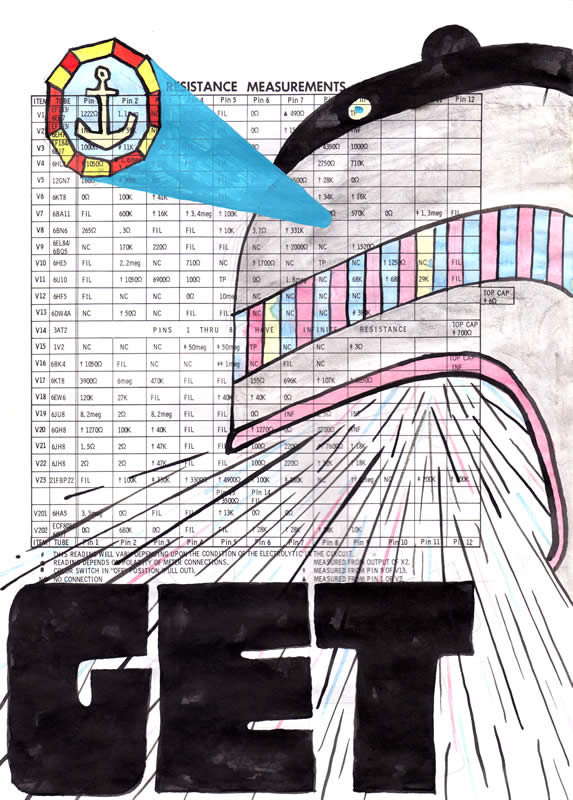
I feel that my greatest artistic shortcoming is my absolute inability to render a convincing human figure. I’m sure many of you are familiar with the first Moby-Dick film as well as the exquisite Rockwell Kent illustrations. In each of those iterations, great care was taken to put forth convincing, unique, visually distinct representations of each of the characters. I didn’t think I would be able to pull that off, especially over 552 pages, and I wasn’t sure that I even wanted to. This was primarily because I wasn’t interested in creating a simple visual narrative, a linear A to B journey through the book via paintings and drawings. I wanted to dig much deeper, get to the meat of things, and show the book as I saw it in my own inner theater. One of the many things which has always astounded me about the novel and the men behind the harpoons is the staggering willpower involved in choosing such a path. I’ve already alluded to this, but the idea of leaving home for years and years at sea, for little money, living on a tiny wooden island, and setting out on the unknown watery deep to stab to death the most massive and often savage creatures to ever see the sun…well, I find that almost inconceivable. So before beginning the illustration for page 004, the first time  in this project that I would have to depict a seaman, I spent some time thinking about just who these men were. What drove them. What inner architecture supported these brave deeds. Gradually, these men began, in my mind, to resemble ships. The very ships they sailed on or the ironclads of the Civil War. In some ways, part machine, part tool, part man. That was quite honestly the only way I could even begin to rationalize the choice to endure such deprivation, such isolation, such wandering, all for the sake of a few barrels of whale oil and a handful of dollars.

The line I chose, from a much more poetic paragraph, is Ishmael wondering “What of it, if some old hunks of a sea captain orders me to get a broom and sweep down the decks?” In a way, this quick piece was a good warm-up for what I knew would be many many more seamen and captains, Ahab and otherwise, throughout the book.

A simple, prow-like head. A band of some kind of optical devices. The anchor, (for me) the universal symbol of naval authority, radiating from his forehead almost aggressively. The booming voice bellowing commands. And again, an illustrated word. Words have shown up in many of these illustrations so far, and they have always seemed inseparable from my vision of the text itself.

These stylistic choices would repeat themselves many times until reaching their apotheosis in my vision of the mad Captain Ahab. But that’s a tale for another day.

Page 006 also represented a first in that it was my first opportunity to explore the whale as a visual symbol. In a bit of foreshadowing, Ishmael describes one of his most powerful reasons for choosing a life at sea as “Chief among these motives was the overwhelming idea of the great whale himself.” Knowing that I would be exploring the meaning of the whiteness of the whale at great length later, I chose instead to focus quite literally on Ishmael’s motive, “the great whale himself.” The meaning of the whale, as embodied by the whale. The proto-whale. The avatar of the whale.

Nothing but mass. Sheer, terrifying size, rising from the horizon. Something so huge that it cannot possibly be seen in its entirety at once, with one set of eyes. It must be broken into pieces, here by the borders of the paper, to even be comprehensible. An idol of the great leviathan. And an almost perfect fusion of power and simplicity. I was deliriously happy with this piece, and although many of the later images of whales would become a great deal more dynamic, detailed, fiddly, surreal, fantastical, and more, this to me is still the epitome of the great whale himself.

On Tuesday, I will introduce you to everybody’s favorite cannibal Queequeg.

Another Extract

“A symphony must be like the world. It must contain everything.”

Gustav Mahler.

Daryl asked, “Are the extracts required reading?” I say absolutely. In fact, I think they’re so important that I want to add another one to them: the Mahler quotation I opened with. Think of it as a kind of meta-extract, describing what strikes me as Moby-Dick‘s overriding goal and illustrating the way the extracts condense and expose that goal.

What goal is that, you ask, and what way? (I’m so glad you asked.) Moby-Dick is the earliest novel I know of that tries to be about everything. Daniel touches on this in his contribution to the conversation about how the book is modern, and Matt K. takes it as literally the base of his project. For one thing, this is a broadly contextualized and extensively allusive book. Even when it isn’t about, say, the fortress of Quebec (ch. 8) or the assassination of Thomas à Becket (ch. 16), it assumes you know those various subjects well enough that they can be dropped in as figurative language without any explanation. (This is why I appreciate my Norton Critical Edition, even if it does also footnote the very most obvious things in all the world.) Moby-Dick, to paraphrase another writer of the period, is large, it contains multitudes.

That’s essentially a question of style; but the book’s inclusiveness stretches also to the level of content. The opening of the book—this whole first week’s reading, in fact—is awfully leisurely. We’re officially about a fifth of the way in, and Ishmael still isn’t even on the boat. Plot is obviously not the primary concern. I mean, there’s a whole chapter about chowder. The editor of any “normal” novel would have chopped that out right quick. And Queequeg’s “Ramadan” doesn’t appear to have any plot justification, since we get no explanation for it and, at least through chapter 39, no further mention of it. (Where that vigil does come into play is in the book’s critique of domineering Christianity.) While I am excited for the chase after the white whale, I’ve always felt like the plot is more in the line of a vehicle that Melville uses to carry out his other concerns—and in that respect, the most apt vehicle to compare it to may well be a clown car.

To return to the extracts, with a quick detour about their putative compiler, the “painstaking burrower and grub-worm of a poor devil of a Sub-Sub”: Daryl wondered why he even exists. I hadn’t considered the question before; I just knew he was about my favorite of literary supernumeraries. But I think Matt B. hit on it with his talk of empathy. That bracketed benediction to the Sub-Sub is so lovely, so affectionate—even if it is a bit condescending for comedy’s sake—that it really helps set the stage for what’s coming. Personally, I find it makes me more receptive to taking in the extracts, after seeing what care went into their assembly.

And there’s quite a lot to take in, by design. The scope of the extracts is intimidating. They’re international: Without researching, it looks to me like there are sources biblical, Greek, Roman, Viking, French, English, Dutch, Scottish, Spanish, Swedish, U.S. American, and German. They include biblical history, folk tales, wisdom, and prophecy; classical science and history; medical lore; poetry; political philosophy; satire; expository prose on slaughter; voyage chronicles; legal commentary; physiology; songs; natural history; fiction; demography; and economic analysis. At least one is invented, smuggled in with the same authority as Pliny. This is a deliberately bewildering mass of information, speculation, commentary, and rhapsody that, if you let it, tells you what you’re in for over the course of the book. It’s like a hologram, containing in one small bit the whole of the completed work.

Actually, that’s not entirely true. There is one thing it leaves for the body of the text to surprise you with: humor. Except for the attribution “Edmund Burke. (somewhere.),” the extracts are significantly less funny than the novel proper. I’ll close with an observation about Melville that never ceases to amuse me. Joan’s got a whole post on the beauty and majesty and suppleness of Melville’s remarkable writing; what I love is that, couched amid all that thoughtful eloquence, he regularly makes time for penis jokes. Ishmael’s nervousness about sharing a bed with a harpooneer (“And when it comes to sleeping with an unknown stranger, in a strange inn, in a strange town, and that stranger a harpooneer, then your objections indefinitely multiply”) cracks me up every time, and it’s not the only joke of its kind. The incongruity of such silly jokes in such an impressive book makes it all the more enjoyable.