Illustrating ‘Moby-Dick’ – page 001

I am often asked just how I decide which line of text from Moby-Dick I am going to illustrate, and if I simply read one page each day. Since I have read the book a number of times, I am relatively familiar with most of it (although each reading has revealed more and more to me). Generally, I will read a few chapters at a time and simply marinate on them for a while. Turn them over in my in my brain almost subconsciously. When the time comes, I will re-read a few pages and select a passage that I have an immediate response to. I’m not choosing passage that would simply be easy or fun to illustrate, nor am I necessarily choosing passages that I think will continue to advance the narrative in a visual way. I’m not trying to create a graphic novel version of Moby-Dick, or some sort of storyboard for the tale. I think it would actually be fairly difficult to follow and comprehend the thread of the story simply by looking at my illustrations alone, unless one had already read the novel at least once. That may be a weakness of the project, but to me it is simply another layer in the mosaic that’s been built up around the book over the decades and it doesn’t trouble me.

Once I’ve selected a line to illustrate, I will again let my subconscious go to work. I’m always aware that what I am really doing is channeling all of the visual imagery that I have soaked in over a lifetime of looking at things and reacting to the text from that state of mind. I can see all sorts of influences in nearly every one of the illustrations I’ve made so far. Some are almost obvious while others are more subtle. But again, as I mentioned before, each of these illustrations is an intensely personal reaction to the text and the novel itself, as I see it, as it plays out in my own inner theater. I’m not certain if this is the way I’ve always seen Moby-Dick, but I do know that many of these images are strangely familiar to me so at some point in the past this is what the novel became, visually, to me.

Unfortunately, I have a habit of never planning anything very well. A good example was my choice of the Signet Classics paperback edition of the novel, which uses Roman numerals for the “Front Matter” and begins Chapter 1 on page 1. That edition has 552 pages, meaning I would have to create 552 daily pieces of art. I have since learned that the Dover Giant Thrift Edition has only 464 pages, some of which are introductory material and that if I had done just a bit of searching and chosen that edition I would have saved myself almost 4 months of labor and obsession. Ah, well.

So we come to the first page. The first illustration. The first step on this 18 month (at least) voyage. To be blunt, the choice of text was a no-brainer. “Call me Ishmael.” One of the most well-known lines from the novel. Indeed, one of the most well-known lines in literature.

In a sense, my illustration again demonstrates how I don’t necessarily always think things through. We all know that Ishmael is the narrator, and that in many ways it is his voice we hear throughout the novel. He is never far from the reader, a constant companion on the waves, and I mistook that constant narrative voice for a constant visual presence. One of the many tricks one learns when illustrating a comic book is to make the main characters as simple to draw as possible. This is especially necessary since the artist will be drawing them again and again and again, panel after panel after panel, page after page after page. While it may be a thrill to create some incredible vision replete with all sorts of fiddly details like folds and pleats in the clothing, belts and pouches, wildly colorful patterns and so on, those details can become sheer misery to draw so many times. So mistaking my Ishmael for a constant visual in this series, I depicted him as simply as possible.
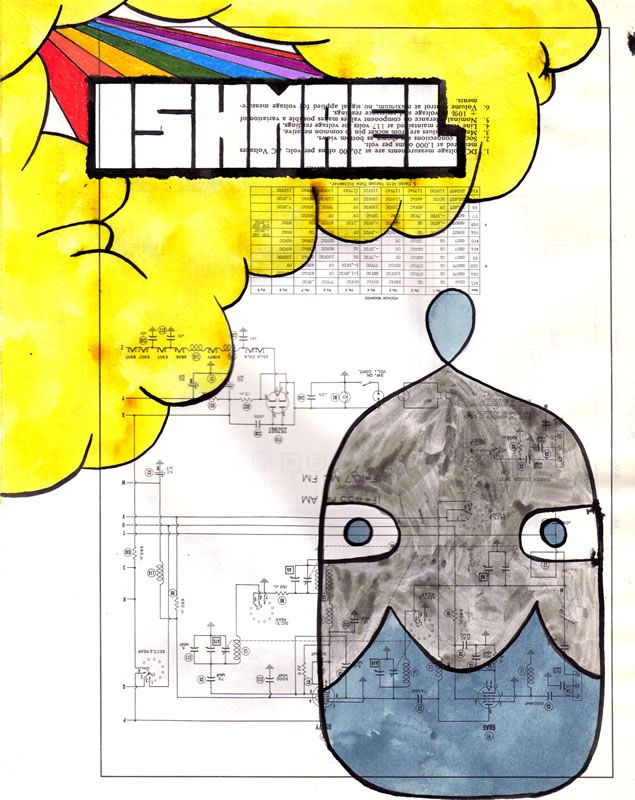
In retrospect, I have absolutely no regrets. This image actually turned out perfectly, just the way it had to be. Ishmael, a vaguely whale-shaped mask. A cipher. A perfect stand-in for the reader. The man with the sea inside of him.

I had been thinking a lot about the simple, almost abstract art of painters such as Yuichi Yokoyama, Paul Klee and Joan Miro and the way that, for them, identity is often expressed through almost totemic masks. Ishmael, for me, became a mask. A symbol. Which I felt appropriate because even though his voice is our constant companion, we know next to nothing about him, even after the nihilistic fury of the novel’s climax has been spent. Ishmael is the one character everyone is aware of but nobody knows. This kind of symbolic, mask-like representation was something I had been thinking about for a long time, and something I would explore again and again with every one of the characters in the novel.

Beyond that, a few simple details remained. The first chapter and its first page are largely Ishmael’s thoughts alone as he half-drifts through a reverie of ennui and aimlessness. Best, to me, depicted through the vaguely ominous, bruise-yellow storm clouds gathering above. As for the name, well, honestly, how could that not be included? Again, a nod, perhaps, to many many years of reading comic books, but for me the word as a design element is something I would return to again and again. Perfectly suited, I think, for a novel like Moby-Dick, where the white whale himself is often compared to a kind of book.

On Friday, a nameless “old hunks of a sea captain” and “the overwhelming idea of the great whale himself.” As always, comments and critiques are always deeply appreciated, even if they are negative. I value honesty far more than praise.

Beautiful Phrases

Hi everyone, I’m Joan and I’m returning to the Zombies fold after almost totally folding on 2666!  I first read Moby-Dick as an adult and I’m really glad that it was never required reading for me.  I approached it the first time with open arms and I fell in love.  It was the pick of the reading group I was in at the time in Brooklyn, and although we extended the time-frame by a month I was the only one to finish it.  So I had only myself to discuss it with.  Now, around 12 years later, I’m already way ahead in terms of discussion and analysis and it’s only week 1!

This time around I’m doing side reading, working my way through a number of the books Daryl reviewed here, particularly Hoare’s The Whale, Delbanco’s Melville, and soon Beachy-Quick’s A Whaler’s Dictionary which should arrive today.  Additionally I’m dipping into Eric Jay Dolin’s Leviathan.  I feel as though I’m completely immersing myself in Moby-Dick and what a rich world it is.

In what is looking like a bit of a theme for the first week here, I’m going to touch on one of the elements of the work that I truly love.  I’m a total sucker for beautifully crafted phrases, the ones that take your breath away and make your heart sing, the ones that you stop, read again, underline and star in the margins, the ones that can in just a few words speak a universal truth.  Many years and so many wonderful books have come and gone since my first time with Moby-Dick I had almost forgotten just how poetic and beautiful Melville could be.  Sure, it’s an adventure story, and there are so many styles and tones woven together, but it’s those beautiful phrases that keep me coming back.  Here are just a few of my favorites so far.

Chapter 12, regarding Queequeg’s native land:

It is not down in any map; true places never are.


Chapter 14, right at the end regarding Nantucketers:

For years he knows not the land; so that when he comes to it at last, it smells like another world, more strangely than the moon would to an Earthsman.  With the landless gull, that at sunset folds her wings and is rocked to sleep between billows; so at nightfall, the Nantucketer, out of sight of land, furls his sails, and lays him to his rest, while under his very pillow rush herds of walruses and whales.


Chapter 16, regarding the Pequod, the well known but still wonderful to me, and beautifully illustrated by Matt:

She was a thing of trophies.  A cannibal of a craft, tricking herself forth in the chased bones of her enemies


Which ones are moving you?

Week 1: The Point of Departure

Hello, everyone! I’m Matt Bucher and you might remember me from such group reads as “Infinite Summer,” “Murder in the Desert: 2666 and You,” and “The Ontological Despair of Ramona Quimby (and Her Sister): A 32-week Read-Along Course.” I’m happy to be here with you all as we try to read Moby-Dick in six weeks of summer. My way of getting around this is by reading as fast and furiously as I can before the official starting bell rings. When I first tried reading Moby-Dick, I’d take my time with the first 100 pages or so, relishing the time Ishmael spends in Nantucket, on dry land, and getting on the ship. That’s how Melville hooks you. However, when we pushed off the docks and faced the endless horizon of the sea, I’d start to get a little panicky. I’d long ago read a comic-version of the story so I knew how awesome the ending was, but between Chapter 21 or so and the end was a pacific-wide stretch of story that I had trouble sinking my teeth into. This time around, with the compressed schedule and all, I’m taking the aggressive approach of licking my thumb and *skimming* the first 20 Chapters, just driving right up to the Pequod’s departure. In all fairness, I’ve probably read that first 20 Chapters a half-dozen times, and once partly this year when we went back and examined Father Mapple’s sermon for the 2666 read, and while I love it dearly, the heart of the novel, I believe, is that chase for the whale. I love stories of the sea, especially stories of people who are pushed to the very limits of human endurance and experience (polar explorers and Holocaust survivors mostly), but I would not automatically read any story about a whaling adventure (although I probably would watch any giving episode of “The Deadliest Catch”).

What makes Moby-Dick special is its characters. Melville’s ability to create a voice inside the head of Ishmael that is still able to align with the empathy and thought patterns of readers 150+ years later is truly a stunning achievement. What I mean by empathy there is causing the reader, even in some small way, to think, “That’s how I would react, too!” or “That’s exactly what I was thinking!” This leads me to make even broader generalizations and say that when we talk about the author’s “style” we end up talking about characters. Diction, word choice, point of view, all of it ends up being in service of creating memorable characters—especially when we end up seeing the story unfold through a particular character’s eyes. Which leads me to this: Who is the main character of Moby-Dick? Is it Ishmael, Ahab, or the whale? How is Melville playing upon traditional ideas of the hero or the hero’s quest (the odyssey) by having Ishmael appear to be a passive observer throughout much of the book?

One illustration for every page…

On August 6th of last year, my lifelong obsession with Moby-Dick reached what may come to be its zenith. That was the day I decided, almost on a whim, to embark on a project to create one illustration each day for every one of the 552 pages of my Signet Classics paperback edition of the novel. You know, the blue one with the amazing Claus Hoie painting on the cover.

I have never considered myself an artist. My undergraduate degree is in secondary education with a focus on English and my master’s degree, earned over a decade later, is in library and information science. I haven’t taken an art class since community college in 1987. I have no MFA, not even a BFA, to bolster my credibility or lend authentication to any “artist’s statements” I might hope to one day display on a placard pasted to a well next to where one of my illustrations hangs. And yet, in spite of this, I have been making pictures for my entire life.

My earliest memories of reading, of the thrill of being able to pull books that I myself had selected off a bookshelf and to read them at my own pace, on my own time, are of illustrated stories. Mostly myths, fairy tales and folklore. Collections by Andrew Lang and Padraic Colum, illustrated by the likes of Willy Pogany, Kaye Nielsen, Arthur Rackham and others. And quite honestly, for good or ill, I’ve never really grown up, whatever that means, since then. Sure, I’ve read plenty of books without pictures, whether for school or for pleasure or to keep up with my mature friends. But for me, there is absolutely no thrill compared to that of journeying through a fantastically illustrated story.

Those early experiences led to a childhood, and adolescence and even adulthood immersed in imagery. Definitively lowbrow imagery. Silver Age Marvel comic books, pulp science fiction paperback covers, Saturday morning cartoons, prog rock LP covers, Heavy Metal (the comic, not the music) magazines, action figures, 8-bit videogames, and Dungeons & Dragons books. Often my memory of these things eclipses my memory of actual events, relationships, and experiences.

So, in spite of never considering myself an artist, of having no formal artistic background or education beyond the ordinary high school classes and the aforementioned community college Art 101, I’ve been almost obsessed with making pictures ever since I was old enough to look at them. Like most, I imitated what I loved and aped the style of my heroes. I drew mostly monsters – dragons, sea serpents, and dinosaurs with the occasional robot or alien threw in. And I did that for years. Years and years and years. Well into adulthood, really.

Actually, I still do it.

I’ve tried my hand at making comics, mostly to Xerox and staple and give to friends, and over the years I’ve slowly developed a personal mythology that I’ve taken stabs at illustrating when time allows. But I’m always being drawn back to books and stories and that sense of narrative. Late last summer, taken with that (simple?) idea of creating what I’d like to see, I decided it was time to take everything I’d learned, everything I’d seen, everything I’d done and made and give life to my own vision of Moby-Dick.

The pace, one illustration per day, every day, for 552 days, was a deliberate conceit and the only rule I set. Many of my drawings had become almost overwrought with obsessive detail and the act of drawing was beginning to feel like a prison to me. I dreaded that. I thought that by forcing myself to complete one illustration per day, every day, I would be forced to step back from my overreliance on details, my close personal partnership with rulers and circle templates, and my own very real horror vacui. I would have to learn to work quickly, to do more with less, and to explore other media beyond colored pencils, pens and ink.

Beyond that, there were no rules. I would create each illustration in any media I chose, whether it was ballpoint pen, collage, cheap craft paint or magic marker. After years of working in used bookstores, and taking home the detritus of what customers didn’t want and the bookstore couldn’t sell, I decided to create each of these Moby-Dick illustrations on “found” paper, or paper I had harvested from these old books and encyclopedias and manuals. I was especially drawn to diagrams, maps, and anything with a pictorial representation of information. While I didn’t consciously realize it at the time, I know now that my use of this found paper, which allows me to layer paint and ink and color over other layers of imagery, is a deeply personal response to the layers and layers of meaning and narrative in Moby-Dick itself. The book that is at once a story about just about everything there is or ever was. I spend very little time specifically selecting the paper and media to use, relying primarily on my own intuition and gut instincts. Fascinatingly, on many occasions I have seen elements revealed through the juxtaposition of my own art and the elements already on the found paper that seem to almost eerily mirror the tone or content of the line of text from the page of Moby-Dick that I am illustrating. It has been both unsettling and thrilling, both.

In every way possible, this project of mine is astoundingly self-indulgent. Yes, I have seen the Moby-Dick illustrations by luminaries and giants such as Leonard Baskin, Boardman Robinson, Rockwell Kent, Barry Moser, Frank Stella, Bill Sienkiewicz and Gilbert Wilson among others. I am certain I have internalized some of that. And I am even more certain that I have and will continue to at times pay homage to that, sometimes overtly in my own paces. But more than anything, this is my Moby-Dick. This is how, over the years and all the many times I’ve read the novel that I have come to see the men, the ships, the whales, and that world.

I still don’t consider myself an artist, but I do like the pictures I’ve made and I am looking forward to sharing some of them with all of you as well as some of what went in to how each was made.

Week 2: O Captain, Where Art Thou?

One of the more interesting aspects of the book so far is how little we have seen of Captain Ahab.  Last week, Matt asked “Who is the main character of Moby-Dick? Is it Ishmael, Ahab, or the whale?” It’s a question I’ve never really considered before.   I mean, the sort of easy summary of the book is “Ahab chases whale” and yet clearly the story is Ishmael’s.  And, since I haven’t finished the book yet, it’s hard to say who the main character is.

Now, at this point it would be foolish to discount Ahab’ role in the story, for we haven’t gotten even half way through yet.  However, we’ve seen barely anything of this fearsome Captain thus far.  But even if he isn’t the main character (to be determined), his role in the story is pretty essential, so what gives with the lack of the Captain?

I think that Melville is deliberately building tension about Ahab.  After 100 or so pages, we’re pretty invested in Ishmael.  His tone is one of a friend, a fellow traveler whom we might meet and who would tell us this story (including wanting us to be completely filled in on every detail of the trip.  And so, Melville uses a kind of slow reveal, keeping the Captain under wraps with just a few glimpses and portents about the man.

I may have gotten a bit carried away with some of the longer quotes (apologies), but after not seeing the man for a quarter of the book, getting this much detail is pretty powerful.

At first he is mentioned almost fearfully; Ishmael says he normally wouldn’t sail on a vessel without meeting its captain (sound advice, I would think). And, of course, Ishmael is told that the Captain is more or less crazy, but is recovering nicely.

But our first look of real menace about Ahab comes from Elijah (the prophet), who warns Ishmael about going on board the ship.

Even as the they set out (in a chapter called Ahab), Ishmael notes, “For several days after leaving Nantucket, nothing above hatches was seen of Captain Ahab” (119).* Our fears for him are assuaged when he reveals that it is not uncommon for the main captain to not really command the ship in the beginning of a voyage, that he’ll deal with the whale part, but the mates can run the first lengths.

And then Ahab appears, almost out of nowhere, and we get this amazing description:

He looked like a man cut away from the stake, when the fire has overrunningly wasted all the limbs without consuming them, or taking away one particle from their compacted aged robustness. His whole high, broad form, seemed made of solid bronze, and shaped in an unalterable mould, like Cellini’s cast Perseus. Threading its way out from among his grey hairs, and continuing right down one side of his tawny scorched face and neck, till it disappeared in his clothing, you saw a slender rod-like mark, lividly whitish. It resembled that perpendicular seam sometimes made in the straight, lofty trunk of a great tree, when the upper lightning tearingly darts down it, and without wrenching a single twig, peels and grooves out the bark from top to bottom, ere running off into the soil, leaving the tree still greenly alive, but branded. Whether that mark was born with him, or whether it was the scar left by some desperate wound, no one could certainly say. (120-121).

Ishmael is slowly blown away by him:

So powerfully did the whole grim aspect of Ahab affect me, and the livid brand which streaked it, that for the first few moments I hardly noted that not a little of this overbearing grimness was owing to the barbaric white leg upon which he partly stood. It had previously come to me that this ivory leg had at sea been fashioned from the polished bone of the sperm whale’s jaw. (121)

And the infamous leg:

was struck with the singular posture he maintained. Upon each side of the Pequod’s quarter deck, and pretty close to the mizen shrouds, there was an auger hole, bored about half an inch or so, into the plank. His bone leg steadied in that hole; one arm elevated, and holding by a shroud; Captain Ahab stood erect, looking straight out beyond the ship’s ever-pitching prow (121).

But still he does not say a word:

Not a word he spoke; nor did his officers say aught to him; though by all their minutest gestures and expressions, they plainly showed the uneasy, if not painful, consciousness of being under a troubled master-eye (122).

Now that’s an entrance.  And yet, despite all of this, we still don’t know anything about him.  He’s barely spoken, he just seems to have an air of menace.

From this point, we get little snippets of Ahab.  For the most part he is still silent, until he has an incident with Stubb:

Stubb, the odd second mate, came up from below, and with a certain unassured, deprecating humorousness, hinted that if Captain Ahab was pleased to walk the planks, then, no one could say nay; but there might be some way of muffling the noise; hinting something indistinctly and hesitatingly about a globe of tow, and the insertion into it, of the ivory heel. Ah! Stubb, thou did’st not know Ahab then.

“Am I a cannon-ball, Stubb,” said Ahab, “that thou wouldst wad me that fashion? But go thy ways; I had forgot. Below to thy nightly grave; where such as ye sleep between shrouds, to use ye to the filling one at last. – Down, dog, and kennel!”

Starting at the unforeseen concluding exclamation of the so suddenly scornful old man, Stubb was speechless a moment; then said excitedly, “I am not used to be spoken to that way, sir; I do but less than half like it, sir.”

“Avast!” gritted Ahab between his set teeth, and violently moving away, as if to avoid some passionate temptation.

“No, sir; not yet,” said Stubb, emboldened, “I will not tamely be called a dog, sir.”

“Then be called ten times a donkey, and a mule, and an ass, and begone, or I’ll clear the world of thee!”

As he said this, Ahab advanced upon him with such overbearing terrors in his aspect, that Stubb involuntarily retreated. (124).

But that scenes ends quietly, and we soon see the Captain and his three mates sitting down at to a civil, albeit quiet meal.  But all of this silence, all of this trepidation can only lead to some kind of outburst.  As if Ahab’s clomping around the deck of the ship (with his more and more insisting pacing) were some kind of anticipatory drum roll, we see that Ahab is about to let loose.

Stubb, once again, whispers (out of Ahab’s earshot this time):

“D’ye mark him, Flask?” whispered Stubb; “the chick that’s in him pecks the shell. T’will soon be out” (158).

Shortly afterward Ahab comes forth, calling all of the crew to attention.  He asks them a series of silly whaling questions, sort of like a good ol’ pep rally at football game.  And then he flourishes a Spanish ounce of gold–“holding up a broad bright coin to the sun”– and reveals the secret point of the voyage. (159):

whosoever of ye raises me that white-headed whale, with three holes punctured in his starboard fluke – look ye, whosoever of ye raises me that same white whale, he shall have this gold ounce, my boys!  (159).

Although Starbuck is hesitant, Ahab quickly produces a hot, hard drink and all parties drink heartily (a perfect bonding moment).  After a few more rallying cries, Ahab ends the scene:

Drink, ye harpooneers! drink and swear, ye men that man the deathful whaleboat’s bow – Death to Moby Dick! God hunt us all, if we do not hunt Moby Dick to his death!” The long, barbed steel goblets were lifted; and to cries and maledictions against the white whale, the spirits were simultaneously quaffed down with a hiss. (164-165).

And the captain, on this high note, quietly retires to his cabin.

Before the week’s end, Ishmael muses about Moby-Dick (who is more or less making his first appearance in the book too) and about Captain Ahab. This final chapter gives a more detailed, nuanced look into the mind of Ahab (at least as Ishmael sees it).  I can’t decide if it’s entirely necessary (as it comes across as a lot of “telling” after a pretty clear “showing” but it does go someway toward cementing Ahab’s emotional complexity.

So Melville has done a pretty masterful job of building up suspense and then unveiling his master creation.  We read nearly a quarter of the book before we actually see him.  And if you’re reading carefully (or it’s 1851 and you’re only slightly familiar with the story), this slow build before revealing the madman at the helm is really quite effective.

I mentioned on my home post that the book was meant to be leisurely read (not crammed in a few days before a midterm!).  And, if you are prepared to sit back and let the language wash over you, the pacing for the book is really masterful, especially if you had a hint of what was to come.  And there’s really something striking about all of the build up before getting to this major character.

*This week, and for future weeks, I’ll be using the page numbers at this  Princeton site.  Sorry for the confusion

Week 1: Religion

This is my first read of Moby-Dick (and my first time posting as a Zombie).  I wanted to focus on religion in the first week’s read.

I don’t know very much about Melville.  I am planning to do some background work on the man, but I kind of like taking the reader-response tour of MD.  Of course, I think that works as a reaction to a book, I’m just not sure how valid it is when doing critical analysis (I’ll find out soon enough).

Reader-response aside, I’ll give a quick background to myself.  I am not a religious person.  I was raised Catholic but have since lapsed.  However, I have mixed feelings about religion: I’ve seen religious people do very good things, and yet, in general, I think it is a tool for bossing people around.

So, I’m not pushing any agenda here.  I’m just noting that religion plays a major part in this book, and I’m fascinated by it.

And it starts with the Extracts.

The first five Extracts are from books in the Bible.  And that might tell you something.

References abound in the text proper, too.  When he admits that he will sweep a deck if a captain asks him, Ishmael notes: “What does the indignity amount to, weighed, I mean, in the scales of the New Testament?  Do you think the archangel Gabriel thinks anything the less of me… (15*).

In Chapter 2 we get references to Lazarus.  And in Chapter Three there’s talk of blessed Saturday and Sunday night.

But once Queequeg comes in, religion really comes to the forefront.

Queequeg is, as we know, a cannibal and a seller of New Zealand heads.  And yet, he is also something of a Christian (he is seen at mass after all).  And yet, he is, of course, also, a pagan, a savage.

When we first meet him, we see he is tattooed head to toe.  And Ishmael thinks, “he must be some abominable savage or other shipped aboard of a whaleman in the South Sea, and so landed in this Christian country” (30).

And yet, it is more with fascination than a seemingly expected horror that he watches Queequeg unveil what he at first thinks is a “black manikin … a real baby preserved in some similar manner [to the New Zealand heads]” (30).  But it turns out to be a wooden idol.

Queequeg sets out to worship by setting the idol up in the fireplace.  And again, it’s Ishmael’s attitude that I find fascinating: “The chimney jambs and all the bricks inside were very sooty, so that I though this fire-place made a very appropriate little shrine or chapel for his Congo idol.” 30).

Queequeg and Ishmael have a bit of a tussle over the sleeping arrangements.  The landlord calms things down.  The men seem okay with each other and we get this fascinating observation from Ishmael:

“Better sleep with a sober cannibal than a drunken Christian” (31).

So, just what is going on here?  There is a lot of talk about the Bible and Christians, and yet, rather than trying to convert the Savage, Ishmael not only welcomes him, but thinks he may be a better companion than some other Christians.

And then comes the famous sermon. Chapter 7 focuses on the Whaleman’s Chapel.  And Queequeg is there! (in another Chapter, it is revealed that Queequeg left his home land so that he could explore Christian lands).  The chapel contains plaques that memorialize dead whalers.  It also contains a pulpit that is mounted via side ladder found on a ship.

Father Mapple gives a lengthy account of Jonah and the Whale.  Now, I admit that I haven’t read the Jonah story in years (if I ever read the whole thing at all).  So, I don’t recall any of the backstory (about running from God); I assume that’s all true, and I do figure I’ll check it out one of these days). As such, I’m not sure if he is putting his own theories into Jonah’s actions (do the other shipmates really think that he is a criminal as soon as he steps on board?  I think I need to investigate that further).

This sermon (which is quoted in the extracts) is completely appropriate for the whalers.  And, given the deadly pursuit, it’s not surprising that there would be many whalers in the church.  And yet Ishmael writes, “But Faith, like a jackal, feeds among the tombs, and even from these dead doubts, she gathers her most vital hope” (41).  Religion as a desperate man’s drink?

But to me the most surprising thing is when Queequeg invites Ishmael into his own ceremony.  Ishmael ponders:

I was a good Christian; born and bred in the bosom of the infallible Presbyterian Church. How then could I unite with this wild idolator in worshipping his piece of wood?

What I liked was his very open-minded resolution:

But what is worship? thought I. Do you suppose now, Ishmael, that the magnanimous God of heaven and earth- pagans and all included- can possibly be jealous of an insignificant bit of black wood? Impossible! But what is worship?- to do the will of God? that is worship. And what is the will of God?- to do to my fellow man what I would have my fellow man to do to me- that is the will of God. Now, Queequeg is my fellow man. And what do I wish that this Queequeg would do to me? Why, unite with me in my particular Presbyterian form of worship. Consequently, I must then unite with him in his; ergo, I must turn idolator. (both 54).

Moving away from Queequeg, when we get to the Pequod, Captain Bildad (and indeed many other Nantuckers was a Quaker).  My knowledge of Quakers is that the are a peaceful, entirely pacifist lot, so to get this quote was very funny:

For some of these same Quakers are the most sanguinary of all sailors and whale-hunters. They are fighting Quakers; they are Quakers with a vengeance. (71).

And of course, Bildad has been studying the Scriptures, now, for the last thirty years.  “How far ye got, Bildad?” Captain Peleg wants to know (73).

The last bit of religion is Queequeg’s fast, which Ishmael calls The Ramadan.  Daryl’s already answered my question about this, with the logical assertion that Ishmael is just picking Ramadan because his religion is “other.”  And I think that’s fair enough.  Ishmael is reasonably well versed among Christian sects, but any further afield and it’s all Hindoo and Muslim to him.

[This is actually unsurprising.  When Dewey created his Decimal System (in 1876), he created a section for Religion.  200 is religion.  220 is the Bible 230 is Christian theology.  240 is Christian moral and devotional theology.  250 is Christian orders & local Church.  260 is Christian Social theology.  270 is Christian church history.  280 is Christian denomination and sects and then 290 is Other and comparative religions [294 Religions of Indian origin, 295 Zoroastrianism, 296 Judaism, 297 Islam, 299 Other].]
So Queequeg’s Ramadan is played for comic effect, certainly. And yet, the joke is not really mocking.  For he and Queequeg are now fast friends.  And while he fervently wishes that Queequeg would fully convert (as does Captain Peleg who demands to see Queequeg’s papers: “He must show he’s converted” (83).) he still respects Queequeg as a human being and as a harpoonist (harpooner?).`

So, what to make of Ishmael?  He states matter of factly,

Now, as I before hinted, I have no objection to any person’s religion, be it what it may, so long as that person does not kill or insult any other person, because that other person don’t believe it also. But when a man’s religion becomes really frantic; when it is a positive torment to him; and, in fine, makes this earth of ours an uncomfortable inn to lodge in; then I think it high time to take that individual aside and argue the point with him (81).

And he’s also quick to comment

This is the reason why most dyspeptic religionists cherish such melancholy notions about their hereafters. In one word, Queequeg, said I, rather digressively; hell is an idea first born on an undigested apple-dumpling (82).

I don’t know that I’ll be pursuing the religious thread in future posts, but I was really fascinated by this mix of Christian attitudes and yet wholly open-minded attitudes towards non-Christians.  It was quite a surprise for me.

* I am using The Norton Critical Edition for my page notes.  If we decide on a standard citation, I’ll update accordingly.

The Whiteboard

Since the beginning of my participation in the Infinite Summer and spin-off reads nearly a year ago, I’ve dog-eared books, scribbled dog-legging notes in the margins, and woken up in the middle of the night to frantically scrawl near-illegible paragraphs in a little notebook. I’ve drafted things in Google Docs, written ideas on decade-old receipts I’ve found tucked into books as bookmarks, and, to my children’s great consternation, inked my hand with sudden thoughts when out of reach of paper. But I had never — until last night — resorted to a whiteboard.

My dilemma was one of what felt like an unrein-in-able tendency toward expansiveness. There’s so much good stuff in this opening week’s reading that I wanted to write about it all. But my children need a father, my wife a husband, my employer a sub-sub of a something or other. So, having broken out the whiteboard to draw diagrams for my day job, I allowed myself a great white tabula rasa (Dare I confess how tempting it was to encircle my my notes in the outline of a great sperm whale? Only my howling ineptitude in the fine arts prevented it.) and narrowed the field of topics to thirteen items.

As I started to try to put an essay together, I found myself yearning to be expansive. I was going to head into a very busy weekend attempting to write a monograph or bust. And since I rather suspect there’s going to be a spurt of really intriguing posts early in the week from the other fine folk blogging here, I decided to pull back a little bit and offer instead a brief statement, a quote, and an invitation to ponder the two together as we go forward.

So, the statement. Moby-Dick has always struck me as an old-fashioned text. I’ve written before about how, before I read it, I expected it to be stodgy and dull and humorless. These things it is not, but it does present its share of sort of epic Biblical language (usually from the Quakers). It is highly allusive, and it addresses philosophical or moral questions in often direct ways, with figurative language, surely, but not in ways so hidden in elements of plot and character that sussing out its meanings becomes a puzzle. Melville will come right out and say something like:

And still deeper the meaning of that story of Narcissus, who because he could not grasp the tormenting, mild image he saw in the fountain, plunged into it and was drowned. But that same image, we ourselves see in all rivers and oceans. It is the image of the ungraspable phantom of life; and this is the key to it all.

I don’t think you often encounter such direct statements in more recent fiction. Authors these days often deliver meaning via things like character development rather than by just coming out and saying things directly as Melville often does. Of course, allegory and symbolism are as old as the hills, and there’s plenty of less-directly conveyed meaning in Moby-Dick as well. Still, something about this mode of writing has always struck me as not at all modern (or Modern).

That was an awfully long statement. Now for the quote (a lengthy one), from Andrew Delbanco’s Melville, which I’m well over halfway into and am enjoying immensely.

Looking back at his labors on Moby-Dick, Melville saw “two books . . . being writ . . . the larger book, and the infinitely better, is for [his] own private shelf. That is, whose unfathomable cravings drink his blood; the other only demands his ink.” Moby-Dick was Melville’s vampire book. It sapped him — but not before he had invented a new kind of writing that, we can now see, anticipated the kind of modernist prose that expresses the author’s stream of consciousness without conscious self-censorship. Melville was aware of this ideal in its incipient Romantic form, having marked approvingly a passage in an essay by William Hazlitt that declares true writing to be “an ebullition of mind,” a “flow of expression” that, by analogy with frescoes, must be executed with fast and free strokes before the wet plaster dries — a burst of inspiration whose “execution is momentary and irrevocable.” Melville was the first American to write with such outrageous freedom. He was the first to understand that if a literary work is to register the improvisational nature of experience, it must be as spontaneous and self-surprising as the human mind itself. Aware, as Freud later puts it, that “in mental life nothing which has once been formed can perish,” Melville also knew that by concealing the existence of earlier versions of his work, he ran the risk of falsifying himself. In this sense, Moby-Dick was like an active archeological site in which the layers of its own history are left deliberately exposed.

So, my old notion of Melville as an amiable if in many ways old-fashioned author is dashed to bits. He’s a pioneer, Delbanco has it, writing in ways that anticipate the sorts of encyclopedic and fractured narratives that have often appealed to me from much more recent authors.

What was your first impression of Melville? Does Moby-Dick have for you an old-fashioned feel or does it (I know we’re only partway through) bear the markings of something newfangled for its time?

A Few More Intros and a Plug

I wrote intros for new contributors Matt Bucher and Matt Kish and promptly realized that several who had written for 2666 had never gotten formal introductions. Then another blogger signed up. I hate to lump these together, but I also hate to bombard you with a bunch of short individual intro posts on the eve of the kickoff, a day on which I imagine several posts about the book itself will land. So with apologies to the contributors I may be giving short shrift here, please allow me to introduce the other zombies.

Jeff Anderson is a writer and copy editor; he’s also a quilter, an incessant reader, a sometime musical ambassador to Cuba, and a member of that very exclusive elite: the 150 Jeopardy! contestants who lost to Ken Jennings. Although he wrote about Infinite Jest at his own blog, he started writing for Infinite Zombies as we plunged into 2666, about which he wrote this memorable and defining and pitch-perfect haiku:

I was just thinking,
“You know what else this book needs?
Prison rape with blades”!

Jeff lives in Los Angeles with his husband.

Paul Debraski is a librarian in New Jersey.  But he does not relish your silence…speak out about what you love.  Paul loves his wife and two awesome kids.  Pictures of said kids are littered about the internet but can be seen by following specified links on his blog I Just Read About That, where you’ll find more thoughts about Moby-Dick and all manner of other big books. Paul has been a frequent commenter here at IZ, but this will be his first time blogging here (if you haven’t read his summaries of 2666 at his blog, run — don’t walk — go to take them in).

Joan Sberro has been a part of the Infinite Summer series of readings from the beginning but made her debut as a blogger right here at Infinite Zombies, cutting her teeth, so to speak, by writing a number of posts pertinent to Dracula. Although she was visible in the comments for 2666, she didn’t blog much about it, but she’s enthusiastic about Moby-Dick. And, having swum with the pink porpoises in the Amazon and walked under the great squid model every day on her way to work at the American Museum of Natural History in New York, how could she not be enthusiastic about this sea-faring book? Joan now lives in Orlando and plays Wagner at high volume for her retired greyhounds.

Well, and then there’s me. Just because I’m organizing this thing doesn’t mean anybody knows who I am. I’m Daryl L. L. Houston, and I happened into administering this site after signing up as a “maybe” blogger for Infinite Jest last summer. I wound up writing obsessively and, it sometimes must have seemed, near-daily, and I guess I ran everybody else off. I’m squatting still. A computer programmer and sysadmin by trade, I’m a student at heart. Moby-Dick is one of my all-time favorites, though I’ve enjoyed it largely in a vacuum and so am excited to see what emerges from the discussion here. I live in Knoxville with my wife and two kids.

And now for the plug. When contemplating a post the other night, I wanted to count occurrences of a particular family of words in the first week’s section of reading. Not wanting to reread the whole section and tally the words manually, I fetched the text for free from Project Gutenberg and wrote some code to count the words for me. That effort blossomed into a little project to make it so that I could do the same for any word, and then I decided it might be neat to make it available to any other nuts who’d be interested in that sort of analysis. It makes for a fun few minutes of poking around in the text, in any case. So, for fellow-nuts, I hereby plug Moby-Diction.

Welcome Matt Kish

In the very heart of Moby-Dick, Melville dedicates three chapters to artistic representations of whales, with decreasing levels of scorn for the accuracy thereof. He rates them “monstrous,” “less erroneous,” and “true” and then holds forth briefly on artifacts of scrimshaw and the like created by people who actually hunted whales rather than merely painting them based on hearsay.

There is, of course, another type of art — art that is willfully not realistically representative but that nevertheless evokes, expands, and delights. It is this variety of art that Matt Kish creates. Quick to shrug off the title “artist,” Matt has nevertheless begun to accrue a sort of niche fame for his current ongoing project, in which he creates a piece of art a day by illustrating an excerpt from a page a day of Moby-Dick. As he meekly put it in his first blog post about the project on August 6, 2009:

Because I honestly consider Moby-Dick to be the greatest novel ever written, I am now going to create one illustration for every single one of the 552 pages in the Signet Classic paperback edition. I’l try to do one a day, but we’ll see.

A few days later, he landed his first brief interview. By December, he had landed another interview and been invited to be a guest illustrator at quotizzle.com, and he closed the year on the news that one of his illustrations had been the inspiration for a poem at The Storialist. So far this year, he has been interviewed for a couple of German web sites, had his portrait painted by another interviewer (!), and begun making standing-room-only appearances to display his work in Ohio and New York. He fits this all in, of course, around a day job and a schedule of creating a piece of art a day, some of it meticulously detailed and clearly a labor of love and time.

When I found his site a few weeks ago, I immediately flipped back through all the pieces he had done to date, and I’ve been keeping up with great interest ever since. You can imagine how thrilled I was when he agreed to write for Infinite Zombies. Please do yourself a favor and check out his site. I think the perspective he brings — not only that of a great admirer of Melville’s book but that of someone who has paid particular detailed, visual attention to it — will be a great addition to the discussion.