A Fool’s First Installment on Fate

Surely, everyone has discerned by now that I am a fool for this novel.

I admit that as much as I admired the first two parts, I was a little lonely for some plot. I know. I know. That is like looking at a Willem de Kooning and asking, “But can he draw?” So you are going to have to take my word on this. I am a very sophisticated, artsy kind of guy. But even I was hungry for a more traditional story after the first two parts. Roberto Bolaño must have heard my mutterings ten years before I muttered them. This sort of thing can happen in his world, you know. I am sure that he said something like this:

Plot? You mean like opening, development, anti-climax, climax, and conclusion? You mean like story line? (He spat the words “story line.”) Yeah, I can give you that, Steve. I have settled enough scores with those other writers I detest–for the time being anyway. But I am going to give it to you on my own terms. This kind of thing bores me. I am going to have to amuse myself while I do this.

I love film noir. I am going to start with a voice-over speaking in retrospect as we pan in on a journalist at his desk in New York. But I need to add a degree of difficulty to something that I could otherwise do in my sleep. I need a challenge. I am going to make this journalist African-American. Let’s see if I can do black characters from the United States of America. I honestly don’t know myself whether I can.

I am going to give my main character a cheaply evocative name like John Shaft. He is not going to be a John Shaft though. Isaac Hayes is not going to be singing in the background. He is just going to be a black guy with a bad stomach.

Just for fun, I am going to adopt a totally different style of writing. I am going to channel Don Ernesto, giving you for the most part only the facts of what happens. I am not going to give you hints as to how you ought to feel. Let’s see if by doing that and only that, I can create some suspense. Maybe I can get some real emotion out of you as you read this. This is going to be poetry of an entirely different kind.

I have always admired Camus’ The Stranger. That opening with Mersault amid the aftermath of his mother’s death is good stuff. Mersault’s response to his own mother’s death is so flat. I am going to open this novel with my main character in the aftermath of his own neglected mother’s death. I think I can do it better than Camus did. . . .

And on he blathered. And I found it to be one helluva ride.

The African-American Picturesque

@naptimewriting didn’t like this week’s reading, finding the portrait of Barry Seaman to be a caricature:

Really, my first thought was, what does this Chilean author, who has been masterful with southern Arizona and northern Mexico (what I know of them, anyway), know about aging Black Panthers in Detroit? Yes, some people, particularly those in political and social movements, are caricatures. But seriously?

One of my great flaws as a reader is that I’m over-credulous. I’m too ready to take what the narrator says at face value, and I’m too slow to make judgments of characters. Maybe I lack an innate radar that some have for deciding whether a character is likable or true. At some point during college, I figured out that you couldn’t always trust the narrator or accept a straightforward reading of a character, and I began reminding myself that I had to really think and ask myself whether or not I thought I was intended to like a character. Sometimes when a character is a rascal, you’re not supposed to like him; other times you are. I bring all of this baggage to my reading of 2666. So I’m a little embarrassed to admit that it hadn’t occurred to me that Seaman was a caricature (though in retrospect I suppose it’s obvious; can’t you just imagine Dave Chapelle with a powdered head mugging and talking about poke chops in a grotesque, almost Uncle Remus-like impersonation of this character?).

Upon reading @naptimewriting’s post, I thought of another line that follows shortly after Seaman’s lecture. Having leafed through the volume of The Slave Trade that Antonio Jones had given him and realizing that the author was white, Fate reflects on the reaction to his story about Jones:

To most of his colleagues, Fate noted, the story was little more than a venture into the African-American picturesque. A loony preacher, a loony ex-jazz musician, the loony last member of the Brooklyn Communist Party (Fourth International). Sociological curiosities.

It occurs to me that our critics from the first part of the book are caricatures of a sort as well, providing a glimpse of the academic picturesque. Still, while someone on the fringes of academia can provide this latter glimpse reasonably enough (and nobody complained that Bolaño was off key in part 1), it does seem, as @naptimewriting points out, that Bolaño may be a bit out of his element in trying to portray an aging Black Panther.

But is it possible that he’s doing it for effect, that Seaman is a caricature not because Bolaño happens to be writing about something he shouldn’t and so hits the highlights with none of the nuance but precisely because Bolaño means to be writing about something he shouldn’t? Maybe, that is, he’s missing the note on purpose, with the aim of saying something about the untrustworthiness of writing. He meditates on this later, saying “society tended to filter death through the fabric of words… Everything was passed through the filter of words, everything trimmed to fit our fear.”

Words can’t necessarily be trusted, and the story you get about a character or event can’t necessarily be trusted. What Fate’s colleagues recognize as something of a caricature, his readers receive well enough that he’s hired on as a staff writer. What you’ve read about Mexico, what you’ve heard about coyotes and crummy conditions and squalor across the border may not be trustworthy. What you may have read in bits and pieces about the St. Teresa (née Cuidad Juarez) murders probably isn’t right, certainly isn’t enough; if filters out too much of the horror. Here’s a portrayal of an aging Black Panther reduced to a doddering old man passing out conventional wisdom and recipes, with all the fear and grit of his life filtered out. Coming up next, I can imagine Bolaño thinking, is a more trustworthy account of the set of horrors central to the book, with a much different, much more permissive, filter.

Any Two Points Define a Line Segment

I know this is late, but let’s talk about the Testamento geométrico. It seems to have captured some interest, and I want to push it a bit. As a preliminary matter—even though I’m disinclined to trust any text that tells me something is obvious—Amalfitano appears to be probably correct when he says the book “obviously” came from Santiago de Compostela rather than Santiago de Chile. The phone numbers for the bookstore are plausible phone numbers for the Spanish province of A Coruña (also La Coruña, which are both the names of the province’s capital city as well), where Santiago de Compostela is located. How the book got from there to Santa Teresa remains a mystery, but it is at least a confirmable known unknown.

The Contents
The three sections of the book are laid out on p. 185: “Introduction to Euclid, Lobachevsky and Riemann,” “The Geometry of Motion,” and “Three Proofs of the V Postulate.” Euclid is of course the Father of Geometry; his Elements is one of the monuments of mathematics. Lobachevsky formulated the first non-Euclidean geometry, in which lines that are parallel are not equidistant from each other at all points. And Riemann formalized nonhomogeneous non-Euclidean geometry (which to my mind—having no formal math training beyond the first rank of college calculus—sounds like a similar-magnitude advance over Lobachevsky to that which Lobachevsky accomplished over Euclid).

The geometry of motion I have no information on; it seems like it might just mean nontransformative movements, the things you may remember from junior high as translation (sliding, and how’s that for a loaded technical term in our discussions?), reflection (flipping), and rotation (spinning). If that’s the case, though, I have no idea how it could possibly be worth an entire section of a book. I basically don’t know what’s in this part, or how to figure it out. The hazards of trying to expatiate on the contents of a nonexistent book.

“V Postulate” I originally read as the letter V, but it’s actually a Roman numeral, and this section of the Testamento thus purports to offer three proofs of the fifth postulate of the Elements. (“Amalfitano had no idea what the V Postulate was or what it consisted of, nor did he mean to find out.” This is what we call a red flag.) The postulate says that if two lines intersect a third line at angles that sum on one side of the third line to less than 180°, when you extend those two lines in the direction of the side where the angles sum to less than 180, those two lines will eventually intersect each other. Seems intuitively obvious, but there’s more to say about it.

The Point
Personally, although I’m viscerally repelled by the abuse of a book, I think the idea of teaching a geometry book a thing or two about the real world by hanging it on a clothesline is very funny. (I actually thought much of the Part About Amalfitano was quite funny, while at the same time dread-full.) And people have already remarked on the book’s symbolism of Amalfitano himself, utterly passive with respect to their environments.

This V Postulate thing, though, bears some scrutiny. Like I said, it sounds plainly manifest to the intuition, but it gave geometers and philosophers about two thousand years’ worth of trouble. (Here’s an easy 90-year-old article on the subject.) Partly that’s because of its complexity; the other four postulates are as simple as “All right angles equal one another” and “There is such a thing as a circle.” Because of this complexity, the fifth postulate seems more like a proposition (the items that Euclid proves by doing geometric constructions based on his definitions and postulates), and thus like it should be provable rather than just assumable. But the proofs have been notoriously slippery, using hidden assumptions that amount to rewordings of the very thing they’re trying to prove.

Schopenhauer (in Die Welt als Wille und Vorstellung) thought it was basically stupid to try to prove the fifth postulate, because the necessity of a proof indicated a prioritization of logic and derivation from first principles over direct, sensory impression. The attempts to prove the postulate, though, created some very interesting and useful results. One of the most productive of these attempts was by Lobachevsky, who began (as many did) by supposing the postulate to be false and looking for a resultant contradiction. What he found instead was a wholly consistent geometry that did not function according to the Euclidean rules that were assumed to order the universe.

And here’s where I’m going with this: The V Postulate, which the Testamento seeks to prove, doesn’t seem to be provable. It is, however, a necessary assumption to one of the foundational systems of human understanding of the world. Loosely put, it is an optional rule that, when adopted, yields a highly useful system of convention; when it is discarded, the result is an equally consistent but very different system. In this way, the postulate is like any number of social rules that are not, sensu stricto, necessary but are essential to the orderly and humane functioning of human interaction; there are modes of human interaction that do not follow those rules, and they can be incomprehensible if seen through the lens of those rules. Some of these rules differ from culture to culture (shades of 2666‘s prodding of national identity), like the cabbie’s view of Espinoza and Pelletier as Norton’s pimp. Others seem like they ought to be reasonably panhuman—no killing young women on a whim. I think we’ve seen lots of examples so far in 2666 of this kind of social Jenga, and the various ways human relationships collapse (and the new and unfamiliar shapes they take) when certain fundamental bases are removed: Espinoza and Pelletier beating the cabbie; Edwin Johns and his hand; lots of what happens with Lola; the general atmosphere of Santa Teresa. I’m sure there’s more. How economical of Bolaño, to figure the whole thing in an object that’s already doing multiple duty as a symbol.

Bernardo O’Higgins

Before we leave The Part About Amalfitano, we ought at least to mention that fascinating book O’Higgins is Araucanian by Lonko Kilapán. Why I have taken this upon myself is as much a mystery to me as Amalfitano’s ruminations on the book are.

After the last appearance of the voice that we read of, Amalfitano begins to think about telepathy. That leads his thoughts to the Mapuches or Araucanians, the indigenous people whom the Spanish could never whip. For the 300 years before Chilean independence, the Mapuche lived in their own autonomous region abutting that portion controlled by Spain. His train of thought leads him to reexamine this book, which had been given to him at some time previously as a joke.

Amalfitano’s ruminations on the book are framed by and interrupted twice by descriptions of episodes involving Marco Antonio Guerra.

Somehow, Amalfitano concludes that Lonko Kilapán is half Indian. Perhaps there is something in that name that gives this away. This is a “vanity book,” the publication of which was financed by its author. Apparently, Amalfitano knows this because of his familiarity with the nature of the particular publisher’s business in Santiago.

The book has typographical errors. In one case Amalfitano infers a typographical error by assuming that an event described by the author actually occurred in 1974 rather than 1947 as written. (1974 happens to be the year that Augusto Pinochet became President of Chile.) The footnotes are strange, in one case simply repeating information that is given in the text itself and in another case asserting that Prometheus stole the gift of writing from the gods.

The author purports to establish through 17 “proofs” that the mother of Bernardo O’Higgins, one of the founding fathers of the nation of Chile, was an Araucanian. It is historically accepted that O’Higgins was the illegitimate son of Ambrosio O’Higgins, a Viceroy of Peru, which included the region of Chile, and María Isabel Riquelme, a criolla woman of Basque descent. Marriages between peninsulars, as Ambrosio was considered to be, and criollos, people born in the new world, were prohibited without permission from the Spanish crown. For reasons unknown Ambrosio never sought that permission and never married Isabel. (I have tried to save you some time nosing around in the encyclopedia.)

The Prologue noticeably refers to the famously illegitimate O’Higgins as “legitimate” for the reason that the text itself suggests that his father actually married the Araucanian mother in a traditional Araucanian ceremony that included an “abduction ceremony” causing Amalfitano to infer abuse and rape by old Ambrosio. Page 217.

At the heart of Amalfitano’s ruminations on this book, there occurs a weird but interesting passage at pages 224 to 225. This by the way is where Cortázar’s “active reader” is mentioned. It is here that Amalfitano thinks that the active reader could entertain the strange proposition that Kilapán was simply a nom de plume for one of any number of Chilean politicians of all political persuasions, not just neo-fascists,

which wouldn’t be so strange either, this being Chile, in fact the reverse would be stranger, in Chile military men behaved like writers, and writers, so as not to be outdone, behaved like military men, and politicians (of every stripe) behaved like writers and like military men. . . .

I have taken to regarding all this as I do Alexander Pope’s The Dunciad, freely conceding that it is witty to those who find it witty without my being able to appreciate the wit because I am not familiar enough with the personalities who are being mocked. It is clear to me, though, that Bolaño is unloading some bile here regarding the Chilean literary establishment and, when one reads on, Chilean society generally.

But back to the Araucanian mother of O’Higgins. The text leads inexorably to the conclusion that not only was Bernardo O’Higgins a telepath because his real mother was Araucanian, but also Lonko Kilapán is a telepath, all of this because Araucanians were telepaths who kept the Spanish at bay through the use of this power to gather intelligence and communicated via telepathy with other Araucanians in other parts of the world. Whew!

It seemed clear to me that when all was said and done, Amalfitano had concluded that he himself was probably a telepath. Page 225. Why does that seem clear to me? I have not the faintest idea. He was startled and his hair stood on end for five seconds after he considered the similarity between his own mother’s name and the name of the historically accepted mother of Bernardo O’Higgins–nothing at all to do with the alleged Araucanian mother.

I am not contending that this is the key to The Part About Amalfitano by any means. I am not sure there is any such key. But if I am wrong and if Amalfitano’s hair stood on end for some other reason, what was it?

And do these passages not remind you Borges people of Borges? Does anyone else smell a sly mockery of Borges here?

It’s All in the Details

Here is what I mean when I say that there is really no macro approach to this part. It is all in the detail, detail that can affect us as readers if we are vulnerable. Our reactions are subjective, of course, but can be idiosyncratic in fact. That is the reason that it is difficult to make sweeping statements about The Part About Amalfitano. This also, by the way, makes it difficult to discuss.

Robert Bolaño can get into your head if you do not keep an eye on him. He fires off shotgun loads of rich images with the hope that a few hit you in the head. I have started to think that it would be a good idea not to get hit.

Admittedly, this is all about me. I am The Solipsist after all, and I spend a lot of time gazing at my own navel. But I write this as a public service. I write this as an object lesson. I have alluded to parts of this elsewhere, but here is the whole story.

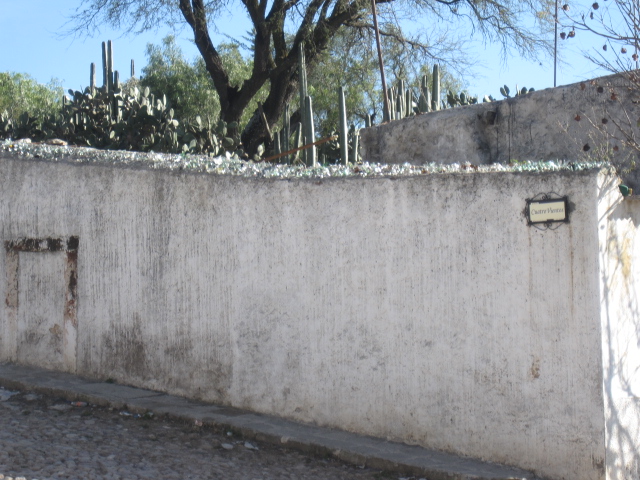
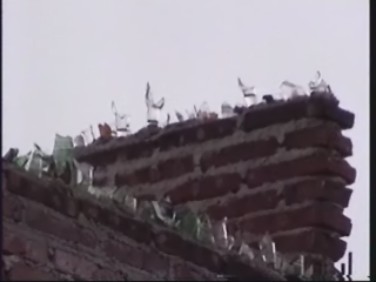
I started this book while house-sitting for an acquaintance who was off in Mexico City on business. I was alone there for several days with an old dog. I read the book in long sittings in the sun in an interior courtyard bordered on two sides by a high wall with glass shards embedded along the top. This is a very common home security device here if you cannot afford an alarm system and bodyguards. A wall with glass shards on the top and a dog–preferably two dogs. I took in this book in big gulps, which was my first mistake.

In The Part About Amalfitano there was this:

He walked to the back of the yard, where his wooden fence met the cement wall surrounding the house behind his. He had never really looked at it. Glass shards, he thought, the owner’s fear of unwanted guests. The edges of the shards were reflecting the afternoon sun when Amalfitano resumed his walk around the desolate yard. The wall of the house next door was also bristling with glass, here mostly green and brown glass from beer and liquor bottles.

Page 187.

Nicely done, I thought. Shortly thereafter there was this regarding the book on the clothesline:

Well, pretend it’s mine and take it down, said Rosa, the neighbors are going to think you’re crazy. The neighbors who top their walls with broken glass? They don’t even know we exist, said Amalfitano, and they’re a thousand times crazier than me. No, not them, said Rosa, the other ones, the ones who can see exactly what’s going on in our yard.

Page 197.

That is when it first sunk in that Amalfitano’s yard was open to the outside. He does not live in a classic Mexican house closed in with high cement or brick walls with an interior courtyard. Like the one I was in.

Then this after the voice begs him not to consider the voice a violation of his freedom:

Of my freedom? thought Amalfitano, surprised, as he sprang to the window and opened it and looked out at the side yard and the wall of the house next door, spiky with glass, and the reflection of the streetlights in the shards of broken bottles, very faint green and brown and orange gleams, as if at this time of night the wall stopped being a barricade and became or played at becoming ornamental, a tiny element in a choreography the basic features of which even the ostensible choreographer, the feudal lord next door, couldn’t have identified, features that affected the stability, color, and offensive or defensive nature of his fortification. Or as if there was a vine growing on the wall, Amalfitano thought before he closed the window.

Page 202.

Feudal lord? The offensive or defensive nature of his fortification? How the hell can it be offensive? Okay. Anyway, it had become an ornament at night rather than a barricade. Fine. But I was taking breaks now and staring at the glass shards above me on the top of my wall, which does have vines growing on it. Instead of my navel for a little change of pace.

Now who knows what this all means. Amalfitano was spooked by that voice that was so real. Perhaps at this point the poor guy was thinking that if he had cement walls around his yard with glass shards along the top like any sensible Mexican’s house does,  that damned voice would not have gotten into his.

As for me, it was always in my mind that Rosa lived there, too. That was when I was still house sitting alone, and it could get a bit spooky at night. I was not sure that old dog–Zumm is his name–would be worth anything in a crunch. It was silly. But I’ll tell you, I have been through about 37 theories concerning Bolaño’s glass shards since, usually while staring up at them here.

Then came this:

Young Guerra’s voice, breaking into flat, harmless shards, issued from a climbing vine, and he said, Georg Trakl is one of my favorites.

Page 226.

I bumped into shards again in The Part About Fate.

They can indeed be pretty at night. Just last evening I saw colored shadows on the wall of a room, shadows of the glass shards on an exterior wall outside, backlit by a streetlight. Guess what I thought about. To tell you the truth, I would rather not think about it anymore.

All I am saying is, be careful out there in Bolaño land, young people.

Amalfitano’s Fate

Daryl in focusing on what I call Amalfitano’s impotence comes as close as one can to an overview of the man at this point in his life. There is really no macro approach to this part. I believe that it will take more form in our minds as we read further into this novel and look back on it.

I have been exchanging thoughts with others about Marco Antonio Guerra and the voice over in the forums at Las obras de Roberto Bolaño . In that context I hope to discuss Lola’s telepathy, Amalfitano’s bizarre epiphany that he himself is probably telepathic because of the similarity between his mother’s name and the name of Bernardo O’Higgin’s telepathic mother, and all that weirdness. I will not take that up here.

In anticipation of leaving The Part About Amalfitano, I return repeatedly to this reverie:

He imagined himself locked up in an asylum in Santa Teresa or Hermosilla with Professor Pérez as his only occasional visitor, and every so often receiving letters from Rosa in Barcelona, where she would be working or finishing her studies, and where she would meet a Catalan boy, responsible and affectionate, who could fall in love with her and respect her and take care of her and be nice to her and with whom Rosa would end up living and going to the movies at night and traveling to Italy or Greece in July or August, and the scenario didn’t seem so bad. [Emphasis mine.]

p. 212.

Now does this not echo Lola and her poet in that other asylum nicely? Perhaps Amalfitano can learn to blow smoke rings during his commitment, which was the poet’s primary pastime.

I like the man so much that I would prefer that he not get into that Las Suicidas mezcal too seriously. When I consider all the alternatives, it appears to me that his impotence will prevent him from ever leaving Mexico himself. He simply cannot bring himself to take any action now on any front. Of those alternatives I have concluded that the asylum scenario does not seem so bad to me either. . .as long as Rosa does get out of Santa Teresa and back to Barcelona.

The Magnanimous Cuckold

Belgian playwright Fernand Crommelynk wrote a play entitled The Magnanimous Cuckold (sometimes translated The Magnificent Cuckold). Its protagonist (if it can be said to have one; let’s call him an antagonist in a play with no real protagonist) suspects his wife of cuckoldry and, through mounting paranoia and a bizarre need to confirm his suspicions, forces his innocent wife into cuckolding him with not only his brother (I believe it was his brother) but with the whole village, including himself in disguise. On a side note, the staging for Meyerhold’s 1922 production of the play bears some resemblance to certain elements of Duchamp’s machine céibataire, whose topic is at least obliquely (perhaps inversely) related to the idea of a cuckolding.

Having set myself up last week to establish a seating in literary tradition or convention (e.g. comedy for the first section of the book) and with Crommelynk’s play in mind, I latched onto Amalfitano’s cuckolding. It’s not exactly a convention, but it is certainly a recurring theme in literature. And for lack of anything more solid to latch onto, I decided to explore the topic a little more deeply.

Before I go on, I’m going to posit that there’s a relationship between the way a man feels about his daughter’s purity and his wife’s fidelity. The disturbing phenomenon of the purity ball takes the idea rather to the extreme, but it’s really no coincidence that we joke about shotgun weddings or polishing the (phallic, by the way) shotgun when dear daughter’s boyfriend comes to pick her up for a date. The deflowering of a man’s daughter is often taken as an assault on the man’s honor (of his property, really, I suppose), and so it seems to me like a variant of cuckolding.

That Amalfitano is raising a nubile daughter in an environment saturated with the fear of sex crimes perpetrated on young women makes him doubly and justifiably afraid of a filial cuckolding. We learn on page 198 that he feels spied on. On page 196, he asks himself why he brought his daughter to this horrible place. On the next page, he confides in Pérez that he’s a nervous wreck with fear for his daughter. Later, the voice in his head tells him to do something useful for his daughter. On page 202, we’re told that the wind is slipping into Rosa’s underpants.

But there are other significant things that are more suggestive of a fear of infidelity (of a sort) on the daughter’s part that goes beyond typical fatherly hand-wringing. Imma reads for the poet Lola is chasing a poem about Ariadne lost in a labyrinth. Ariadne, recall, was the daughter of King Minos, who kept a horned beast in his labyrinth. She betrayed her father first by helping Theseus kill the beast and second by eloping with the same lad. Ariadne’s name is figured by some to come from a word meaning “utterly pure.”

Later, after Amalfitano has learned to embrace the voice he hears, Bolaño tells us he feels like a nightingale. Oscar Wilde wrote a story (perhaps informed by Persian literature, which tells of the nightingale’s love for the rose?) entitled “The Nightingale and the Rose” (remember that Amalfitano’s daughter’s name is Rosa) about a professor’s daughter’s refusal to dance with a student and subsequent faithlessness to the student once he offers her the rose she requires. She opts instead to favor a man who sens her some jewels, ruining the notion of true love for the student and abandoning frivolously what we can assume must have been the sort of true love one would expect a father to want for his daughter.

Even the separation of Amalfitano from his daughter in airports because of their different citizenships points to a sort of infidelity (if not one she’s really culpable for), as he goes through one line while his daughter is frisked by strange men (one can imagine) in another.

And then there’s the voice’s repeated exhortation for Amalfitano to do something useful for his daughter. He is essentially telling Amalfitano to snap out of it and be a man, a reasonable enough suggestion for a character who displays nothing of manhood anywhere so far in the book. Professor Pérez all but throws herself at him (dressed like a ’70s movie star, caressing his face, touching his thigh, taking his arm as if they’re lovers), but he’s ever a cold fish. Several times, he considers planting a tree in his yard, an act that would produce fruit and demonstrate fertility and a lapse the voice reminds him of, but he never follows through, with telling symbolism.

I believe it’s even worth considering whether or not Rosa is Amalfitano’s child. The origin of of the word “cuckold” lies in the habit of the cuckoo of laying its eggs in another bird’s nest. Lola expresses a desire to carry the poet’s child, and at some point she has her son Benoît. Having left a child in Amalfitano’s nest before running off to seek the poet, has Lola in fact left behind Amalfitano’s child or the child of another with whom she’s cuckolded him? (“Lola” is a diminutive form of dolores, meaning “sorrows.” On pages 204 and 210, we see references to “birds of sorrow” and to “tiny little eggs.” Is it reasonable to put these things together to give weight to the Lola-as-cuckoo and Rosa as bastard conceits?) The lack of anything like passion in descriptions of their interactions or their history certainly leaves the possibility open.

Yet Amalfitano takes his matrimonial cuckolding in very gracious stride. Lola writes to him of her experiences with the poet, but he doesn’t seem angry. It’s clear that he loves her (that beautiful image he has of her typing him a letter, reflected in the sky outside an office window), and after her long-overdue return, he sends her away with most of his savings when she leaves. He is the very definition of a magnanimous cuckold.

Much has been made over whether or not Amalfitano is gay, and whether Guerra is gay. (Incidentally, back on the matter of the cuckold as a man with horns, I had trouble not imagining the Guerra of page 218, decked out like a cowboy and jumping out to sort of attack Amalfitano, as a man in conquest of a bull.) Although he seems passionless, I don’t think of Amalfitano as gay. He’s more sexless, something of a bachelor (remember Pelletier’s meditation on the machines célibataires as he himself contemplated aging and the search for fulfillment?) unsure of his relation to the women in his life. Or, for that matter, to the men. Amalfitano seems to me like Prufrock without the yearning.

I can’t quite find a way to bring this to a tidy conclusion. The cuckold is usually a comic figure, and yet Amalfitano is, to me, a sad, sympathetic man. Maria may have it right that Bolaño is saying something, with Amalfitano, about how alien homosexuality is to a virile Hispanic man. But this seems an awfully heavy section of the book for describing what seems to me to wind up being a pretty shallow cultural artifact. In a follow-up comment, Maria says “We do know that it’s men, not women, who are abducting a ton of girls and then torturing and killing them in that strange, sad border town. And this is a real thing that is really happening, in a real border town, to this day.” And maybe that is what really lies at the heart of the Amalfitano section. He’s more or less as helpless to do something useful for his daughter as he is to keep his wife from abandoning him and screwing around on him. What does it mean to be a man in a world in which men are so powerless to hold onto and protect those they would cling to?

Fear of Fluids in Mexico, Sentimentalism in the Alps

The more I think about it, the more I’m convinced that Daryl has the gold-star post of these first three weeks. (And I swear on a stack of Infinite Jests that I’m not saying that because I got linked and block-quoted; that’s just gravy.) That makes more sense of the Part About the Critics than anything else I’ve read or thought so far. It also makes me feel better about a slight post, since I know Daryl’s got us all covered.

Before I get to the part of this week’s reading that stuck in my brain, though, I want to make a quick mention of a delightful bit of horror: That toilet in Pelletier’s hotel room. I’m haunted by that toilet. Even before it became an oneiric avatar of body horror, it was menacing. Any toilet that somehow gives the impression that it was damaged by having a human head smashed into it by someone else is a scary piece of plumbing, and it’s one of my favorite extras in the whole book so far.

But to the point: I kind of loved the montage that closes the Part About the Critics. You know the part I mean—where, in a film version, you’d hear Norton’s voice-over (Emma Thompson would be a lovely choice, although Emily Blunt is probably more like it) reading the e-mail she sent to Pelletier and Norton, while the visual action shows how those two spend their days in Santa Teresa. It was beautifully structured, and nicely told. Yet there was one false note that I keep rehearing in my mind, and I can’t quite make sense of it. When Norton writes about Edwin Johns’s death, she thinks about “his hand, now doubtless on display in his retrospective, the hand that the sanatorium orderly couldn’t grasp to prevent his fall, although this was too obvious, a false representation, having nothing to do with what Johns had actually been” (151). And that just sounds ridiculous to me. How melodramatic: Johns slipping off his rock, the orderly leaping to his rescue, grabbing desperately for his hand—and closing his fingers on empty air where a hand used to be, inches from the truncated end of Johns’s arm. All it’s missing is for the orderly to actually grasp the hand and then watch in a confused instant while Johns continues to fall and the wrist end of the plastic prosthesis slips out of his coat sleeve. Picture the aghast orderly accidentally waving goodbye to Johns’s receding body with the stump of Johns’s own fake hand, and you’ll see what I mean. It’s almost comical.

In plain terms, I don’t trust the narration here. (And not in the “I fear this narrator may be unreliable!” kind of way. Every narrator’s unreliable.) The book has obviously not been maudlin up to this point; if anything, it’s been disconcertingly blasé. And although she’s been presented as intellectually quirky, Norton hasn’t been a sentimental kind of character either. I may be misreading, but I take the “false representation” from the quote to refer not to Norton’s imagined scene falsely representing the real scene—that is, not as a disclaimer of the reconstruction—but to Johns’s hand as artistic artifact representing the man himself. (That’s where “what Johns had actually been” comes into it, in my reading.) So I keep trying to figure out what this little line is for, and I’ve got nothin’. Maybe it’s just a wrong step by Bolaño. That’s not a very satisfying explanation, but I haven’t yet come up with an intentional reason for him to have included such a clanging insincerity with the rest of the book’s matter-of-fact whimsy. And it’s bugging me.

Also: Happy Olympics!

The Part about the Critics as Comedy

In her post for this week, Sarah says, probably correctly, that if this part of 2666 had been published on its own as Bolaño had instructed his heirs to do, it would have been something of a disappointment. Chatter generally has been that though the critics themselves have seemed kind of aimless and homogeneous, the writing is pleasant enough. Still, is vaguely pleasant writing enough to sustain a book in which the characters aren’t really all that compelling?

After reading Sarah’s post, I read Jeff’s comment on my long piece about the dreams. He says:

When I finished the Part About the Critics, I thought I was unsurprised to find Norton with Morini because I had no expectations to be overturned—the characterization had been so opaque that I didn’t have any feeling of what might have been out of character or unpredictable.

Suddenly it occurred to me — what if we regard this section of 2666 as a comedy , not in the Seinfeldian sense (necessarily, though it often enough applies) but in a literary sense?

Consider the following excerpted matter from the passage about comedies of manners in A Handbook to Literature:

The stylized fashions and manners of [members of an artificial, highly sophisticated society] dominate the surface and determine the pace and tone of this sort of comedy. Characters are more likely to be types than individuals. Plot, though often involving a clever handling of situation and intrigue, is less important than atmosphere, dialogue, and satire… Satire is directed in the main against the follies and deficiencies of typical characters… A distinguishing characteristic of the comedy of manners is its emphasis on an illicit love duel, involving at least one pair of witty and often amoral lovers.

Just try to tell me we don’t see a lot of these things in 2666 so far!

My college Shakespeare professor described comedy in the Elizabethan sense as the sort of literature in which there is some problem in the beginning (e.g. mismatched pairs of lovers, political problems) that can be resolved by a the proper alignment of and marriage of a pair or pairs of lovers. (Tragedy, by contrast, is when there’s a problem that a strategic marriage would solve that goes unsolved when the marriage falls through; Romeo and Juliet, within this set of definitions, is comedy turned tragedy.) All’s Well that Ends Well, which describes the nature of the Shakespearean comedy in its title, is a comedy. As You Like It is another. A Midsummer Night’s Dream is yet another.

Dreams in the summerish climate of Mexico are what finally tie Norton and Morini together after several attempts at mismatched relationships within 2666. In comedy, there really are, to borrow a phrase from Jeff, no expectations to be overturned.  Shakespeare’s plays are pretty transparent from the beginning about which pairs should and will line up and get married at the end to resolve the central conflict.  Bolaño isn’t up front about the proper pairing, but upon analysis of the dream content binding Norton and Morini together, it becomes obvious (I contend, if obvious only in retrospect and with a bit of digging, which I suppose isn’t in fact all that obvious after all) that they are destined from the beginning to come together. Whether or not their union resolves any central conflict besides the Pelletier/Espinoza/Norton love triangle is debatable.

(Consider comedy on the big screen today, though. I defy you to name a Hugh Grant or Julia Roberts movie in which the characters you know in the beginning will get together don’t get together in the end. These movies pay lip service to there being some larger central conflict — a life ruined by tabloid photographers, a chain store edging the little guy out of business, etc. — but they are ultimately about resolution of the relationship. I suppose we want to expect more of Bolaño, but maybe we shouldn’t; maybe the point for him is that focus on atmosphere and satire that the venerable editors of the Handbook describe.)

In any case, Bolaño seems in some way to be influenced by the old convention here. I wonder, then, if it’s not useful to think of this part of the book as a sort of comedy in that old sense (I also raised the question in a comment somewhere of whether or not part 1 was something of a picaresque). If so, I wonder also if each part of the book will emerge as a take on another subgenre of literature, and I wonder how those parts will play together.

Dreams in The Part about the Critics

The first section of 2666 gives us boatloads of dreams, most of them vivid and several of them downright disturbing. It’s hard to write about dreams before the section is done with while avoiding spoilers, since some of them anticipate other dreams or events in the story. So, while I’ve been cataloguing dreams over at the mother ship, I’ve held off on any sort of heavy duty analysis. Frankly, I’m a little skeptical about doing much in the way of real analysis. To speculate about the meanings of or purposes for events corresponding to the reality of the story as set out in the book puts one on shaky enough ground from a critical perspective; to speculate about the meanings of or purposes for bizarre dreams may be even shakier. Still, a number of little motifs appear in many of the dreams, and I think one can fairly safely draw conclusions about how they support certain impressions about some of the characters and their relationships to themselves and to others.

First, I’ll dump out a catalogue of some of the motifs I spotted. I may have missed some, and I may be making mountains out of molehills for others (for example, the age discrepancy one, the crowd one, and the distance one). After I’ve dumped them out, I’ll end with a few impressions the dreams have helped me to form.

Non-Dreams and Maybe-Dreams

Technically, this little sub-list isn’t a catalogue of motifs so much as a collection of instances in which dreams or dream-like states were referenced, suggesting that even when dreams aren’t real dreams, they’re a pervasive element within the text.

  • 14, Morini: May have dreamed a horrible unrecollected dream
  • 22, Frisian lady: Has trouble sleeping
  • 34, Norton: Enters a hypnotic, post-sex state
  • 35, Morini: Has a weird experience with temporary blindness that it’s conceivable (though not suggested explicitly) could have been a dream.
  • 40: Norton’s ex existing only in dreams
  • 76: beating the Pakistani is said to have taken place during a dreamlike state
  • 94: After Morini’s absence after meeting with Johns, Pelletier describes his reappearance as having been like waking from a bad, baffling dream

Fluid

  • 35, Morini: Awakened from his maybe-dream by perspiration (and light)
  • 45, Morini: Dreams of Norton diving into a huge pool with oily patches. Fog appears and the pool empties.
  • 78, Pelletier: Lives with Norton near a cliff overlooking a beach, which is later seen to butt up to metallic water. Later in the dream, he sweats and sweats, as if sweating from a spigot you couldn’t turn off. The tremor he spots on the sea makes it look (he thinks) as if the water is also sweating.
  • 114, Pelletier: Dreams of shit and blood in the bathroom containing his broken toilet.
  • 115, Norton: Swollen, pulsing vein in the reflection’s neck makes one think of the blood coursing through that vulnerable spot.
  • 155, Pelletier: Dreams of a boy diving into water that turns out to be alive.

Supernatural Abilities

  • 45, Morini: Norton speaks to Morini via telepathy
  • 78, Pelletier: Can sometimes soar like a seagull.
  • 114, Espinoza: People in the painting move slowly, as if living in a different world in which the speed was different
  • 115, Norton: The woman Norton sees reflected in the mirror isn’t Norton, and the reflection behaves very strangely.

Sounds

  • 78, Pelletier: Metallic sea is associated with a humming of bees and then an awful silence.
  • 85, Espinoza: Dreams of a distant moaning as of a child or a sheltering animal
  • 114, Pelletier: A muffled noise wakes him up (within the dream)
  • 114, Espinoza: Hears barely audible voices. The word freedom sounds to him like the crack of a whip in an empty classroom.
  • 115, Norton: Hears a noise in the hall and thinks someone may have tried to open the door. Later, there’s total silence.
  • 155, Norton: A thunderclap wakes her up (whether in real life or only in her dream she doesn’t know)

Trees

  • 45, Morini: Norton walks away into a forest giving off a red glow.
  • 131, Norton: She plants and replants an oak tree that sometimes has no roots and that at other times trails “long roots like snakes or the locks of a Gorgon”
  • 115, Norton: When thinking about Morini, she sees his empty wheelchair and an impenetrable, dark green forest that turns out to be Hyde Park. She also has a sense that a fire is raging nearby; the juxtaposition of these two images seems noteworthy given Morini’s dream (45) that Norton walks off into a forest giving off a red glow.

Weird Word Stuff

  • 78, Pelletier: He’s reading Archimboldi papers written in French rather than in German
  • 85, Espinoza: Dreams of some indecipherable words a prostitute said to him, and the point of the dream seems to be to try to remember them. The prostitute in the dream is reading some words written on the wall and spelling them out as if she doesn’t know how to read.
  • 114, Espinoza: Words “tunneled through the rarefied air like virulent roots through dead flesh”
  • 114, Espinoza: Recognizes just a few stray words all conveying urgency or haste.
  • 115, Norton: Begins taking notes as the woman reflected in her mirrors cycles through the varying grimaces of madness.
  • 131, Pelletier: Dreams of a page he can’t decipher no matter which way he turns it.

Faces, Facelessness, and Backs Turned

  • 35, Morini: In his maybe-dream about blindness, as he’s trying to compose himself, he thinks of (among other things) still shots of faces.
  • 45, Morini: Dreads the evil woman who wants him to turn and see her face (it turns out to be Norton, who says “there’s no turning back”; earlier, Morini [not in the dream] has said that nothing is ever behind us). Let’s not forget that Norton is described as the Medusa.
  • 78, Pelletier: Norton is more or less a sort of background noise; she’s there but never really quite seen or heard in a meaningful way; when he cries out for help, she’s nowhere around.
  • 115, Norton: Her front is reflected in one mirror and her back in the other; she’s unable to say whether she’s about to move forward or backward. As the head in the mirror turns, she realizes that if it keeps turning, its owner and Norton will eventually see one another’s faces. The reflected face makes a grimace of fear, causing Norton to look behind her for the source.
  • 155, Norton: Morini’s back is to her, a fact that particularly upsets her. His wheelchair is facing her, and the chair and Morini are described almost as if they’re facets of the man himself; this resonates with the duality of Norton in her dream about the mirror.

Dark/Light

  • 35, Morini: He’s awakened from his maybe-dream by light (and perspiration)
  • 78, Pelletier: He doesn’t sleep much, and he sometimes, while trying to sleep, looks at the beach and sees it as a black canvas or the bottom of a well that he searches for the hint of a flashlight or a flicker of fire.
  • 85, Espinoza:  Bulbs are burnt out in his prostitute dream.
  • 114, Pelletier: Someone had turned on the bathroom light.
  • 114, Espinoza: “bright desert, such a solar yellow it hurt his eyes”
  • 115, Norton: dreams of herself reflected in dim light (later described as ashen); the dream itself deals with the infinity seen between two mirrors, a trick of light.

Age Discrepancies

  • 45, Morini: Dreams of a much younger Norton
  • 115, Norton: Dreams of herself dressed in the style of the 50s.
  • 131, Espinoza: Dreams of the young girl selling rugs
  • 155, Pelletier: meets a boy who spends the whole day diving into living water.

Madness

  • 115, Espinoza: The slowness of the painting in his hotel room was what kept whoever was watching it from losing his mind.
  • 115, Norton: The woman reflected cycles through a series of expressions of madness.

Sadness

  • 45, Morini: Feels “deeply and inconsolably sad”
  • 78, Pelletier: He weeps
  • 115, Norton: Begins to cry in sorrow or fear. Later, the reflection grimaces in despair. Norton takes notes on the reflection’s expressions as if her happiness depends upon it.

Rocks/Jutting

  • 45, Morini: A rock juts from the enormous pool.
  • 78, Pelletier: Once the people leave the beach Pelletier and Norton live near, all that’s left is a “dark form projecting from a yellow pit,” which turns out to be a horrific/beautiful statue

Crowds

  • 45, Morini: People begin to leave a crowded area
  • 78, Pelletier: People are always on the beach he and Norton live near, doing frivolous things. Eventually, they desert the beach. He has the impression that they move as a crowd, arriving each morning as if for work, or that they live at the beach.

Fear/Defenselessness

  • 45, Morini: Thinks of the the figure wandering at the bottom of the pool (whom he had thought might be Norton) with sadness, as if she’s his lost love wandering in a labyrinth. He also imagines himself, with legs that still worked, lost on a hopeless climb.
  • 78, Pelletier: People begin to leave the beach, some clinging to bushes or stones and others climbing the cliff. He wonders if he should bury the thing projecting from the beach, “taking all necessary precautions.” Later, he shouts for help, but it’s as if the silence following the water’s tremor and buzzing sound swallows up his cries.
  • 114, Pelletier: He’s more revolted by the shit than afraid of the blood smeared in his bathroom.
  • 115, Norton: the stillness of her body reminiscent of defenselessness; later, a grimace of fear on the face of the reflection causes Norton to look behind her.
  • 131, Espinoza: He dreams of the girl he bought a rug from and wants to tell her something and spirit her away, but the perpetual motion of her arms keeps him somehow from doing it.

Distance

  • 45, Morini: The pool is 1000 feet wide by 2 miles long
  • 78, Pelletier: Thinks about how far he’d have to walk to get to the beach; the people in his dream never get very far from shore.

And now for some analysis (or maybe it’s synthesis).

It’s straightforward enough to suggest that the various weird word issues among the dreams speak to insecurities about the particular dreamers’ critical fitness. While they sit in the thrones of their academies and look down upon the third-rate critics who flock around them throughout this section of the book, they, like all of us, wonder about their own capabilities. Pelletier dreams about turning a text this way and that and trying to reread and reread it without success only to find himself lounging about the hotel reading and rereading the Archimboldi books he has brought with him.

For Espinoza, words are secondary somehow to flesh and life and crisis. He seeks to understand the writing on the wall (with all its Biblical freight?) but  only to unravel the mystery behind a probably obscene comment during sex that he’s reminded of when he sees a love bite on his thigh. In other dreams, he seems to hear cries of urgency, and in a dream about the girl who sells rugs, he wants to rescue her from something but can’t (captivated, in a way, by the physical flesh of her thin, dark arms). Even his attempt to decipher the writing on the wall is a sort of rescue, as he tries to save an illiterate prostitute by figuring out what it is she’s trying unsuccessfully to read. Espinoza is the Romantic, perhaps the poet (here the interpreter of arcane knowledge) of the bunch. Recall that he wanted to be a writer rather than a critic. He’s got that Spanish machismo that Maria wrote about (remember that Pakistani cab driver), and the little bit of insight we have into his dreams backs up her assessment of his hot-blooded, sort of heroic, persona.

Norton’s writing in one of her dreams is that of a college student hoping to please. She takes notes as if cramming for an exam, but the exam she’s cramming for has no right answers, for it’s one of identity. Her dreams are of mirrors and faces, uncertainty and fear (noises in the hall and jolting thunderclaps). She explores, in her dreams, where she stands (literally) in relation to herself and to Morini. As she has different personas with Espinoza and Pelletier in the boudoir, so too is there ambiguity about her self-identity within her dreams. Insecurity about who she is (is she the she she sees in the mirror?) manifests itself in that most insecure of instruments for female characters: the mirror, in which she goes so far even as to appraise the outfit the her she doesn’t think is her happens to be wearing.

Pelletier becomes something of a lone wolf as the book moves forward, choosing to read in solitude rather than to go out with Espinoza. When he dreams of living with Norton, she’s background scenery, and even the water begins to sweat when he sweats. The world he looks out over from his house on the cliff is as one constructed for his benefit, the beach-goers showing up as if for a job, filling roles he expects to see filled out on the shore day after day in the world of his making. He can sometimes soar like a seagull. In Pelletier’s dreams, he’s a sort of god. He’s more worried about the dirtiness of shit smears than the dark implications of blood smears (and why not be, for gods are immortal but not necessarily immaculate). Still, he has his insecurities, particularly with respect to his abilities as a critic, as evidenced by the weird word dream incidents outlined above. And it was Pelletier, recall, who demonstrated a fear of being an old bachelor ; the fear rears its head again as he dreams about watching a boy diving over and over into the water. Whether Pelletier sees the boy as an incarnation of youth gone by or as the quarry of a confirmed old bachelor is left to the reader’s imagination (though I tend to favor the former interpretation). When imagining Pelletier as a self-styled god alongside his dream image of a time-worn statue projecting from a vast expanse of beach, I can’t help thinking of Shelley’s “Ozymandius”:

I met a traveler from an antique land
Who said: “Two vast and trunkless legs of stone
Stand in the desert… Near them, on the sand,
Half sunk a shattered visage lies, whose frown,
And wrinkled lip, and sneer of cold command,
Tell that its sculptor well those passions read
Which yet survive, stamped on these lifeless things,
The hand that mocked them and the heart that fed;
And on the pedestal these words appear:
My name is Ozymandius, King of Kings,
Look on my works, ye Mighty, and despair!
Nothing beside remains. Round the decay
Of that colossal wreck, boundless and bare
The lone and level sands stretch far away.

Morini too dreams of a form projecting from the vicinity of a body of water. The form in his dream I suppose is phallic, a rock nearly lost in the enormous landscape of a drained pool, the owner of that phallus (and the dream) an incomplete man ever in need of a helping hand, confined to his home while his male companions run off to Mexico with his would-be lover to consummate at last the ménage a trois that has seemed inevitable for 100 pages.  It’s fitting, given their final reunion in this section of the book, that Morini and Norton’s dreams are the most disturbing, and that they’re linked in a vaguely supernatural way. She finds herself staring at his back in her later dream, where he found himself stared at from behind in his early dream. He and his chair are a single, fractured being in her later dream as she is at one point the woman walking in the bottom of the pool and at another the woman behind him in his dream, and, further, as she is (and isn’t) a reflected woman in her own dream.  Pritchard characterizes Norton as the Medusa, and Morini is afraid to look at her face in his dream. Yet after their gazes do finally meet in his dream, she walks off into a glowing red forest; when she thinks of Morini during her mirror dream, she pictures a dense, green forest and has a sense of nearby fire, and she’s trying (but is unable) to make an exit. As they’re connected in their dreams, so they come together in real life.

It’s not all quite that tidy, of course, but these are some impressions I’ve formed after living with and reflecting on these dreams over the last few weeks. The dreams seem to me to reinforce certain currents that run throughout the book (despair, squalor, crowding, madness, sex, fear), but they also provide color for these characters who, minus their dreams, have seemed awfully homogeneous and flat.