A character by any other name.

As this book opens I couldn’t help but focus on names.  I have always been attuned to the names authors use.  When I used to attempt fiction, I could spend as much time trying to come up with the perfect meaningful name (see how the name comments on the action?) as with a story itself.   So when I see an author using especially peculiar names, my reading senses tingle.

This story is just full of unusual names.  And on several occasions names, or lack of names is significant.

Before starting on names though I have to chime in and say that “shut your piehole, cakeface” is hilarious.  And the whole argument about punctuation on T-shirts had me cracking up.

First of all, with a comma before “cakeface,” the shirt would have to be considered “officially punctuated” which would require a period be placed after “cakeface,” not to mention a colon, if not another comma, after “Jonboat Say,” and quotation marks around the catchphrase itself….  This, believed Jonboat, was more punctuation than a T-shirt could abide.

But back to names.

Part 1 Section 1 “Jonboat Say” starts off with the character named Jonboat.  I suspect most people have heard the nickname Jonboy, but I have personally never heard Jonboat before and I liked it immediately–weird and memorable.  There’s also his full name Jonny Pellmore-Jason and that his father is named Jon-Jon Jason.

It’s also interesting how the narrator introduces his family.  Since his family name [Magnet] is an everyday object that could be used as a descriptive word as well, introducing his family as “My family’s. We Magnets'” is certainly not the most direct way of providing information. My first thought was that it was metaphorical and that his family were the kind of people magnetically attracted to trouble.  This doesn’t even address his first name yet.  in fact, his first name won’t come for a long time.

The other prominent name in this section is Blackie Buxman.  This name doesn’t specifically signify anything to me at this point, but they all strike me as meaningful.  Most of the characters aren’t named common Anglo-Saxon names (well, okay, Jonny, but he is Jonboat).

So is “Blackie” a nickname like Jonboat or a given name?  There’s no way to know yet and maybe we never will as he doesn’t seem to be very important after the tetherball match.  I looked up the origin of Buxman and learned it’s the Americanized spelling of German Buchsmann, a topographic name from Middle High German buhs(boum) ‘box (tree)’ + man.  That doesn’t seem significant–although later he does punch the main character “in the asshole.”

Just after the first black dot triangle section break, there’s a geographically made up name: “Wheelatine Township” in the Chicagoland area.  Is the made up use of Wheelatine an indication that things are not real right from the start?  (I don’t know anything about Chicago, so if it’s a play on a region, it is lost on me).  Or is it just a simple narrative device to prevent people from fact-checking details?

Also, what the heck does Wheelatine mean?

Then there’s the main invented plot device, the “cures.”  The way these are introduced puzzles in the same way as “magnet”: “There I had my cure rustling around in its PillowNest.”  [shades of George Saunders with this naming convention].  This is deliberately confusing, there’s no question.  No capital, no italics, no capital C, there’s no indication that it is significant.  I had to read this sentence a few times just to see what I could possibly be missing.

Cure is short for Curio (which makes a lot of sense both as the real name and as an abbreviation).  It is a pet of sorts.  And he has named his Blank.  The Curio’s full name is Kablankey–named at his mother’s suggestion for the sound of its sneeze.  But ever since he’d “vented his temples” (?) he’d changed it to Blank, which was less childish but retained connections to his missing mother.

Curios had originally been called Botimals

By the way, “rear ejection” is what they call its waste.  Ha.

There are a whole bunch of names for things that happen to Curio owners. More words that have mundane meaning which are clearly used differently.  For instance, kids “go into overload” (which gets them on the news).  This is bad.

All of this in the first ten pages.

Then we finally get to the main character’s name.  Or what his name isn’t:

“Billy, listen–” said my father.
“That’s not my fucking name.”

Chapter 1 Section 2 is called “Two Hundred Some Quills”

I feel like I’ve heard the name Quills before for cigarettes, but the only thing a quick search provides is in a Stephen King story (which might be where I heard it).

As this section opens, our 38 year old narrator gets a birthday present from Clyde the Dad (his father is finally given a name).  Clyde is away (fishing with friends) and not-Billy is on his own.  Usually Clyde leaves money in the Marvin Hagler bust, be he has forgotten.

We also meet Grandmother Magnet who calls to wish him a happy birthday.  The narrator doesn’t feel like talking to her so he messes with her and she twists the Magnet/Jonboat piehole phrase to “Plug your dirty sheeny coinslot, ovensmear.”

Grandmother Magnet is full of racist name-calling, which is a shame because “ovensmear” is a wonderfully weird insult.

Not-Billy goes to the White Hen to by Quills from Pang, the owner (okay, sure) of the establishment.  Pang says that not-Billy is not creditworthy.  Instead Pang gives him a piece of Dubble Bubble (which not-Billy muses about and speculates could have been called bubbleychew). Speaking of gum, I’m glad Levin has settled the age-old debate that the plural of Bubblicious is Bubbliciousi.

Not-Billy returns home without his Quills only  to find “a check for $1,100 made out to my father.  My SSDI check.”  So he takes it to the bank.  Names are crucial at the bank as well.

The teller who helps him doesn’t have a nameplate up.  He is however, “wearing a pinstriped vest and decisive mustache … with a golden chain that disappeared inside the watchpocket.”  We soon learn his name is Chad-Kyle or C.K.

This fellow is just full of name brands:

“the most buzzed about line of Graham&Swords PlayChanger PerForumulae for Curios since 2008’s SloMo or perhaps even 1993’s BullyKing.”

He also passes out fliers at shows for DJ Crystal Worm.  And of course Crys-Dub’s style of sleazebeat was a revolution on the scale Wang Kar Pourquoi’s first forays into fuzzdub or even Murder-ers’ trademark-infringement days when they were still called Murderers Jr.  The fliers are for a party at Killer Queen Marmalade’s, sponsored by Que Padre Mezcal.

The teller is offering to give not-Billy an advance of the new Curio forumlae “Independence.”  He has already given it to his cure Tiddlywinks.  But when not-Billy says he doesn’t want to show off his Cure, the teller assumes that Blank is a hobunk.

Finally they get around to the transaction.  Not-Billy doesn’t have an ATM card.  When he shows C.K. his state ID, C.K says, “Now that is a name.”

Turns out the check is a problem because of names:

It’s my SSDI check. I’m the beneficiary.  My father’s my guardian, though, so it’s made out to him.

Outside of the bank we formally meet Lotta Hogg (a name that is hilarious, offensive and absurd but not out of the realm of believability).

Unless I missed it earlier, Lotta is the first person to say not-Billy’s full name: Belt Magnet.  She says it in full at least three times and addresses him by his first name many times during the conversation.  She even gives this name a series of nicknames: Beltenhauer, Magnetron, Beltinya Magnetovich [that one is inspired].

It turns out that Lotta and her friends (we finally have conventional names here: Kelly, Jenn and Ashley) were somewhat in awe of him back in 1987 [Belt was 12, Lotta was 9, give or take].  His actions caused them all to menstruate at the same time [?].

They talk about the return to town of Jonboat and his fiancee (?) named Fondajane. [There’s a lot to unpack with that].

As this conversation ends, Lotta wants to see his cure, but he tells her it is a hobunk and “could tear your friends to pieces.”

Chapter One Section 3 is called “About the Author.”
He tells us that he deliberately did not reveal his name at the beginning.  He didn’t want to write “My name is Belt Magnet, and sometimes I’m psychotic–at least that’s what they say.”

This section is a mostly a series of questions in interview format.

His psychotic symptoms manifest in being able to converse with inanimate objects or “inans.”  He needs to have his “gate” open to receive their messages (which are written in between vertical lines: ||Maybe that’s your own problem||.

The next question concerns Lotta Hogg and how she and her friends all had “the onset of puberty” at the same time because of what he did.  What he did has been named “the swingset murders.”  He essentially destroyed a series of swing sets with a bat, and they are continually referred to as “murders.”

In the newspaper article the girl who describes him as “so cute” is not named: “identified only, to my great frustration, as a “member of the popular set at WJH.”  Earlier it was said that the team name is Washington, so it’s safe to guess Washington Junior High.

Belt has an abetter in his murders, an eight grader named Rory Riley.  Belt had just destroyed the Blond family swing set.  Their son Ron Blond high-fived Belt for doing so (he hated that old swing set).  Riley also hated the swing set and proposed he fins another for Belt to murder.  Chuck Schmidt lived in “Old Wheelatine” where Feather lived, and they encouraged him to murder the Feather swingset.  This murder is what got the newspapers’ attention.

A question asks about his psychosis.

When discussing his medication, he talks about Eileen Bobbert who likes pun-driven jokes (and gave him Risperdal).  His prior doctor was named Emil Calgary who liked more scatological pun-driven jokes (and gave him Haldol).

There’s not much more in the way of names after this (even the doctor names aren’t revelatory I don’t think).  But one of the questions in this section stresses the naming of the Curios as botimals.  It was called a Botimal, a “robot made of flesh and bone,” but it was a pet to him–a new kind of pet.  He has never been able to think of Blank as a robot.

There’s more unusual word choice here though.  People “kill” their cures, regularly.  In fact, that seems to be what you’re supposed to do to it.  Earlier Belt said he had never so much as hurt Blank before.  Belt has been unable to do so, but he never prevented anyone else from doing it.  Nevertheless:

Blank was my pet, though.  My friend.  My sibling.  I didn’t want to kill it, even when I did.

Belt has possibly the oldest living Curio.  The oldest publicly stated Curio was owned by a monk and named Basho (17th century Japanese haiku master).

Finally, Belt reveals that he is an author.  His novel is named No Please Don’t.  It was published by Darger Editions (Henry Darger was an American writer, novelist and artist who worked as a hospital custodian in Chicago, Illinois).  It concerns a character named Gil MacCabby who has lost his most favorite toy, and intergalactic smuggler called Bam Naka (which seems Star Wars inspired).

Belt also wrote an essay for Harper’s which was not published (although it is printed here) called “The Magnets, the Birds and the Balls” (June 2006) about his Grandma Magnet having an affair with a mobster by the name of Salvatore “Sally the Balls” DiBoccerini.  The Balls had an African Gray parrot named “Mouth” who would repeat just about anything (including lots of curse words).

There’s a lot to look at with all these names.  Most are probably not significant.  Many are probably just there for a joke.  And there’s nothing wrong with that either.

I don’t imagine there will be too many more significant new characters introduced,so I doubt there’s going to be many more new names to look at.

Nevertheless, with Levin’s clear love of language, I’ll bet whatever names he does come up with will be entertaining.


♦          ♦

As a writer, he reads a lot.  Here’s a list of the stories he mentions

Donald Barthelme “Balloon”
Franz Kafka’s “Blumfield”
Jeff Parker “Our Cause”
Robert Coover “The Hat Act”


♦          ♦

Incidentally, I co-posted this on my own site which includes a “Soundtrack” for each post.  All of the posts for Bubblegum will “feature” bubblegum pop songs.  This week’s is The Archie’s “Sugar Sugar.”
Marks and Meaning

This week’s reading brings us up to page 81, and boy is there a lot of stuff one could chomp into here — behaviorism, reliability of the narrator, stories within stories, the difference between aloneness and loneliness, what we mean by sentience, fun with names, comparison with certain other authors to whom I plan largely not to compare Levin during this read, and a fair few others. But what I’m going to focus on for my first post proper about Bubblegum is Levin’s use of marks on the page.

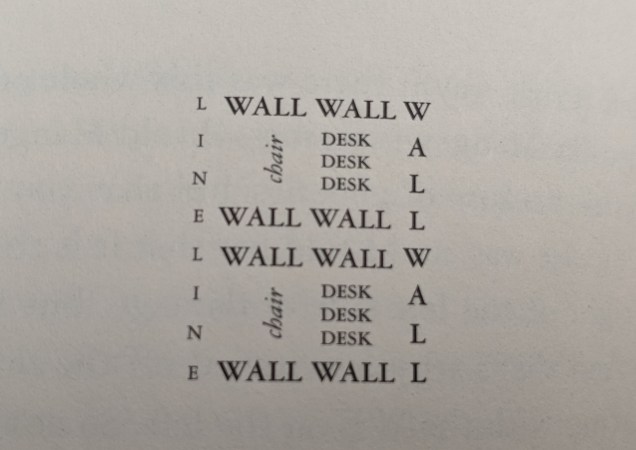
First, I want to look back at Levin’s first novel, The Instructions, in which he in several places uses words to form pictures. These word pictures grow more and more elaborate as the book goes on, but here’s a simple one from the first half of the book:

wp-1589056851718.jpg

I mention this to establish that Levin seems to be willing to use words and letters to signify more than the simple words that stream along the mental ticker tape that plays in our heads when we read. In this picture, Levin uses words to create physical models of what they represent rather than merely abstract symbols that our brains translate for us into their physical referents.

I have not yet run into anything quite so concrete in Bubblegum, but having seen this sort of concrete poetry in Levin’s past work, I was primed to think about Levin’s use of marks on the page in Bubblegum as more than the simple utility dots and strokes that I think we usually take them for.

The first that really caught my eye occurs on page 4:

wp-1589057704346.jpg

We see here three dots that, if connected, would form an isosceles triangle, right? I didn’t think so. The rightmost dot looked just a little closer to the top dot than the leftmost did. I didn’t measure the distances initially, but I marked the dots in my book to remind me to come back to them later. I wondered if the configuration of the dots might change somehow as the book went on and be imbued thus with some sort of meaning. So far, they seem to’ve kept this same configuration. I did wind up breaking out a ruler and measuring the distances later, and indeed the rightmost dot is closer to the top dot than the leftmost dot is, by just a little bit. But what does it mean? I have no idea. Belt on page 52 describes his Cure as a single-legged triped. Does this little three-dot section-divider represent something like the points Blank’s “peds” would make when it stands on all three of its limbs? Whether or not that’s the idea, why the subtle difference in distance?

The next close attention to marks in the book is the argument between Belt and Jonboat about commas and hyphens in the phrase they plan to ink onto tee-shirts:

I, however, was of the opinion that, absent “gaylord,” the comma should be restored to its original position between “piehole” and “cakeface,” whereas Jonboat claimed restoring it would ruin the shirt. He said that, first of all, with a comma before “cakeface,” the shirt would have to be considered “officially punctuated,” which would require a period be placed after “cakeface,” not to mention a colon, if not another comma, after “Jonboat Say,” and quotation marks around the catchphrase itself, i.e….

This, believed Jonboat, was more punctuation than a t-shirt could abide… But I did suggest that a hyphen be placed between “piehole” and “cakeface”… Jonboat wasn’t sure. He thought a  hyphen might suggest “official punctuation,” giving rise to the problem that ditching the comma had already solved. Then again, it might not. A hyphen might be more like a spelling thing — more like an apostrophe.

I’ve cut out a fair bit here, and the two boys talk about it further later. Later still, on page 50, Belt explains that he has taken some liberties in his reproduction of conversations he has had with Lotta and Chad-Kyle:

I’ve reported Lotta saying what she said the first way rather than reporting it the second or third way not because the first way seems to me to more accurately depict what Lotta said or who Lotta is than do the second or third way, but because all three seem to me to be highly and equally accurate depictions and, to my ear at least, the first way sounds better (it’s more in keeping with the rhythm of the paragraph from which I’ve excerpted it, and it comes across more clearly with regard to pronouns) than the second or third way.

So, Belt via Levin is paying special attention to how he puts things on the page, to how the arrangement of the marks on the page sort of regulates the flow of the ticker tape of meaning. The how of the saying is as important as the why to Belt, the way you hear it in your own private head as important as what what you hear means.

Belt’s mention here of pronouns takes me back to page 3, when a word in the second sentence caught my attention: “The piehole thats shutting he’d demand was rarely mine, though.” We’re accustomed to using “whose” as an inanimate possessive pronoun, or using something twisted like “The piehole of which he spoke of the shutting of was rarely mine, though.” We don’t know it yet when we get to this 23rd word of the novel, but there’s a lot of meaning in this weird “thats.” It’s as if Belt is sort of promoting the inanimate by giving them a real pronoun of their own, calling attention to the lack of one and thus, perhaps, to their sort of second-class status. When later we learn that Belt not only talks to inanimate objects but pities them, tries to help them — in short that he treats them as if they are sentient — his use of this odd new possessive pronoun makes pretty good sense.

The use of a whole new pronoun is a bit of a digression from the use of individual utility marks, which I’ll return to now.

On page 38, Levin introduces the || and | marks as substitutes for double and single quotation marks when inans speak to Belt. It makes a certain amount of sense. Belt tells us that they communicate directly into his brain. Why not indicate this via weird punctuation marks? Well, sure, I guess. But there are plenty of books in which people think to themselves (direct in-brain communication) and in which that thinking is written using regular old quotation marks or italics. I suppose there aren’t as many books in which inanimate objects communicate directly in-brain via something called a gate, though. Maybe that merits the use of a different mark. When I first ran across these marks on page 38, I jotted in the margin the word “caesura,” which is the name given to a big pause in the middle of a line of poetry. When marking the rhythm of poetry, you use the || to indicate where a caesura falls. Maybe Belt via Levin chose this mark to indicate some sort of mental pause bookending the injection of the inans’ communication into Belt’s brain. Or maybe he just wanted to use a different set of marks to set them off more starkly.

The final mark I’ll mention is one that’s missing. Belt’s book No Please Don’t should have a comma after “No.” I’m not just being picky about grammar myself here. Belt has demonstrated from as far back as middle school that he is a person who thinks about correct punctuation and punctuation’s influence on how you’d speak a phrase. He is also not stingy with commas on the whole. This title demands a pause — a caesura — after its “No.” It’s hard to imagine that the Belt who argued with Jonboat over commas and hyphens or the Belt who deliberated over the rhythm he used to relate Lotta’s telling of a story would omit the comma here. But he does.

While I don’t have a clear thesis about this stuff, I think there is an assumption I can acknowledge: that marks on the page that we don’t think of as signifiers themselves are  easy to not pay much attention to or assign much value to. They are utilitarian in that they help us navigate what we’re reading, offering pacing, rhythm, boundaries, and so on. But they are not, in general, the point.

To stretch a bit, I’ll suggest that the same is true of things like book jackets, which draw you in but then become largely an annoyance. My Bubblegum jacket sits limply now on a pile of neglected books on my nightstand, as I don’t want to have to fool with it as I lug the book around from room to room. A couple of people mentioned in comments here wondering if a faint whiff of bubblegum smell was real or imagined. Levin confirmed in a conversation on the podcast The Great Concavity that the jacket had been made with a heat-activated scent. The slight warmth of your hands on the jacket causes the jacket to smell faintly of bubblegum (the warmth of your skin in the world of Bubblegum also happens to keep cures alive). It’s kind of marvelous. And it also, to me, works as sort of a functional rhyme with some of what’s happening with the various marks I’ve made note of here. ||Attend more closely,|| these things seem to say to me, ||things that do not usually garner much attention are more significant than you think.||

On page 44, Belt says a fair bit about the phenomenon of his destruction of the Feathers swingset:

There were writers who insisted in their Herald op-eds that the swingsets functioned as symbolic metaphors of juvenescence… And I don’t know — maybe. But to me, those explanations seemed overblown… I think it was probably all a lot simpler. I think the aesthetic pleasures of watching a boy destroy a swingset were vastly underrated by our town’s editorialists. I think those kids found the act to be beautiful — not its “meaning” (at least not so much its “meaning”), but what the act looked like, sounded like, felt like…. And what I’m getting at is that while the “meaning” of a group of children standing around to watch a boy murder a swingset with a bat might not be much, if any different from the “meaning” of a group of children standing around to watch a boy murder a swingset with an ax, the experience of seeing the boy use a bat differs markedly from that of seeing the boy use an ax.

On pages 21 – 24, Belt mediates on bubblegum, its function and its meaning.

I still wasn’t sure Dubble Bubble stood for anything. I still wasn’t sure what I wanted it to stand for.

This feels pretty familiar to me. I have no tidy thesis here, but part of me wants to make an airtight case that calling our attention to easily-skipped-over marks on the page causes us to treat these marks, in a way, as Belt treats inans — giving them attention, engaging with them as items worth engaging with, and that in doing so, Levin is writing a book whose form at times sort of mirrors the content. Pope played with this in his “Essay on Criticism“, using a long slow Alexandrine (twelve syllables, alternating unstressed and stressed, with a caesura in the middle) to demonstrate how an Alexandrine could be long and slow:

A needless Alexandrine ends the song,
That, like a wounded snake, drags its slow length along.

Pope writes several similar lines in which the content demonstrates the precept he’s sharing (soft, whispery sounds in a line about the blowing wind, for example). Maybe Levin is doing something similar, giving marks on the page we would usually skim over more significance, as Belt grants inans and cures more significance and even a sort of sentience.

Or maybe he’s just playing around. Maybe I’m looking for significance where there is none. Still, it’s fun. Whether there’s meaning in these things or not, the possibility of meaning, the experience of reading a book that allows me to try to tease these sorts of things out, has so far been rewarding.

Turn and Face the Strange: On Bubblegum

The very existence of science fiction proves that people love weird, imaginative shit. As long as it rings true to the author, as long as it functions within its own logic, someone else out there in the world will also dig it. Like Dune, there are moments in Adam Levin’s Bubblegum where you will have no idea what is going on with the whole book. There are moments where you won’t have any context and things just seem postmodern a la Moe Szyslak’s definition: “weird for the sake of weird.” Hang in there, I am telling you. The structure of the novel artfully sifts together many divergent strands with the “main” story of Belt Magnet and his cure.

Why do we read books like this at all? Everyone has their own answer, but for me, part of it is to face the strangeness head on. In fact, I think there is no limit to the amount of strange, weird shit people will read or watch or look at. Have you ever stared at a Breughel painting or a Cy Twombly or Kandinsky painting and wondered not only what the thing was trying to communicate to you and the rest of the world, but also what sort of mind produced this particular image at that particular time? That’s a little bit of how I felt reading Bubblegum. As as sort of intro to the book, if you haven’t started yet or if you have only read a few pages, I encourage you to stay curious about the story and the storyteller.

Throughout this novel, you will see Adam Levin reveal himself as the artist in the picture (another postmodern / metafictional necessity), and some of the adolescent characters and their argot might be familiar if you have read The Instructions. But to me, there was enough substance in the book that resembled nothing I’d read before. That said, literary critic / icon Steven Moore notes in the introduction of the first volume of his book The Novel: An Alternative History that “avant-garde, experimental novels are not a 20th-century development, as is commonly believed, but instead have a long, rich history, one never properly told.” This style of storytelling, if it seems strange and new enough, is proof that it has been around forever. With its varying pieces sewn together with multiple characters and subplots, Bubblegum is a throwback in some ways, but, like all great novels, it feels completely a product of its moment in history.

Every book we read fits into the landscape of previous books we’ve read. If you’ve just spent months with Ahab and Ishmael and Queequeg occupying your every waking thought, and then you jump into something like Ducks, Newburyport or My Struggle, your brain might take a few clicks to recalibrate to the 21st Century, but soon enough you will start to see similarities, overlaps, parallels, symbolic analogies, harmony, etc. partly because of the whaling fiction already burned into your retinas and partly because that’s how brains work: seeking patterns, fitting together loose parts in order to make sense.

There will be much for us to sort out in Bubblegum. What are these furry little creatures called Cures? What’s wrong with Belt Magnet? It’s a strange book, a strange object, but I’ve always liked this quote from Donald Barthelme:

‘“The aim of literature”, Baskerville replied grandly, “is the creation of a strange object covered with fur which breaks your heart.”’

The Hat Act

I’m going to cheat just the tiniest bit here on the schedule and mention something from the end of the first week’s reading, on page 75. It’s not especially spoilery — indeed I’m not really going to write about Bubblegum very much at all — and I think it might help sort of set the table a little. If you’ve read anything about Bubblegum, you’ve likely read that the book does a bit with metafiction. Levin’s first lengthy novel, The Instructions, has been compared to work by Pynchon, Gaddis, Barth, Wallace — you know, the big writers of metafictional and postmodern bricks (we’ve written about books by three of them here; maybe we should add Barth to the list at some point). It is no stretch to imagine that Levin might continue in a similar vein in Bubblegum.

Cue on page 75 the mention of a story called “The Hat Act” by Robert Coover, another of the grandsires of metafiction. I didn’t remember this story, but it turns out that I had read it some years ago in Coover’s collection Pricksongs and Descants, which I happen still to own a copy of. I unshelved the book and gave the story a read.

Coover’s story starts with a sort of a mise en scène:

In the middle of the stage: a plain table.

A man enters, dressed as a magician with black cape and black silk hat. Doffs hat in wide sweep to audience, bows elegantly.

Applause.

From there it escalates, alternating between magician and audience reaction, with the magician doing increasingly impossible things and the audience amping up its response, booing when things go wrong, catcalling the magician’s assistant, and so on as the magician’s act, which starts with a simple rabbit-out-of-a-hat trick, becomes increasingly impressive and ultimately troubling and unsatisfying.

It doesn’t take much imagination to suggest that Coover is here writing about writing, about how you try to do all these neat tricks to write something new and unconventional, and the more fantastic your tricks the more you must continue to amp up the tricks and the greater the demands of the audience until ultimately everyone winds up in a panic or a snit and is, in the end, unsatisfied somehow. Such a lack of imagination does it take to suggest as much that I suspect it’s a facile reading of the story and that more is going on here than I’ve got the smarts to detect.

Facile or not as a reading of Coover’s work, I still think it’s worthwhile to keep this little reference and context in mind as you wade into Levin’s book. He is a writer working within, or maybe trying to work beyond (I don’t know yet), a tradition that itself seeks to inspect and play with traditions. Levin includes the reference at a point in his narrative at which it is especially fruitful to think about signal and noise, call and response, action and reaction, actor and acted-upon, interpretation and misinterpretation. It’s very clever and feels pretty richly layered to me.

All of which is to say here as I wrap up this first post proper that — acknowledging first that I’m only 81 pages into a nearly-800-page book and that there are acres of room for me to be off base here — I think it’ll be useful to think in particular, as we read, about things like who is manipulating whom. Is it more interesting that the magician creates the audience’s response or that the audience’s response influences the magician’s actions? What does this mean about Levin as an author, and about us as readers, and about us as readers responding to one another’s writing about this book that seems to be responding in part to other work? How should we (or should we even) think about this stuff with respect to how we exist in the world? When reading a book set in a world (mild spoiler, but again, if you’ve read a blurb for this book, you know this already) without the internet, how should we (or should we even) think about this stuff with respect to how we exist in a world in which so many of us live staring at these little mechanical devices hooked up to a vast network of call and response, action and reaction, tweet and subtweet, and so on? I don’t know. Maybe it’s a throw-away reference, a little shibboleth winking at metafiction without all the import I’m here assigning it. But maybe not. We’ll see as we go. Turning it over in my mind has been a pretty fun exercise at any rate, and I’m enjoying the book a lot so far.

Bubblegum Timeline

My copy of Bubblegum arrived today, and I’ve had a chance to flip through it and come up with a timeline for reading it. I figure that about 100 pages a week should be doable, and the book breaks down fairly neatly into sections of about that length. Here’s what I propose:

Date Read Through Page
May 11 81
May 18 176
May 25 282
June 1 377
June 8 476
June 15 583
June 22 660
June 29 767

That means it’s fair game to write or comment about the first 81 pages on May 11, the first 176 on May 18, and so on. I’m not going to worry too much about spoilers, but I suppose it’d be a kindness to readers sticking close to this pace to avoid any huge or far-future spoilers as we write about and discuss the book.

If you’re planning to write posts along with me and have done so here in the past, your account should still let you do so. If you’ve not written here in the past and would like to, send me a note at infinitezombies at gmail or comment here and I’ll be in touch. Anyone of course is welcome — indeed encouraged — to comment. The more ideas we toss around in the comments, the more I think we’ll get out of the book.

The schedule’s not set in stone, so if you’re a would-be writer and this simply won’t work for you, let me know. I’m open to making some adjustments over the next few days. Otherwise, I’m looking forward to kicking things off in earnest the week of May 11.

Bubblegum

bubblegumWhen I floated last week the idea of spinning up a new group read, I proposed only books that had been published for some time. We’ve generally discussed books here that’ve been published for a while. I posted to the wallace-l mailing list to see if there was any interest (there had been some overlap between that group and people participating in the initial Infinite Summer read that resulted in this site). There was. And several people suggested Adam Levin’s forthcoming book Bubblegum. Just about a week ago, I had finished Levin’s The Instructions and liked it. Another brick by the same author is appealing to me. So is wading into a book that’s not a reread.

DFW mavens Matt Bucher and Dave Laird run a podcast called The Great Concavity, and they recently had Levin as a guest. They spoke some about Infinite Jest but also spoke about Bubblegum and read a couple of passages from it. Consider giving that a listen to whet your appetite.

The book comes out on Tuesday, and any who are interested in reading it will need some time to get the book. I’ve placed an order with my local indie bookstore, which isn’t properly open during the pandemic but which is taking orders and mailing books out or doing curbside pick-up. If you’re game to join in a group read of the book, I hope you’ll do the same. I’ll post more about the timing once I get a sense for how long it’ll take to get the book into enough hands to make a group read plausible.

If you’re in, consider commenting to let me know (and if you can ballpark the timing on getting the book, that’d be helpful too). If you’d like to contribute posts here, let me know that too (by email at infinitezombies at gmail if you’re shy about speaking up in the comments).


COVID-19 Read?

Well, it’s been a minute. COVID-19 maybe has a lot of people spending more time on pursuits like reading, and I’ve wondered if it might not be a good time to spark up another online group read. Do people even use the internet for this sort of thing anymore? Is everything on Reddit and Discord now? Does literary discourse mostly happen in bite-sized dispatches on Twitter? I don’t know! I’ve had my head pretty much in the sand and done most of my reading in isolation since my last post here more than six years ago.

Granting for a moment that there might be people on the web who still look at sites like this and who would like to read a big book together, what book would be fun to do? Some potential candidates:

  • Jerusalem, by Alan Moore
  • Ducks, Newburyport, by Lucy Ellman
  • The Decameron, by Boccaccio (topical-ish)
  • Mason & Dixon or Against the Day by Pynchon
  • The Pale King, by David Foster Wallace
  • The Broken Earth Trilogy, by N.K. Jemisin (a bit of a departure from what we’ve done here previously)
  • Lincoln in the Bardo, by George Saunders
  • Cloud Atlas or The Thousand Autumns of Jacob DeZoet, by David Mitchell
  • The Round House, by Louise Erdrich

I’ve read and own all of these, which I’ll confess is a motivating factor for starting the list with these. I’m definitely more interested in rereading some than others. Maybe there are others still that’d be fun to read along with people who’ve frequented this site in the past.

If you’re maybe game for reading something together over the next few months, drop a note in the comments. If you’d like to express a preference for a particular book (whether on the list above or not), please do — and if you’d be game to blog a book alongside me, please say as much and I’ll be in touch if we go forward and select a book you’re interested in writing about.

I’m just putting out feelers for now. This may not happen. But maybe, if enough people seem interested and we can settle on a book, it will.

The End of the Tour

There’s much hay being made among fans of David Foster Wallace recently about the announcement that a film about Wallace is on the horizon. Titled The End of the Tour, the movie will be based on David Lipsky’s book Although of Course You End Up Becoming Yourself, which I reviewed favorably here. Jason Segel and Jesse Eisenberg will star as Wallace and Lipsky.

I have pretty negative feelings about the idea of this film but haven’t been able to sort out exactly why. I can’t really object on the basis of the actors. I think I’ve seen Segel in one or two things and found him at worst unobjectionable; I’ve read that he’s actually done some good, sincere work, and he’s a better pick to play Wallace than droves and droves of people might have been. It’s not as if the producers cast Jack Black or the guy who famously screwed a pie in a couple of movies. Eisenberg I guess I know from The Social Network, but let’s face it — my undies are not in any sort of wad over the portrayal of Lipsky here.

I thought briefly along with Edwin Turner at Biblioklept that the movie would be a “crass cash grab,” but I’m no longer convinced, having read an argument on the wallace-l listserve to the effect that not much money would really have been in play here for Lipsky or the estate. And anyway, Lipsky I took from the beginning to have good intentions. He generously swapped a few emails with me at the time of his book’s publication, and I felt very much as if his heart was in the right place. He was at least as much a fan of Wallace’s as I was, and he was gracious and even sweet. I’m willing enough to grant that even if he made some cash by selling the rights to the book, his main motivation was to tell the story to a broader audience.

Questions of audience are probably what my negative feelings mostly come down to. My introduction to Wallace’s work came during Christmas of 1997, when I was given Infinite Jest as a gift while in college. I holed up and read the book over the course of the break, doing little else. It was an audacious, difficult book, one of the first things I remember recognizing on my own as a good book. Sure, I had read lots of classics and had jumped on the various bandwagons that young people jump on (Salinger so gets me!), but most of what I had read had been filtered to me as something I ought to read. I knew in advance that they were great books. I was given Infinite Jest explicitly because it wasn’t by a dead guy or considered (yet) a work of classic literature, and I blundered into recognizing greatness in it. So in a way, it was a validation of my ability to see a thing as a thing of quality. When I learned later that there was a community of readers devoted to Wallace’s work — that he was considered among these apparently smart people at least to be a writer with important things to say in artful ways — I felt further validated.

To write about discovering things relatively early (albeit after all the hype that I had somehow missed) is kind of dangerous ground for me. I’m vehemently anti being-a-hipster. I dislike the posture of it, the attitude that liking things before anybody else did is a thing that confers any sort of merit. Yet here I am patting myself on the back for feeling glad that I was able to recognize value in Wallace’s work before he was very far into the recent mainstream. Maybe I’m a loser hipster after all, at least in this one little part of my life. In any case, what I’m getting around to is that an affinity for Wallace’s work is something that I’ve always felt as if I had somehow earned. I did the work and recognized the quality of his writing and joined the little club of people who had done the same, and I suppose I came over time to feel as if I had some kind of stake in Wallace’s legacy.

So I guess a lot of my angst about the movie stems from my love of Infinite Jest and a selfish feeling that this sort of creation story around the phenomenon of the book can’t really belong to people who haven’t cultivated a basically emotional appreciation over time for Wallace’s work. I read Infinite Jest so many times, studied it, wrote about it. I felt a kinship with Wallace (even though doing that is stupid). It’s a very personal book to me. I also managed to take his death super personally (stupid or not). Of course then I read Lipsky’s story about the tour and later read D.T. Max’s biography and thought of them both as gifts. Wallace’s legacy was growing more and more mainstream, and it seemed a little weird. More and more people were reading the books rather than just carrying them around or using them as doorstops. I actually sort of loved the early post-mortem mainstreaming of Wallace. The Infinite Summer project was a wonderful thing, for example, and I was pulling for John Krasinski’s adaptation of Brief Interviews with Hideous Men. So I don’t think it’s that I really object to broader exposure of Wallace’s work (maybe I’m not a hipster after all!). But still there’s something about this film that doesn’t feel quite right to me.

Part of it I suppose is that I’m struggling to understand how the story could possibly be of any interest to anybody who doesn’t know Wallace’s work well, who hasn’t read Lipsky’s book out of a real sense of yearning to know the story behind the creation of Infinite Jest. In other words, it’s not just my selfish feeling that prospective moviegoers are not entitled to the story but genuine incredulity that most moviegoers would be inclined to receive it. Why make the movie, then? Or, if you’re going to make it, how are you going to manufacture an audience for it? Well I suppose you’re going to go dirty with it, or sensationalize things in it. Or maybe you make it a movie loosely based on Lipsky’s book and Wallace’s life, but in that making you lose a lot of the nuance. You write a bullshitty movie about mental illness or you write some kind of bro flick that squeezes the humanity and intelligence out of the conversations Lipsky gave us in his book. Or you write a story that’s not about Wallace at all, that’s about his name and his tour but that mythologizes him for better or for worse but that doesn’t actually portray him (in which case why pick over the corpse?). I suppose I’d be happy enough to see the movie as a documentary, but there just seems so much opportunity to get a biopic wrong, and I can’t figure that Wallace is well enough known that he merits a mainstream biopic, which fact all but necessitates fictionalizing the story and telling the wrong mythology (I know, I know, there’s no right mythology). So then it begins to feel like a movie that rides whatever wave Wallace’s recent broader fame has created without actually having much of a chance at doing Wallace any justice.

Putting aside my personal hangups, there’s the fact that part of the point of Infinite Jest is that too-easy consumption can have bad consequences. So here we have a movie starring mainstream actors that many people who’ve never read a word of Wallace’s will spend a couple of hours staring passively at, and in the story, the main characters will talk about heady issues surrounding a book in which people who did pretty much exactly this type of passive consumption had their brains fried. It could practically be a blurb from James O. Incandenza’s filmography (just add maxillofacial pain). Maybe it’s a brilliant concept after all.

I also have anxiety about actually watching the movie, which I will almost certainly do in spite of my reservations. Once years ago, I went and saw a friend perform in a play. I had known him first as a friend and only later as an actor, so that when I saw him on the stage, he wasn’t the character but was my friend pretending to be a character. It was very strange, and I couldn’t distance myself enough from my knowing him as a person to decide whether his performance was good or not. Was he playing the part well or badly? If I thought he was doing well, was I biased? If I thought he was doing badly, was it simply because he seemed so different from the person I knew and because I somehow felt almost as if he was lying to me? Watching The End of the Tour will likely have a similar effect on me. It’s hard to imagine that I’ll love it even if it’s very good, and if it’s very bad, I won’t know whether to trust my judgment of it or not, since maybe I’ll think it’s bad thanks purely to all the angst I’m feeling about its existence in the first place. For me, then, the movie is almost a guaranteed failure.

Since the movie seems destined to be made whether I wring my hands or not, I’m going to try hard to root for it. I hope it shows some of the good and some of the bad in Wallace. I hope it shows his intelligence and humanity. If it shows him being a pig sometimes (as it probably rightfully should), I hope it shows some moral conflict over it, as a big part of what’s so valuable to me in Wallace’s work is how it grapples with wanting to do the right thing but doing the wrong thing anyway (because sometimes you just can’t help it) and hating yourself for it.

Just about in the middle of Lipsky’s book (page 163 if you have it handy), he quotes Wallace on Pauline Kael on the movie Scrooged:

And Pauline Kael has this great thesis about, what’s terribly pernicious about a lot of movies, is that they make the bad guys wholly unlike you. They turn them into cartoons. That you can feel superior to. Instead of making you realize that there’s part of the villain in all of us. You know?

I think one of my biggest fears is that the movie will strip out what’s so enriching about the dialogue Lipsky shared with us and give us instead a road trip movie or a feel-good movie, that it will make Wallace too much the villain or too much the saint, just a character with Wallace’s name and history, that it will wind up a real travesty of a cartoon. I really hope it manages not to do that, though I have a lot of trouble imagining it can avoid it.

Infinite Zombies, Summer 2013

I’ve been thinking for a while about possibly starting up a read for the summer. I have George Saunders on the brain. Before I put in the work, I wanted to collect some feedback to gauge interest. Please lodge your interest or lack thereof below. Note that if you express interest, you can also volunteer to participate more actively by writing for the blog, and you can express preferences about the scope of the project. I imagine we’d start in July sometime if the read materializes.

As you’re planning your summer reading, you should be aware that a new Infinite Jest reading group has sprung up. Summer of Jest starts in just a few days and may be of interest to those who’ve landed on this post either because they’re long-time readers of the site or because they did a search for Infinite Jest and landed here by accident.

Take The Survey!

Review: Chris Eaton, A Biography

Although I have read a fair amount of literature that can safely be called experimental or at least non-conventional, I tend to doubt my ability to make fair, sound judgments about which among these works are good works. Much of Barth is tedious and masturbatory, and there’s plenty under Pynchon’s name that strikes me as very weak, for example, and yet both are widely regarded as masters at what they do. (And of course they’ve also both written plenty that I do find worth serious study.)

In spite of my self-doubt when it comes to such judgments, I think I’ve made some correct calls. Gaddis and Wallace write good books. Some of Bolaño and Pynchon I recognize to be quality work even when it doesn’t appeal to me personally. When a book is a great book, I think I generally have the sense to recognize it as such.

Chris Eaton’s Chris Eaton, a Biography, however much it is a book I found myself rooting for, is not a great book. It is not, in fact, even a terribly successful book. But it is a book that I really wanted to be successful, whose conceit I found appealing if, in the end, very overworked.

The promotional blurb sets the novel up rather promisingly (if a little over-enthusiastically):

Chris Eaton, A Biography is a novel that arises from the idea that we have all been driven, at some point, to Google ourselves. And if you did, what did you find? That there are people out there who seem to have something in common with you? Dates, places, interests? How coincidental are these connections? And what are the factors that define a human life? We are the sum of our stories: Anecdotal constructs. We remember moments in our pasts the way we remember television episodes. In pieces. And we realize that our own memories are no more valid in the construction of our identities than stories we’ve heard from others. Chris Eaton, A Biography constructs a life by using, as building blocks, the lives of dozens of other people who share nothing more than a name, identities that blur into each other with the idea that, in the end, we all live the same life, deal with the same hopes and fears, experience the same joys and tragedies. Only the specifics are different. From birth to death and everything in between, the narratives we share bring us closer to a truth about what it means to be alive. To be you.

This, it seems, will be a book about what it means to be a person struggling through life, and this is what the great books tend to be about. I won’t say that I agree with every word of the blurb, but I thought the use of a shared name as the thread through a life, or a series of lives, demonstrating the universality of the human condition, seemed new and interesting. So often it’s time and place that throw characters together, and I was receptive to this different organization of a novel’s happenings.

Right off the bat, Eaton introduces us to a number of characters whose histories are compelling. It’s a little confusing at first, not least of all because without further comment, he begins suddenly using the feminine pronoun for one of the Chris Eaton characters. It’s unexpected and gave me a pleasant little jolt. A little confusion in a book like this isn’t really a liability. It’s probably part of the point, in fact. But as the book unfolds, we meet more and more characters and some of the story lines begin to blur in what for me were unpleasantly disorienting ways. Was I reading, at a given moment, about the life of the punk rocker, the politician, the artist, the wrestler, the pornographer, the carpenter, or somebody else? And for that matter, was it possible that some of these apparently distinct characters were in fact the same character at different times of life, with me having simply missed the connections linking them across the novel’s time? And if so, was this all really the designed point — that blur that the novel’s blurb mentions — or was it a flaw of the book? And if it was the designed point, was it a good design? These are the sorts of questions that I think make assessing non-conventional literature so hard. It’s tricky to decide when the flaw is in the work and when it is in the reader.

Chris Eaton, a Biography grows more fantastical as we move further into it, with conspiracy plots and people with comically specific occupations and proclivities. Some of these I found rewarding and others gratuitous. We meet many people tangentially related to the various main plots, and they become, in spite of the humor with which their stories are so often told, a really big distraction. Think of Pynchon’s lightbulb conspiracy or adenoid taming repeated over and over in a much shorter book. What’s more, their names or the names of their organizations or areas of interest tend to be anagrams of Chris Eaton, which is clever given the underlying conceit of the book but which becomes so heavy-handed here as to become not just a distraction but a game one can’t help but play.

I’m reminded of a thriller by Dan Brown entitled Digital Fortress whose entire plot hangs on the existence of someone’s anagrammatized name. The last half of Brown’s book hinges on this clue that none of the inspiringly brilliant people in the novel can puzzle out, which turns out to be the anagram that practically blinks on the page. The inability of the novel’s brilliant inhabitants to see this obvious thing becomes infuriatingly comical.

Similarly, Eaton’s book becomes a sardonic game of “spot the anagram.” Some of the anagrams are cute, and I enjoyed some of the stories that go with the name variants, but the game became tiresome. Tonia Hersc? Tina Cerosh? Hornet Cisa? Ian Rotches? A pair named Chorea and Nits studying creatures known as antioch ers? Those couldn’t possibly be anagrams for Chris Eaton, could they?

Many of the side stories Eaton presents seem to exist solely for the purpose of introducing another anagram of the name, so that we get a three-page digression here and another there as back story for a back story. These are often hilarious and well enough written, but they also become a little annoying, the more so because they contribute to the muddling of the plots of the main Chris Eatons.

These side stories also result in the book’s seeming to consist of summary after summary. Again and again we read “he did, she did” prose but precious little (if any) dialogue that brings us closer to the characters. We skip around from one zany summary to the next, and though the book does contain a number of conflicts, it seems to me by and large very emotionally sterile, devoid of any humanizing drama presented in a way that makes me feel for the characters. The result is a book full of cleverness but lacking the gravity that I think is necessary for a book purporting to offer truths about what it means to be alive.

I wanted to like this book on the basis of its conceit alone, and I did enjoy many of the stories in the book, but I don’t think it holds up very well as a novel. It often feels as if Eaton made a list of anagrams and wrote little stories for each one, then stitched them all together into a book loosely centered on the lives of a cluster of Chris Eatons. I’m receptive enough to fragmented narratives, but Chris Eaton, a Biography I think ultimately falls short because of a lack of coherence among its parts. There’s too much in the book that’s not essential.

Still, on the basis of this effort, I’ll root for Eaton. I would try another of his books. I think what he’s written here is intelligent and well-meaning if not altogether successful. It’s something more than a curiosity if something far short of a masterpiece.