Lacing up my rhinestoned shirt in Vegas or: Finking wrecks fun

Part Two of the book is called “The Hope of Rusting Swingsets”

So if you thought the swing set murders were not going to be revisited, you’d have been wrong.

Part 2 Section 1 is called “Look at Your Mother.”  It concerns Stevie Strumm.

Belt has had a crush on Stevie for a while.  She’s the only girl that he can comfortably talk to.  Stevie had once given him a mixtape because he liked her Cramps shirt.  Stevie, the second youngest Strumm, invited Belt over to destroy their rusted swingset (number ten in his murderous spree).  She was babysitting her younger sister while the rest of her family was at a G N’ R show.

The end of the second paragraph promises two events that we haven’t seen and may or may not.  He has a vertiginous feeling that he will feel “while dressing at the foot of Grete the grad student’s bed and after reading No Please Don’t‘s first review.”

This swingset murder attracts a large crowd, but is notable for the conversation he has with the swingset.  The swingset is grateful that Belt came along.  Nobody swings on it anymore, it’s swing is wrapped around the crossbeam.  It’s just rusting.  The swingset is really down on itself ||I know I’m repellent|| and Belt tries his best to comfort it saying he wants to swing on it one last time.

This event is also significant for a few other things.  Jonboat’s driver Burroughs introduces himself for the first time (Jonboat wishes Belt to “break a leg”).  Belt is doing this for Stevie, but is aware that she is not watching and then see that she gets a hickie from Jonbaot in his limo.

And the cops arrive.

A bunch of the kids are at the station and they try to figure out who called the cops.  Blackie is a suspect (he wasn’t there).  Rhino Riggings suggests it was Jonboat (he has a phone in the limo).  But the fink was Sally-Jay Strumm, Stevie’s eight-year old sister. She gives no reason but Belt has some ideas.  She was brought to the station by her grandfather (a biker with hair dyed blacker than his leathers).  The grandfather tells Sally-Jay that “Finking wrecks fun and Finking makes trouble.”

Grandpa has a teardrop tattoo and when he sees Stevie’s hickie he assumed it is police brutality and he stars a brawl.

When Belt’s mother comes to pick him up she is mostly concerned that he wasn’t drinking or taking drugs. She can’t believe he was at a party where people were doing that.

Eventually she asks why he did what he did to the swingset and the story shapes up that Stevie asked him to do it and his mom is happy he likes a girl (even if she throws parties where kids get drunk).

One thing that fascinates me is that the flashbacks are set in 1987.  That’s the year I graduated high school.  All of the flashbacks are part of my childhood memory, so I can relate almost 100%.  But when I think back.  If hypothetically this book was written in 1987 and the flashbacks were set in 1957, those flashbacks would be like the dark ages to me.  So if you are reading this in high school now, 1987 wasn’t really that long ago. It was just a world without the internet–just like Belt’s world.

I hated family sitcoms–so I played the troubled teen who refused to be pacified… You either aimed for Ferris Beuller [Ferris Beuller’s Day Off] or Dallas Winston [The Outsiders]–which on its own was bad enough–but in the first case you’d end up coming off like Ricky Stratton [Silver Spoons], maybe even Mike Seaver [Family Ties], and in the second case Cockroach [The Cosby Show?] or Boner Stabone [Growing Pains].  By You I mean I.  At least for awhile.

My favorite evidence of a different world than ours comes in this hilarious section where Belt is thinking about what a Botimal could actually be.  He hasn’t seen one yet, but could you imagine:

A pet that was somehow cuter than a mogwai?  One that smelled like candy, spoke and sang, and hatched from an egg you wore on your wrist.  A pet of that description that was also a robot?  It sounded about as real as genies.  As ray-guns, light sabers, X-ray glasses. As pocket-size, voice commendable Game Boys that doubled as camcorders , tripled as calculators, and made long-distance telephone calls.

Fantastic.

Part 2, Section 2 is “Eleventh”

It begins with Belt watching Grandpa Reinhardt Alfons Grandpa Strumm making a statement to the media about the pigs.  Then Rory Riley calling him to say he’s a star.  Even Wheelatine High School’s own Milo Sorkin called him!  They all wanted to know when the next swingset murder would be.  But Belt decided not to do any more at least publicly.

Belt wanted to give Stevie a note in school the next day but she wasn’t there.  People speculated why she wasn’t in school.  But it was also revealed that Grandpa fell off a barstool and died last night.

Blackie and “his aspiring toady, schoolwide chess champ Harold Euwenus mocked Belt:  “Why the long face, fuck-ass… Sad about pawpaw.”  When Euwenus jokes that her family probably does call him pawpaw because “they’re total white trash,” Blackie says “My family says pawpaw.”  And give his toadie what for.

But Stevie isn’t sad about her grandpa dying.  “He’s a terrible person.  He beat on my dad.”  He is a Nazi.  in a white supremacist gang called the “Aryan Fuckers.”   But guess who is a Jew?  Stevie’s mom.

Stevie has seen Belt reading Cat’s Cradle, so she was reading Slaughterhouse-Five, “The only non-board book I’ve read twice.”

There’s a fascinatingly thoughtful section about young love.

Belt says he thinks he’s in love with Stevie and she says she knows.  He’s the only boy she ever has real conversations with.  It’s a big deal that he tried to understand her.  She wishes she wanted to kiss him.

I’ll want to one day, I know that much, but it won’t be til you’re twenty, maybe even twenty-five, because that’s the kind of face you have, the kind I’ll like when you’re a man.  Not just me, either. Lots of girls.  Which is exactly what sucks.  For me, it sucks, I mean.  Because the reason you’re into me is I have a certain style and I’m confident about it.  Once your face becomes the kind I’ll want to kiss, though, you’ll know a lot of confident styley girls to talk to.  I’ll be old news.  I’ll be just the same as I am right now, and maybe worse.

This sounds like an insight from experience.

The next swingeset murder was a solitary affair. It was at the Temple house. Their tragic story was a local favorite.

Simon Temple won the state lottery–not the whole pot but enough to buy a BMW and make some household improvements. They had put in a new driveway and garage and just needed to remove the old driveway and carport.  Then Simon and his children Tommy and Jessa died in a car crash. The car was driven by Simon’s wife Clare and she survived.  She was only driving because she had been an alcoholic but sobered up with Simon’s lottery win.  They were at wedding that night and Simon got drunk so Clare drove home and fell asleep at the wheel.  She didn’t go out much.

The carport was still there and their swingset was under  it.  It wasn’t hard to guess the swingset wasn’t happy.  Although this swingset was not rusted, because it was under the carport.  It just had no hope of very being used again.  The swingset has a lengthy conversation with Belt.

It is delusional and believes that it is hallucinating everything, including belt [it’s remarkably sad].

Belt went into the garage across the street and borrowed a long-handled spade.

Belt proceeds to murder the swingset. But when he pauses mid way through, the swingset has second thoughts.  What if it can be repurposed.  Maybe it doesn’t want to die.  Belt tries to reassure the swingset that this is the best recourse, especially now that it is damaged.  The last blow didn’t feel so right after all. “It felt like defeat. Or maybe more like a victory I’d rather not have won.”

Then the spade says he ruined its existence.  During the murder, Belt broke the spade’s handle.  It now has no reason to exist.  Belt decides to murder the spade to make it completely dead rather than just broken. He’s about to slam it on the driveway to bend it, when the owner of the spade comes home.  Her name is Ms Clybourn.  She called Belt’s mom, not the cops, and proves to be very sympathetic to Belt.  She gives him Crystal Light and talks nicely to him: “pleasant accents were contagious.”

He talks about Stevie and she commiserates about being alone.  says she is too pretty to be alone.  She is flattered by him and apologizes for calling his mom–she doesn’t want him to get in trouble.  After he describes the murders, she suggests he has anger issues and that’s what Belt runs with.  He even tells his mother he thinks it’s anger issues because of Stevie.  His mother did not like Ms. Clybourn, calling her a drunk.

They get home and Belt’s father is especially awful.  I could quote the whole thing at length, but I’ll truncate to my favorite parts

Belt’s father says he’s acting crazy.  But there’s crazy crazy and there’s acceptable crazy.   Destroying a swingset is the bad kind.  Belt asks what kind of crazy is okay.

The kind that doesn’t last and makes sense… Like for instance, what?  Maybe this Stevie likes another boy instead of you?  So maybe you–and I’m not saying this is what you should do, but just a for-instance of something that’s the better kind of crazy–maybe you kick his fucken ass a little but.  Like in front of her.  To show her, and him–
“Stop it,” said my mom.
“I’m not trying to say he should kick this kid’s ass….  I’m telling him that hitting people makes more sense than hitting a swingset.  Or a driveway or stealing a shovel. … And don’t get me wrong I’m, not talking about terrorism. I’m not talking about bullying.  I’m talking about the targeted hitting of people who deserve it or who seem to deserve it even though you shouldn’t in the end, actually hit them, probably.  I mean, unless they seem like they’re gonna hit you, or a girl.  And if if that was what you were wishing you were doing when you were hitting that swingset or hitting that driveway–I want you to say so because that would make a lot more sense to me, and then, you know, maybe my fatherly duty is more like I have to teach you how to not be sacred to fight instead of figure out who the best kid-shrink for crazy anger problems is.  The most important thing, though–and honey, please stop shaking your head, let me finish, he has to hear this–the important things is that when you were hitting that driveway and hitting that swingset, the important thing is you weren’t wishing you were hitting this girl, this Stevie.  You don’t hit girls is the important thing, got it?  You don’t even picture it.  You picture hitting somebody, you picture a guy, okay?  And if you’re so angry that you have to hit someone, you better make sure that someone’s a guy or guess what? I’ll hitting you. … And you will deserve it, Billy. Guys like that–guys who hit girls–those are the worst kind of guys there are. Even wore than guys who kick dogs okay?  The only guys who deserve getting hit worse than the one who hit girls are the ones who rape kids, which I don’t even want to get into that with you, into thinking about that.  But am I wrong, baby?  Don’t tel me I’m wrong.”
“You’re sending him the wrong message he’s a coward….  What he should have been doing is talking to us or crying, Clyde.  Crying to us”
“Well I don;t know if that’s true…. Crying about a girl you your parents is–well it’s embarrassing.”

After this huge fight Belt’s mother starts pummeling inans–plates, beer steins.

The section ends with Murder #3.  It was at the house of Regis Piper. When he saw the murdered swingset, he thought nothing of it.  His wife had read about cults, but he didn’t think that was it.  But after grandpa and the Nazi connection came out, Piper went to the cops.  Suddenly Belt was a suspect.  Belt’s dad talked to a cop named Platzik to try to keep Belt out of trouble.  But Platzik had a brother at the Herald and his nephew was Euwenus who’d been a the murder and suddenly its was all over the Herald.

Part 2, Section 3 “Friends” provides a backstory I didn’t necessarily think we were going to get.  And wow does it fill in a lot.  We even get the origin of Belt’s name: Belt Alton Magnet (although no origin for the Alton yet).

Back to 1987.  Basically Belt’s mom sees an ad on the subway (after her car got its second flat tire in as many days) for a study introducing therapy animals to children with psychotic disorders.

This is where he met Dr Calgary Tilly and Dr. Lionel Manx and how he got Blank.

In introducing Belt, Belt’s mother explains that he was named after her Uncle Belt.  Well, Uncle Gunther was his name” but no one much liked that–how could they?”  Gunther’s older brother was bullying him at a bus stop–was making him sing the Happy Birthday song over and over at the top of his lungs

and a young black woman, who my father always swore was Billie Holiday, though no one ever believed him, she approached the two boys and said to my father, “you’re picking on him now, but just you wait.  He’s gonna be a star.  Little kid’s got pipes.  Boy can belt.”  And after that Uncle Gunther was Belt.

He never sang though, because he had stage fright.  But when he got to high school, kids thought he was called Belt because he liked to hit people. So kids picked on him and he actually got good at fighting.  He took up boxing and lost his stage fright.  So then he joined a band.  But in his next fight his hearing was damaged which wrecked his voice.

Belt was her favorite Uncle and everyone liked him so Belt’s dad (even though he wasn’t crazy about the name), let her call him Belt (which even his dad agreed was better than Gunther).

Manx asks him about destroying swingsets.  The doctor asks why he calls them murders and he says the newspapers called it that.  It sounds cooler than “the swingset mercies of the swingset help-outs.”

Belt says he is trying to help them.  Belt says he would repair them if he could but he’s terrible with his hands.  Plus eh couldn’t promise to save all of the swingsets.  He makes an analogy of giving money to a homeless person.  That basically you’re giving them money to drink or buy drugs so it’s not really helping them.  If you want to help, you should give them a home.

Belt is approved for the study.  Manx shows him a series of pets which he says he does not want: puppy, turtle, parrot, snake.  He is very interested in the sugar gliders, but then Manx tries to sell him on these new items, called Botimals.  Manx has no visuals, just a sales pitch. It’s hard to sell a thing that no one has heard of over and adorable sugar glider, but he says they are cuter than Gremlins.  This gets Belt (and Belts mom) excited about the idea.  So he lets Belt try out the Botimal for a week.

There’s a kind of throwaway section that caught my attention and I wondered if it was a hint that will lead to something ulterior.

Graham&Swords sponsored this study.  Manx isn’t sure why.  Belt’s mom asks if Graham&Swords are the “we do dishes right” brand.  Manx says that indeed it is.  But home appliances barely account for a tenth of their business.  The majority of their profits actually comes from armaments, though soon I bet it’ll come from Botimals.

Is there going to be some kind of military component to the Botimals?

So Belt has the unhatched Blank in his room.

There’s an example of an inan expressing happiness toward Belt.  His swivel chair thanked him for when he occasionally rolled around the room ||Generally speaking, we are vastly underutilized as modes of short-range transport.||

Belt has been stealing Quills from his parents ever since his mom yelled at him for asking for one.  He always knew he wanted to smoke.  But much of the reason was because he wanted to be a writer and knew his life up until now wouldn’t provide much material.  Whereas staring to smoke, “a thing that impressed me as a sign of character” could supply him with a moment worth writing about.

Then he started smoking with Stevie behind the dumpsters.  He brought Quills and his Botimal to school. He showed her the egg, but when she asked if she could hold it, he came up with a genius excuse  He told her it was a an Indian agate–like a mood ring.  There was oil or gas inside and he couldn’t let anyone else touch because his skin caused it to from shapes symbolic of his spirit or something.  She thought it was bullshit but let it slide.

When Blank finally hatches, it emitted a sequence of schwas:  “ǝ ǝ,” it said.  He blew on it; it sneezed and got its name.

The next morning his father fed Kerblankey a diced onion dusted in cayenne.  Belt can’t determine his motivation, but Clyde is pretty much a dick.  Blank strangled, thrashed and panicked until Belt taught him to spit.

His father apologized.  Then he said the way it was singing he was having an “over-kissy grammy moment.  I just want to squeeze it.  Eat it right up.”

During this section Belt’s mom tells him that she always anthropomorphized animals-in a way that she felt was unhealthy.  She connects this to his inans.  She says she understands how hard it will be to resist them, but she asks him to promise to never hurt an inanimate object again.

Belt brought Blank to school the next day to show Stevie.  She finds it adorable, but is nervous because she just wants to squeeze it.  Belt doesn’t feel that way.

Then Rory Riley and Jonboat happen upon them.  Stevie thought that Belt and Jonboat could be friends.  But the boys walk in on them looking at Blank and they get really handsy.  Belt punches Rory.  Jonboat is cool about it though and calms everyone down.  Belt tells everyone it’s a it’s a sugar glider.

From then on, kids didn’t bother him, they were respectfully distant.  Perhaps it was because

I was (or at least had been) all messed up  Troubled.  Off.  Lacing up my rhinestoned shirt in Vegas.

I have never heard this expression before.  It’s vivid and wonderful, but so puzzling.  I looked up the phrase online and found literally one entry.  It is for a memorial service.

Wear any bling you have and any bright colored scarves or hats. If you bought a boa or a rhinestone shirt in Vegas or New Orleans, please wear it because my mother would have appreciated it.

It doesn’t help, but it is fascinating.

Part 2, Section 4 is “Applied Behavioral Science.”  This final section for the week is all about Belt’s group study program. Essentially, if he goes through with this study for sixteen weeks, they will give him the animal and pay for his therapy.  Belt says that he felt that Graham&Swords were pretty great to him because he dropped out early but they let him keep Blank and paid for his therapy anyway.

There’s a grad student named Abed (which makes me think of Community).  We see the questionnaires that belt [B.A.M.] was supposed fill out before and after each session.  Mostly the children have group activities where they interact and are observed.  He says most of the kids weren’t really noteworthy, Belt described them playing truth or dare.  Most of the kids took truth and deadpanned answers to “personal” questions.  But the dares hey gave were either impossible “jump out the window and fly” or like this: “Fart really loud while running in place like you’re running from the fart you did and shout how you love it.”

But he did meet three notable children.

James is a boy with a ferret called Screwball. This boy has a lazy eye is very concerned with whether he thinks people are a retard or if they think he is a retard.  He says he’s a hugger, but he notes, “If you have to be a hugger you have to ask permission.”

James is a font of inappropriate language.  I often marvel a the words that Levin conjures.

“That’s how its supposed to be. Poontangy haze, better lays and later days, Belt!”
“James please,” said his mom.
“Pleasey von Sleazy and a bottle of redrum.”

But James has got nothing on Bertrand who greets Belt thusly:

Five in a night makes a happy and healthy twenty-fucken-eight, you cocksucking, cockfucking son of a cunt.”

Belt says Bertrand is Sergeant Harmanesque (the yelling sergeant from Full Metal Jacket).

Bertrand calls Belt “Suspendersed”(which is hilarious) and then introduces him to his gecko Mikeylikey.

This is also where he meets Lisette.

Technically, he first met her on his way to meet the doctors.  They walked towards each other in the hallway and the girl slammed into him and said “Excuse me, excuse me.”  Her mom apologized by Belt thought it was funny.

Lisette was assigned to his group.  She refused to bring her pet (she was the sole non-compliant female).  He was intrigued but intimidated by her.  He believed that he was still mourning Stevie and didn’t want to switch his focus too soon, as if it invalidated his feelings.  So he tried to avoid her.  Until she started playing footsie (aggressive footsie) with him, repeating the excuse me joke.  She makes up an elaborate story about how she got scars saving a bunny from afire.  The story seemed fake because first there were two and then there were three but it was all a test to see how Belt would react to her lies.

I don’t know how much these other children will play into the next section.  I assume we’ll learn why belt left the study, but the preponderance of children with “problems” is certainly an obvious component to the story.

Lisette talks with him about the inans.  She has some intriguing ideas.  She asks if all the voices are male.  They are.  Why?  He doesn’t know.  She asks him to talk to her glove and he says that clothes never really talk to him.  He posits that are shy, but Lisette counters that maybe they are girls and girls don’t talk to him.  Indeed, maybe most things are girls and that’s why you only wind up talking to some things.

He repeats what his father said about maybes:

“Maybe’s a shrug. A shrug and a dodge.  Maybe’s the sound second thoughts make.”
“That’s the single saddest thing I’ve heard this year.  What a disappointment.  You sound like somebody’s dumbfuck father.”

Perhaps the Inans stem from his inability to talk to girls?

As the section ends, Manx gives Belt a prototype Cure Sleeve (the one he still has).  Manx really seems to have taken to Belt or there is something about Belt that makes him think he is perfect for a Botimal.

Abed also gives the news that his mother collapsed and is in the hospital.

Abed makes a hilariously inappropriate and botched attempt at referencing Bugs Bunny.

Evidently Belt’s mother was trying to downplay how serious it was that she had fallen down.  Abed found her on the ground and

She widened her eyes, looking deeply into mine, and plainly stated, “Ah-buh-dee-ah-buh-dee-ah-buh-dee, that is all there is folks.”
“Like Porky Pig?” I said. It didn’t sound like her.  Or Porky Pig.
“No!” Abed said.  “I have made a mistake.  That was my response to her joke.  What she said was, “It appeared as though I made an incorrect turn at Albuquerque, New Mexico.”

Abed seems to downplay the seriousness, but when belt’s grandma arrives she says it is indeed serious and that’s why she’s there.

She clearly has no tolerance for any of this psychology mumbo jumbo.   She say that Belt’s father had imaginary friends too.

He would try to introduce me.  Did I pretend that I saw them?  I did not pretend I saw them.  I did not pretend to believe he saw them.  And guess what happened.  He stopped pretending to see them.

Maybe that’s why he’s mean to her over the phone.

I really didn’t expect much backstory in this novel for some reason.  It seemed like it would be all forward-looking.  I’m very curious now how much more we’ll see of 1987.  And if we’ll meet Grete the grad student.

 ♦
♦          ♦

Incidentally, I co-posted this on my own site which includes a “Soundtrack” for each post.  All of the posts for Bubblegum will “feature” bubblegum pop songs.  This week’s is Ohio Express with “Chewy Chewy.”.
Bubblegum Book Club Tonight on Zoom

Just now, I was sitting on the couch watching TV and multi-tasking by looking at Facebook on my phone, as one does if one does not live in the world of Bubblegum. I happened to run across — purely via serendipity — a Facebook event page advertising a Zoom call tonight at 7pm Central in which people will be discussing this very book. Levin will be joining after an hour for some Q&A.

I would like to attend, though also I am afraid to attend. I can live with spoilers, but I also like forming my own conclusions about books before being exposed to much more than a light summary of them. So I might attend, or I might not.

But if you’re not sick of Zoom calls already and have an opening in your evening and would like to attend, details are available at the link above. I’d love to hear from anybody who does attend.

Gotcher Clickbait Right Here

Folks, I don’t like spending time with Belt Magnet!

All right, that was inflammatory and unnuanced, I admit. Here’s the more considered version: Although I find him an engrossing storyteller and an interesting and perceptive writer, being with Belt and his thoughts makes me uncomfortable.

I noticed it in our first week’s reading. Belt’s first trip to the bank felt…suffocating. Unpleasant for me as a reader. Made me think of George Saunders in his tragic mode, but somehow crueler. And then came the “About the Author” section, that big Q&A section where Belt spoke directly to us and shared his essay about meeting Sally the Balls, and suddenly I could breathe freely again.

It happened again in the second week’s reading. The whole stretch with his dad and the loose screw in the carpet transition strip and drinking the glass of water was excruciating for me. But then in the next section, with the playground and all the inans and teens Belt interacts with, I was all in again.

The trouble I’m having is with being inside Belt’s head too much. When he has someone to interact with and engage his mind with—including more overt interpellation of a reader, like with his novel and his essay—I really like how things go! But when he has nothing to catch his flailing thoughts on except themselves, it much tougher going. (I suspect this is also true for Belt himself, that the more there is other than his own thinking to think about, the greater the relief.) There’s something about his endless indecision trees that hits me as both tedious and dread-inducing, like Cthulhu preparing his taxes. It’s quite possibly a very good depiction of a kind of maladaptive thinking that may even be related to his diagnosis, but I find it so paralyzing, for Belt and me both, that it makes those parts hard to read.

Now. I say all that and it makes it sound like I’m not enjoying the book. I am, overall! I’m eager to pick it back up every time. I’ve liked Belt’s previous writing (the stories-within-a-story), and he seems to interact with the inans in a much more direct and authentic way that I think is really effective, and his flashbacks and reminiscences have been appealing. I just wish he could get out of his head once in a while in the present frame of the novel.

Facts are Subjective Anyway

[Rats, I thought I had published this one Tuesday, but I see that I had accidentally scheduled it for next Tuesday].

I wasn’t planning on focusing on names again this week, but there are a few things that came up that put names back on my radar.  The first of which was the fact that he mentions Adam Levin, author of the novel The Instructions, as a person who smoked as much as he does.  But speaking of this, there is a lot of fiction within fiction revealed here.  So these were two interesting ideas.

In fact though, this was a tough section to write about because a lot happened.  With more action, there seemed to be less to ponder because so much moved things forward.  Not a lot happened in the first week, but comparatively, this was action galore.

Chapter 1, Section 4 “All-Encompassing and Tyrannical”

As this part opens, Belt muses about Lotta’s conspicuous generosity.  As with many other things in this story so far, Belt is super analytical.  He decides that her generosity had to mean something.  But what.

  • What she too spidged to realize she’d given so much money?
  • Was it a communication of some kind?  But what?
  • Was she hinting that she loved him?
  • If she did, it was not mutual but he didn’t want to offend her.  So how should he proceed with the loan?  Anything he did might offend her, which he didn’t want to do.

He “knew a stalemate of hypotheticals when [he] saw one.”

The question of if he should spend the money is mooted when his father returns early.

His father tells a lengthy story about why he left the fishing trip.  He’d gotten a fight with his friends who claimed that Belt was a puker.  Belt did once puke  on a fishing trip.  Clyde’s friend Rick’s son Jim pretty much butchered a fish trying to take the hook out and belt threw up.  Rick said they call Belt “the Duke of Puke.” So Clyde got into a fight with his best friend.  He also realized he’d forgotten to leave Belt money so he came home early.

Clyde is a prickly dude to be sure.  Here’s a couple of example of Clyde’s behavior to his son.

He asked if it was I who’d left the water on the kitchen table, and, if so then why had I left the water on the kitchen table, but before I could answer either question, he’d already begun to sarcastically offer a number of reasons why someone who has just celebrated his thirty-eighth birthday might feel entitled to leave water on a table instead of feeling obligated to spill it in a sink and wash its container or, at the very least, rinse its container. He didn’t say container, but he didn’t only say tumbler.  He named a large assortment of containers–glass, cup, mug, tankard, stein, grail, chalice, etc.–as if he felt that uttering a exhaustive list of names of containers from which one might drink was necessary to bringing his point across with clarity.
When at least he finished speaking, I told him I wasn’t yet finished with the water.
“So finish it,” he said.

We also learn that Clyde had not only purchased one of the “Jonboat Say” T-shirts, he mounted it in a glass frame (and assumed that it bugged Belt.  It did, but doesn’t any longer.

Chapter 1, Section 5 “On the Chin” also has a lot of “action.”

Belt talks to a few inans and it’s interesting to learn that the inans have opinions about each other.

The slide is a whiner and mocks Belt for having to talk to the inans out loud rather than in his head.  The slide encourages him to try to talk in his head, but it’s so muffled the slide rips him apart.

He leaves the slide and when his feet hit the ground, the SafeSurf spoke up.  The SafeSurf is empathetic. and here we get some more incorrect names.  The SafeSurf initially calls him Blight Magnificat.  ||I knew Magnificat sounded off||.  SafeSurf also reveals how much he dislikes the slide because the slide has been calling him |not pebbles| because it replaced pebbles, I guess. But even that’s insulting because SafeSurf didn’t replace pebbles it replaced woodchips which replaced the pebbles.

Then comes the frankly astonishing information that there is a girl, unnamed of course, who can also speak to inans.  Belt has known about this girl for some twenty years and had been looking for her.  But how do you find someone who is talking to inanimate objects?  Especially if she is talking to them in her head.  The inans can’t tell people apart aside from gender, so they’re no help.

Then we hear that ten years ago she had killed herself with pills in the bathtub (news travels slowly among inans but it does travel).  But now the SafeSurf tells him there is a new girl who an talk to inans and it has encountered her.

Then comes some real drama and real action.

Five fourteen year old boys all wearing identical baseball hats embroidered with “yachts” approach.  Their names are on the brims: LYLE, BRYCE, CHAZ, CHAZ JR.  There was a fifth who was further back and called Triple-J (or Trip).  Belt had let Blank out and the boys spotted it immediately The boys think Blank is adorable and want to buy it.  The fifth boy is ignoring them as he is doing something by the slide.

Belt gets tense about the boys closing in on him and he lashes out at them.  Triple-J comes over and subdues him but jumping on his kidneys.  But in a remarkably restrained manner.  He even makes sure that Belt is okay.  But belt has figured out who this boy is.  When Triple-J said “Dicksneeze,” Belt knew that it was Jonboat’s son.

After the beating Belt passed out.  When he wakes up he find a cure taped to the slide–Triple-J had taped him there with Band-Aids.

Belt brought the cure home and wanted to save it.  He doesn’t want to dact on the cure because he wants to remain innocent of that experience.  He assumes that the cure has bonded with Triple-J, so he knows he will need the Independence

He thinks of Chad-Kyle because of his Bic lighter. The sound it makes is claimed to be a flick but it is duosyllabic and it sounds a lot like CHAD-kyle.

Chapter 1, Section 6 is called “Toe”

The cure that belt brought home died over night (Belt tried to save it but wound up killing it instead).  The cure had been in the process of laying a reproductive pearl.

Belt is actually burying the dead cure in the backyard when his father sees him.

It begins with a possibly touching moment between Belt and Clyde.  Clyde got a cure from the cuddlefarmer at the brothel the night before with the intent of then both dacting on it together–a bonding experience.  But it was so cute that Clyde couldn’t get it to his mouth fast enough.

When Clyde sees him burying a cure, he assumes they both self-dacted which makes them even.

But then there’s more of Clyde’s prickliness.

Speaking of forgot, I hope you’re better at remembering which hook you took that spade from than you are at remembering to lock the shed door.
I had locked the shed door.  “It’s locked,” I said.
“Sure,” said my father, “I can see it’s locked now, but it wasn’t while you did whatever you were doing with my spade over there for however long you did it.”
“No one would’ve broken in while I was standing in sight of it.”
I didn’t say they would.  I’m talking about habits. The more often you fail to lock the shed when you leave it, the more likely you are to forget to lock the shed.”
“Maybe,” I said.
Trust me,” he said.
“I trust you,” I said.
“Don’t get all autistic, I’m fucking with you Billy.  Lighten up.  Take it easy.

As Belt leaves the scene, Clyde says he’ll just dig up whatever Belt has buried (which Belt said was a 25 year-old cure).

Belt goes to the bank to return Lotta’s money and to talk to Chad-Kyle about Independence.

He has an awesome conversation with Gus about handkerchiefs and how the demise of the handkerchief is essentially responsible for the death of romance and the rise of child beating (its pretty spectacular).

Gus is an interesting character and Belt likes him.  He even says “I really like your name.  It’s an old-timey name.  A tough kind of name, but not like a bully.  Just straight up tough.

When Belt reveals that his father is Clyde Franklin Magnet, Gus knows him–he was Clyde’s supervisor (before he retired or, you know, was fired).

Later Gus says to Belt, “And so your name’s uh–its’ Cuff, right?”

Belt says he’ll give him an autographed copy of No Please Don’t.  And soon enough Belt’s book will come into prominence in the story.

But first he goes to talk to Chad-Kyle who is trying to get his Independence cure (and two others) to do a (violent) trick which he thinks will get him on the marketing plan for Independence.

Chad-Kyle goes on a long, hilariously inaccurate, diversion about the inventor of dynamite.  “I can’t remember his name” [Aflred Nobel].  Nobel created it to blow up mountains but then someone realized it could be used as a weapon in WWI against the Nazis.  That’s when he had his Topeka moment.  When Belt says he doesn’t think that’s right, Chad-Kyle says, “facts are subjective anyway.”

Finally Lotta Hogg drags Belt away (No worries, Beltareeno) and says she wants to take Belt to lunch.  She says she hates the idea of killing cures–and this makes him think twice about her.  He calls CK a “wang scab” but she says he’s not that bad.  She is playing Berlin’s “Take My Breath Away,” the first music mentioned in the book, I believe.

They go to Arcades Brothel.  They recently started serving pizza (which Belt decides isn’t very good).  Lotta orders them a flight of slices (ha).  It turns out Lotta’s mother is the cutefarmer who sold Clyde the cure last night.

Belt goes into the bathroom trying to decides if he could actually like or even love someone like Lotta.  When he returns he sees that she has a cures toe in her cleavage.  (His mind comes up with some repulsive alternatives before realizing what it actually is).

She tries to get him to eat one, “PWEESE? Aw we want is Cwoseness.”  But Belt will have none of it.

Chapter 1, Section 7 “What the Gold Should Have Done”

The final section of the chapter features Triple-J at the Magnet house.  It also features a lot of detail about No Please Don’t.

Belt says there are three vaguely autobiographical moments in the novel.  Although he won’t spoil the novel by revealing anything more than that Gil Benjamin MacCabby is mourning the loss of his beloved Bam Naka action figure and the chipmunk episode resonates for him in a way it really didn’t for Belt.  (I’m not detailing the chipmunk episode).

When Belt gets home, Triple-J greets him with a quote from the book, “What should gold have done.”

Triple-J says he loves No Please Don’t.  It’s the first book he ever loved and he has read it many times.

Jonboat’s former driver is now driving around Triple-J.  His name is Burroughs.  Belt tells Burroughs to call him “Belt,” but his father says “Call him Billy.”

Clyde and Burroughs get into a tough guy conflict that leads to nothing.  Eventually, Triple-J (Burroughs calls him Trip) invites Belt and his father to “the compound.”

Before they leave, Burroughs takes Belt aside and says that Jonboat was convinced that Belt modeled Bam Naka after him.  He was quite upset about it but has since gotten over it.  Belt assures him that Jonboat is tangentially involved in the narrator if at all.

Triple-J asks if Belt will watch his movie  A Fistful of Fists, and read his two papers “On Private Viewing,” and “Living Isn’t Functioning.”

But despite how much Belt would like to engage with Trip’s media, he decided to reread Chapter 9 (the end of part 1–this is also the end of part 1) of No Please Don’t, the first time he’s read it since he wrote it.

Gil MacCabe is 9 years old.  He was given a ring by his father and he suspects it is not real gold.  Like any good watcher of cartoons, he decides to test the realness of the gold by biting it, as any good cartoon prospector would do.  of course he [like me] doesn’t know what the biting is supposed to prove.

He winds up ruining the ring, but doesn’t know what it even means.

Of all the nugget-biters in the Westerns Gil’s seen…not one of them ever even once explains just what the nugget did or didn’t do between his teeth to assuage his suspicions of its being fools’ gold or confirm his hopes of its being real gold.

This leads to Gil remembering back when he was 3 or 4 years old.  Gil thought about how on shows glass would break.  So when his mother served him water in a glass instead of a sippy cup he wanted to know what kind of glass this was.  His mother doesn’t understand and says it’s just glass.  Glass is glass.

But Gil doesn’t believe his mom wasn’t horrible enough to give him dangerous glass.  So he bit the rim.

It hurt. He bled.  It was all her fault.

Triple-J related to this accusing line that it was all her fault, although Belt didn’t mean it the way Trip took it.

Gil was wrong that it was his mother’s fault.  He was just too young to know it.  But Trip must have made a psychological connection because of his own mother’s alcoholism and subsequent death in a car collision.  Darla Pellmore-Jason, née Field, may not have been an alcoholic when they were married, but she became one after Jon Jon left her for Fondajane Henry.  Presumably Trip felt that Belt also didn’t think very highly of mothers.

On the plus side, Belt takes Triple-J’s misunderstanding as a good sign.  When he was younger, Belt misunderstood J.D. Salinger (Catcher in the Rye and Franny and Zooey) and Kafka (“A Hunger Artist” this time) when he first read them.  Now he sees Trip’s misreading of his book as making him comparable to Salinger and Kafka.

He ends the section by referencing the section above “All Encompassing and Tyrannical” and the time he refused his father’s invitation to go see the Mustangs game and get ice cream.  he promises to mention other times when No Please Don’t was autobiographical in the next few sections.


♦          ♦

Language is so clearly very important to Levin.  You can see it in misunderstandings–as in No Please Don’t or in getting people’s names wrong.

But also in Levin’s use of exotic words.

He emphasizes the word taction (which the dictionary says is obsolete) as the unexpected word for the act of touching.  Belt says, “It seemed important to recall the word.”

And also in this phrasing after Belt gets beaten up: “I was, somewhat literarily, yards from where I’d lain when my father first taught me all he knew about suffering. [emphasis mine].

The use of literarily hearkens back not only to the meta-novel within a novel but also to Belt’s referencing The Instructions earlier in the section.


♦          ♦

Aside from Salinger and Kafka and The Instructions, there’s no other stories mentioned, I don’t think.


 ♦
♦          ♦

Incidentally, I co-posted this on my own site which includes a “Soundtrack” for each post.  All of the posts for Bubblegum will “feature” bubblegum pop songs.  This week’s is Captain Groovy And His Bubblegum Army with the song of the same name.

A Hunger Artist

Often enough, I read the epigraphs to books and then pretty quickly forget them or fail to tie them super meaningfully back to the main text. As a device, they seem like heavy things, clues to the meaning of the novel maybe, but I still leave them behind or write them off as puzzles pretty regularly. Sometimes they seem to me almost like inside jokes, meaningful to the author while writing the book or to put a nice little bow on things, but more puzzling than useful to me. Bubblegum has three epigraphs, two of which it’s easy to connect to specific things in the book pretty early.

The quote from King Lear about killing things for sport calls to mind overloading on cures. Cures don’t seem to be that hard to come by, and people consume them like drugs, for entertainment or diversion — you know, for sport.

The quote from Skinner also mentions a fly, so it sort of connects to the Shakespeare epigraph. But the great behaviorist Skinner generally haunts the part of the book in which Belt describes conditioning Blank to perform his gags (though I’ll confess that I wondered if it wasn’t Blank who was conditioning Belt, especially when I thought about my reading of “The Hat Act” and the idea that artist and audience influence the behavior of one another reciprocally). (Have I taught my dog to go to the door when she wants to go outside or has she taught me to take her outside when she goes to the door?)

But what about the quote from Kafka?

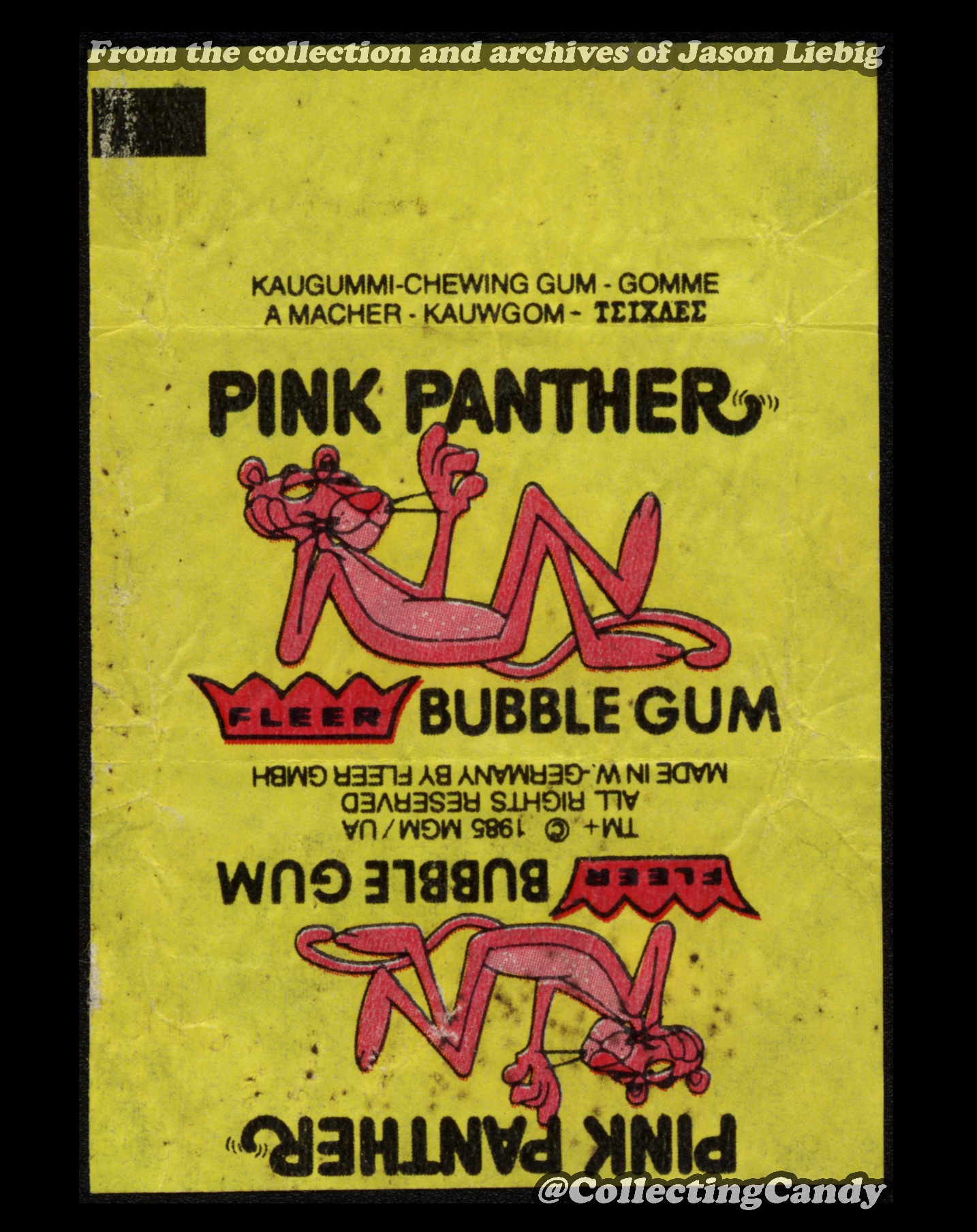
The panther was all right.

image0
Photo courtesy of Jason Liebig at CollectingCandy.com.

That doesn’t seem to connect to anything right away. It seems kind of random. I hadn’t read “The Hunger Artist” in many years. It’s short, so I took a little side trip through the story. In brief, it’s about a man whose job — whose art — is to be put publicly on display starving himself for 40-day periods. He’d like to starve himself for longer than that, but his handler won’t generally allow it. It’s very important to the hunger artist that his audience see that he’s not cheating by sneaking food. He has a sort of integrity as an artist. In the end, he dies, forgotten in his cage, and is replaced by a panther that roars and carries on as if it has a joy for life.

There are several common interpretations of the story. One, which Belt refers to at the end of this week’s reading on page 176, is that the artist was pure and suffered, alone, for his art. Another puts a more religious spin on things, the suffering akin to that of Christ. Yet another, which I lean toward, is that Kafka is poking a little fun at the self-indulgence of artists. The hunger artist takes such care to maintain his artistic integrity, even being sort of ostentatious about it, but nobody’s really interested in that integrity. It doesn’t make his art any better. And toward the end, he reveals that his real reason for starving was that he couldn’t find any food that he liked. That is, his integrity was a sort of self-indulgence disguised as integrity. And he died, and no one cared, and he was replaced by a popular exhibit of a creature with an authentic zeal for life. The panther was all right. Of course, it’s also possible that Kafka, who edited the story from his deathbed while unable to eat thanks to laryngeal tuberculosis, was just very hungry. Kafka was not, by this time, all right.

On page 97, Belt is spending some time in a playground feeling “lonesome and lonely and unimportant,” when the slide strikes up a conversation with him and asks him to try to communicate without speaking aloud, by merely thinking. This is not something Belt has ever been able to do, but he tries. The slide ridicules his effort, describing the communication it received like so:

First there was this field of, like, screechy, pulsing, kind of blindingly fluorescent gray thats hue cooled down until the whole thing resolved into this scene from a traveling circus or carnival. A shiny black panther inside a small cage was pacing and roaring, and people were crowding at the front of the cage, lots and lots of people, a hundred maybe, standing nine- and ten-deep, watching it move, listening to it roar, whistling and cheering and clapping and so on. They couldn’t look away. Then the panther, it reared up on its hind legs and roared so loudly that the image started shaking, and the crowd got even more enthusiastic, and the roar got even louder and that blinding gray field closed in from the edges, blotting everything out, muting the roar, and when the gray cooled down again and resolved, there was no more panther, no more cage, no more crowd…

“You didn’t catch a single word?”

||There was one wordy moment, right at the beginning, during the panther part. Some voice in the crowd said, |Ma, what’s it mean?| and then another voice responded, |It’s saying, ||I’m freeeeee! I’m freeee! I’m free-ee-ee!|| Isn’t that beautiful?|…||

I noted this passage and its probable connection to the epigraph when I first read it, but only when getting to page 176 with the explicit reference to Kafka’s story (which I then reread) did what seemed like a sort of non sequitur on the part of the slide about a panther (for this is essentially a retelling of the end of Kafka’s story) seem a little less random.

Belt makes his reference to the story on page 176 in passing, as he describes looking back at his own novel and Triple-J’s misinterpretation of it. But if we take epigraphs to signify important things about the work, then we should not take the reference in passing. We’re early yet in the book, so it’s early to come to any big conclusions. I do have some questions, though, and rather than writing a full-on interpretive essay here, I think I’ll end on some questions this whole little side quest brings to mind. Maybe one will catch your eye and you’ll have thoughts, or more questions, and we can take them up together in the comments.

If you’ve read “A Hunger Artist,” what’s your interpretation of it? Do you make anything of the epigraph based on what we’ve read so far of Bubblegum?

I’m really stuck on this idea of artist/audience reciprocity that Levin seems to me to be pointing to in the reference to “The Hat Act” and now “A Hunger Artist” (both about performances). There are echoes of this reciprocity and escalation in Belt’s account of his destruction of the Feather swingset, as the kids go into a frenzy, hand him an ax and rally him onward, influencing his performance and its escalation. Is this a theme? Am I reaching here?

The slide seems maybe to have access to Belt’s memory stream. It seems to be tapping into his recollection of the panther in Kafka’s story and possibly also into something — though something a little fractured — about the glass of water Belt writes about on page 174, which in turn maybe connects to the weird episode with Clyde and the glass of water on the table on page 86. Is this a curiosity or is it significant? Maybe I’m seeing something that’s not really there?

Levin is doing a lot with interpretation and the influence of lived experience on authorship in the late part of this week’s reading. Is this just some sort of metafictional authorial navel-gazing or might it be significant with respect to the stuff in the book about empathy (with cures and inans at least)?

Are the epigraphs Belt’s (as this document we’re reading is purportedly his memoir) or Levin’s? Does that change what and how they mean?

Take n+1

Oh man, y’all, I have been through so many false starts on this post. Did you know that when you’re only about 10% of the way through a book for the first time, it can be tough to corral your provisional assumptions and early observations into a proper argument?

Daryl and Paul took a much more sensible first-timer’s path, paying attention instead to what latched onto their reading experience like burrs on their socks and collecting the signals that suggested the future importance of marks and names. I’ma do that too, because the bell that keeps ringing in the back of my mind throughout this first week’s reading is empathy.

And listen, I know it’s thoroughly trodden ground to suggest that a novel might be concerned with empathy. That’s one of the original functions of fiction, right? Inviting empathy is one of the signature strengths especially of the novel as a form, with drama as the nearest competitor. There’s a lot that’s tedious about Percy Shelley, but this part of his Defence of Poetry has stuck with me for decades:

The great secret of morals is love; or a going out of our nature, and an identification of ourselves with the beautiful which exists in thought, action, or person, not our own. A man, to be greatly good, must imagine intensely and comprehensively; he must put himself in the place of another and of many others; the pains and pleasure of his species must become his own. The great instrument of moral good is the imagination.

Of course, he’s talking specifically about poetry (and, gross, specifically about men), but to Percy Shelley literally almost any creative expression of the will counted as one of “the kindred expressions of the poetical faculty”: “architecture, painting, music, the dance, sculpture, philosophy, and, we may add, the forms of civil life.” The point stands well enough, I hope.

(It looks like a scholar by the name of Suzanne Keen has done a lot of work in this field, which I’d love to read.)

But in Bubblegum it’s more explicit than that. Belt withholds from his readers the datum of his diagnosis out of a concern that it will make us unable to empathize with him. He’s afraid that instead of seeing him as a whole person, with varied motivations and experiences (y’all, I wanna quote my Whitman motto so bad right now), we’d only be able to think of him as a psychological disorder taking shape through time. The narrator of our book doesn’t trust us to extend him the empathy he deserves as a fellow human being—and (sad thought) that’s probably a conditioned distrust.

Speaking of conditioning! The cures are another site of empathy as a theme in this book, the way I see them. They were originally designed as therapy animals for children with psychotic disorders—am I remembering correctly that it was called the Friends Study?—who have to learn to understand their needs and care for them. And of course Belt appears to be unique in thinking of Blank as a pet and even a sibling. But “flesh-and-bone robot” is in the blurb we’ve all seen for the novel, right? So we already knew empathy was going to be an issue, specifically the question of who/what deserves it—because that’s why you put a robot in a story. Whatever your personal threshold is, whether it’s sentience or altruistic behavior or being alive or anything else, a story with a robot in it is intended to destabilize your certainty in that threshold.

(Briefly on sentience: The Turing test is our famous benchmark for identifying “intelligent” behavior indistinguishable from that of a human being. But note the formulation there. It’s not for measuring when a machine has become intelligent, it’s when that machine has become capable of behaviors that are consistent with intelligence such that a human observer infers the one from the other. This is a behaviorist test, right? Commonly, inaccurately used to “prove” the existence of something interior, which behaviorism would reject either the existence or the knowability of. Hence the excursus in Bubblegum on training your cure with conditioning methods, and all the documentation on cures that rigidly refuses to accord them any status but machines that produce outputs based on inputs.)

Belt’s threshold, it appears, is much lower than those of the people in the society around him. Much lower, we learn, because it’s not just other people he goes out of his nature into. It’s not just Blank and other cures. It’s…most things. When an inan may strike up a conversation with him at any moment, without warning or even previous identification as an inan rather than an inert object, it seems like there’s very little room for him to draw that circle that contains the empathizable-with and excludes the things that are beneath empathy. His swingset murders are mercy killings, specifically prompted by connecting to the suffering he perceives in the swingsets and their desire to be released from it.

On the other hand, he doesn’t really have any compunction about gaslighting his horrible racist grandmother into thinking she’s having dementia, so. Complicated subject. And I can tell I’m going to be thinking about it a lot!

A character by any other name.

As this book opens I couldn’t help but focus on names.  I have always been attuned to the names authors use.  When I used to attempt fiction, I could spend as much time trying to come up with the perfect meaningful name (see how the name comments on the action?) as with a story itself.   So when I see an author using especially peculiar names, my reading senses tingle.

This story is just full of unusual names.  And on several occasions names, or lack of names is significant.

Before starting on names though I have to chime in and say that “shut your piehole, cakeface” is hilarious.  And the whole argument about punctuation on T-shirts had me cracking up.

First of all, with a comma before “cakeface,” the shirt would have to be considered “officially punctuated” which would require a period be placed after “cakeface,” not to mention a colon, if not another comma, after “Jonboat Say,” and quotation marks around the catchphrase itself….  This, believed Jonboat, was more punctuation than a T-shirt could abide.

But back to names.

Part 1 Section 1 “Jonboat Say” starts off with the character named Jonboat.  I suspect most people have heard the nickname Jonboy, but I have personally never heard Jonboat before and I liked it immediately–weird and memorable.  There’s also his full name Jonny Pellmore-Jason and that his father is named Jon-Jon Jason.

It’s also interesting how the narrator introduces his family.  Since his family name [Magnet] is an everyday object that could be used as a descriptive word as well, introducing his family as “My family’s. We Magnets'” is certainly not the most direct way of providing information. My first thought was that it was metaphorical and that his family were the kind of people magnetically attracted to trouble.  This doesn’t even address his first name yet.  in fact, his first name won’t come for a long time.

The other prominent name in this section is Blackie Buxman.  This name doesn’t specifically signify anything to me at this point, but they all strike me as meaningful.  Most of the characters aren’t named common Anglo-Saxon names (well, okay, Jonny, but he is Jonboat).

So is “Blackie” a nickname like Jonboat or a given name?  There’s no way to know yet and maybe we never will as he doesn’t seem to be very important after the tetherball match.  I looked up the origin of Buxman and learned it’s the Americanized spelling of German Buchsmann, a topographic name from Middle High German buhs(boum) ‘box (tree)’ + man.  That doesn’t seem significant–although later he does punch the main character “in the asshole.”

Just after the first black dot triangle section break, there’s a geographically made up name: “Wheelatine Township” in the Chicagoland area.  Is the made up use of Wheelatine an indication that things are not real right from the start?  (I don’t know anything about Chicago, so if it’s a play on a region, it is lost on me).  Or is it just a simple narrative device to prevent people from fact-checking details?

Also, what the heck does Wheelatine mean?

Then there’s the main invented plot device, the “cures.”  The way these are introduced puzzles in the same way as “magnet”: “There I had my cure rustling around in its PillowNest.”  [shades of George Saunders with this naming convention].  This is deliberately confusing, there’s no question.  No capital, no italics, no capital C, there’s no indication that it is significant.  I had to read this sentence a few times just to see what I could possibly be missing.

Cure is short for Curio (which makes a lot of sense both as the real name and as an abbreviation).  It is a pet of sorts.  And he has named his Blank.  The Curio’s full name is Kablankey–named at his mother’s suggestion for the sound of its sneeze.  But ever since he’d “vented his temples” (?) he’d changed it to Blank, which was less childish but retained connections to his missing mother.

Curios had originally been called Botimals

By the way, “rear ejection” is what they call its waste.  Ha.

There are a whole bunch of names for things that happen to Curio owners. More words that have mundane meaning which are clearly used differently.  For instance, kids “go into overload” (which gets them on the news).  This is bad.

All of this in the first ten pages.

Then we finally get to the main character’s name.  Or what his name isn’t:

“Billy, listen–” said my father.
“That’s not my fucking name.”

Chapter 1 Section 2 is called “Two Hundred Some Quills”

I feel like I’ve heard the name Quills before for cigarettes, but the only thing a quick search provides is in a Stephen King story (which might be where I heard it).

As this section opens, our 38 year old narrator gets a birthday present from Clyde the Dad (his father is finally given a name).  Clyde is away (fishing with friends) and not-Billy is on his own.  Usually Clyde leaves money in the Marvin Hagler bust, be he has forgotten.

We also meet Grandmother Magnet who calls to wish him a happy birthday.  The narrator doesn’t feel like talking to her so he messes with her and she twists the Magnet/Jonboat piehole phrase to “Plug your dirty sheeny coinslot, ovensmear.”

Grandmother Magnet is full of racist name-calling, which is a shame because “ovensmear” is a wonderfully weird insult.

Not-Billy goes to the White Hen to by Quills from Pang, the owner (okay, sure) of the establishment.  Pang says that not-Billy is not creditworthy.  Instead Pang gives him a piece of Dubble Bubble (which not-Billy muses about and speculates could have been called bubbleychew). Speaking of gum, I’m glad Levin has settled the age-old debate that the plural of Bubblicious is Bubbliciousi.

Not-Billy returns home without his Quills only  to find “a check for $1,100 made out to my father.  My SSDI check.”  So he takes it to the bank.  Names are crucial at the bank as well.

The teller who helps him doesn’t have a nameplate up.  He is however, “wearing a pinstriped vest and decisive mustache … with a golden chain that disappeared inside the watchpocket.”  We soon learn his name is Chad-Kyle or C.K.

This fellow is just full of name brands:

“the most buzzed about line of Graham&Swords PlayChanger PerForumulae for Curios since 2008’s SloMo or perhaps even 1993’s BullyKing.”

He also passes out fliers at shows for DJ Crystal Worm.  And of course Crys-Dub’s style of sleazebeat was a revolution on the scale Wang Kar Pourquoi’s first forays into fuzzdub or even Murder-ers’ trademark-infringement days when they were still called Murderers Jr.  The fliers are for a party at Killer Queen Marmalade’s, sponsored by Que Padre Mezcal.

The teller is offering to give not-Billy an advance of the new Curio forumlae “Independence.”  He has already given it to his cure Tiddlywinks.  But when not-Billy says he doesn’t want to show off his Cure, the teller assumes that Blank is a hobunk.

Finally they get around to the transaction.  Not-Billy doesn’t have an ATM card.  When he shows C.K. his state ID, C.K says, “Now that is a name.”

Turns out the check is a problem because of names:

It’s my SSDI check. I’m the beneficiary.  My father’s my guardian, though, so it’s made out to him.

Outside of the bank we formally meet Lotta Hogg (a name that is hilarious, offensive and absurd but not out of the realm of believability).

Unless I missed it earlier, Lotta is the first person to say not-Billy’s full name: Belt Magnet.  She says it in full at least three times and addresses him by his first name many times during the conversation.  She even gives this name a series of nicknames: Beltenhauer, Magnetron, Beltinya Magnetovich [that one is inspired].

It turns out that Lotta and her friends (we finally have conventional names here: Kelly, Jenn and Ashley) were somewhat in awe of him back in 1987 [Belt was 12, Lotta was 9, give or take].  His actions caused them all to menstruate at the same time [?].

They talk about the return to town of Jonboat and his fiancee (?) named Fondajane. [There’s a lot to unpack with that].

As this conversation ends, Lotta wants to see his cure, but he tells her it is a hobunk and “could tear your friends to pieces.”

Chapter One Section 3 is called “About the Author.”
He tells us that he deliberately did not reveal his name at the beginning.  He didn’t want to write “My name is Belt Magnet, and sometimes I’m psychotic–at least that’s what they say.”

This section is a mostly a series of questions in interview format.

His psychotic symptoms manifest in being able to converse with inanimate objects or “inans.”  He needs to have his “gate” open to receive their messages (which are written in between vertical lines: ||Maybe that’s your own problem||.

The next question concerns Lotta Hogg and how she and her friends all had “the onset of puberty” at the same time because of what he did.  What he did has been named “the swingset murders.”  He essentially destroyed a series of swing sets with a bat, and they are continually referred to as “murders.”

In the newspaper article the girl who describes him as “so cute” is not named: “identified only, to my great frustration, as a “member of the popular set at WJH.”  Earlier it was said that the team name is Washington, so it’s safe to guess Washington Junior High.

Belt has an abetter in his murders, an eight grader named Rory Riley.  Belt had just destroyed the Blond family swing set.  Their son Ron Blond high-fived Belt for doing so (he hated that old swing set).  Riley also hated the swing set and proposed he fins another for Belt to murder.  Chuck Schmidt lived in “Old Wheelatine” where Feather lived, and they encouraged him to murder the Feather swingset.  This murder is what got the newspapers’ attention.

A question asks about his psychosis.

When discussing his medication, he talks about Eileen Bobbert who likes pun-driven jokes (and gave him Risperdal).  His prior doctor was named Emil Calgary who liked more scatological pun-driven jokes (and gave him Haldol).

There’s not much more in the way of names after this (even the doctor names aren’t revelatory I don’t think).  But one of the questions in this section stresses the naming of the Curios as botimals.  It was called a Botimal, a “robot made of flesh and bone,” but it was a pet to him–a new kind of pet.  He has never been able to think of Blank as a robot.

There’s more unusual word choice here though.  People “kill” their cures, regularly.  In fact, that seems to be what you’re supposed to do to it.  Earlier Belt said he had never so much as hurt Blank before.  Belt has been unable to do so, but he never prevented anyone else from doing it.  Nevertheless:

Blank was my pet, though.  My friend.  My sibling.  I didn’t want to kill it, even when I did.

Belt has possibly the oldest living Curio.  The oldest publicly stated Curio was owned by a monk and named Basho (17th century Japanese haiku master).

Finally, Belt reveals that he is an author.  His novel is named No Please Don’t.  It was published by Darger Editions (Henry Darger was an American writer, novelist and artist who worked as a hospital custodian in Chicago, Illinois).  It concerns a character named Gil MacCabby who has lost his most favorite toy, and intergalactic smuggler called Bam Naka (which seems Star Wars inspired).

Belt also wrote an essay for Harper’s which was not published (although it is printed here) called “The Magnets, the Birds and the Balls” (June 2006) about his Grandma Magnet having an affair with a mobster by the name of Salvatore “Sally the Balls” DiBoccerini.  The Balls had an African Gray parrot named “Mouth” who would repeat just about anything (including lots of curse words).

There’s a lot to look at with all these names.  Most are probably not significant.  Many are probably just there for a joke.  And there’s nothing wrong with that either.

I don’t imagine there will be too many more significant new characters introduced,so I doubt there’s going to be many more new names to look at.

Nevertheless, with Levin’s clear love of language, I’ll bet whatever names he does come up with will be entertaining.


♦          ♦

As a writer, he reads a lot.  Here’s a list of the stories he mentions

Donald Barthelme “Balloon”
Franz Kafka’s “Blumfield”
Jeff Parker “Our Cause”
Robert Coover “The Hat Act”


♦          ♦

Incidentally, I co-posted this on my own site which includes a “Soundtrack” for each post.  All of the posts for Bubblegum will “feature” bubblegum pop songs.  This week’s is The Archie’s “Sugar Sugar.”

Marks and Meaning

This week’s reading brings us up to page 81, and boy is there a lot of stuff one could chomp into here — behaviorism, reliability of the narrator, stories within stories, the difference between aloneness and loneliness, what we mean by sentience, fun with names, comparison with certain other authors to whom I plan largely not to compare Levin during this read, and a fair few others. But what I’m going to focus on for my first post proper about Bubblegum is Levin’s use of marks on the page.

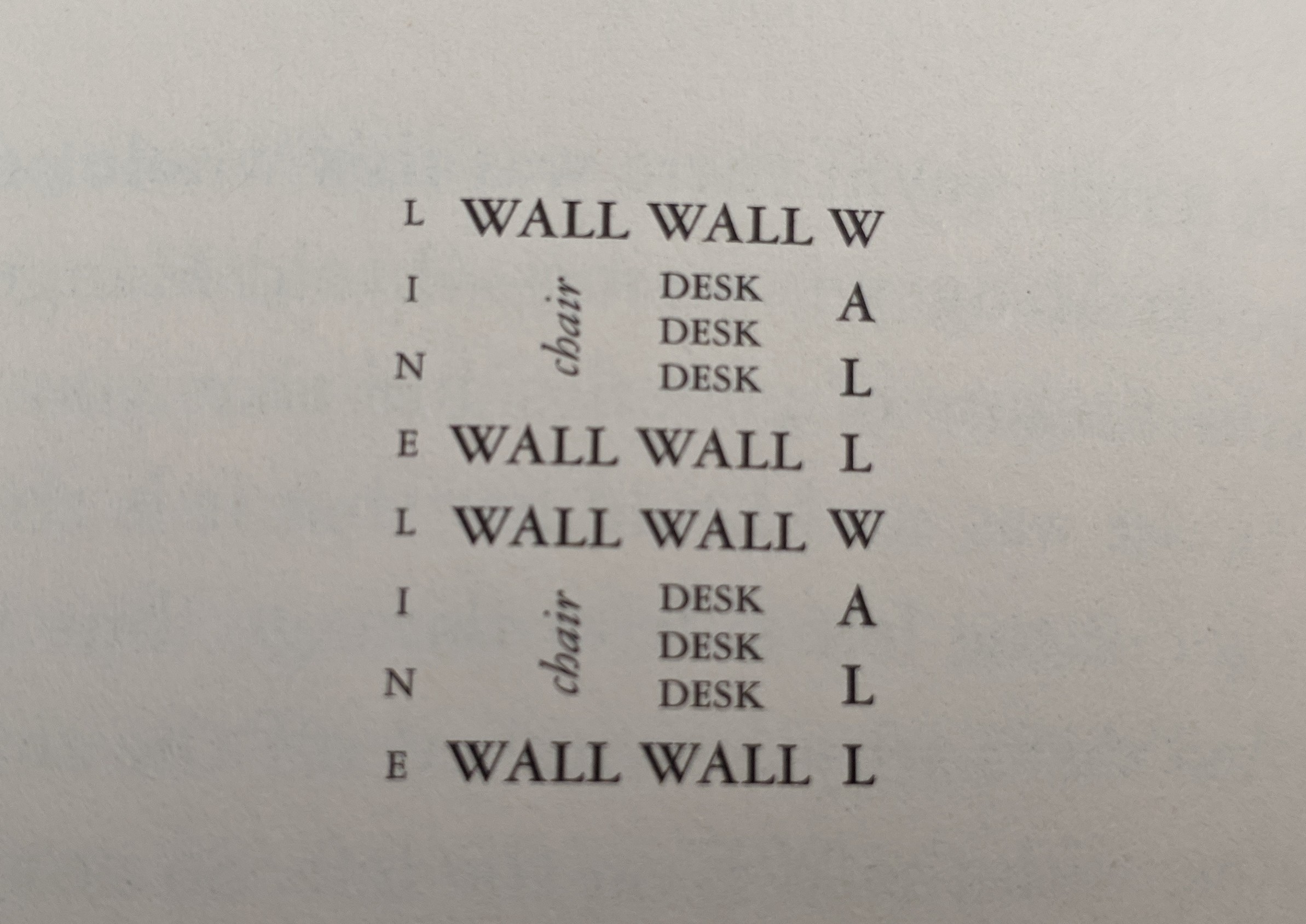
First, I want to look back at Levin’s first novel, The Instructions, in which he in several places uses words to form pictures. These word pictures grow more and more elaborate as the book goes on, but here’s a simple one from the first half of the book:

wp-1589056851718.jpg

I mention this to establish that Levin seems to be willing to use words and letters to signify more than the simple words that stream along the mental ticker tape that plays in our heads when we read. In this picture, Levin uses words to create physical models of what they represent rather than merely abstract symbols that our brains translate for us into their physical referents.

I have not yet run into anything quite so concrete in Bubblegum, but having seen this sort of concrete poetry in Levin’s past work, I was primed to think about Levin’s use of marks on the page in Bubblegum as more than the simple utility dots and strokes that I think we usually take them for.

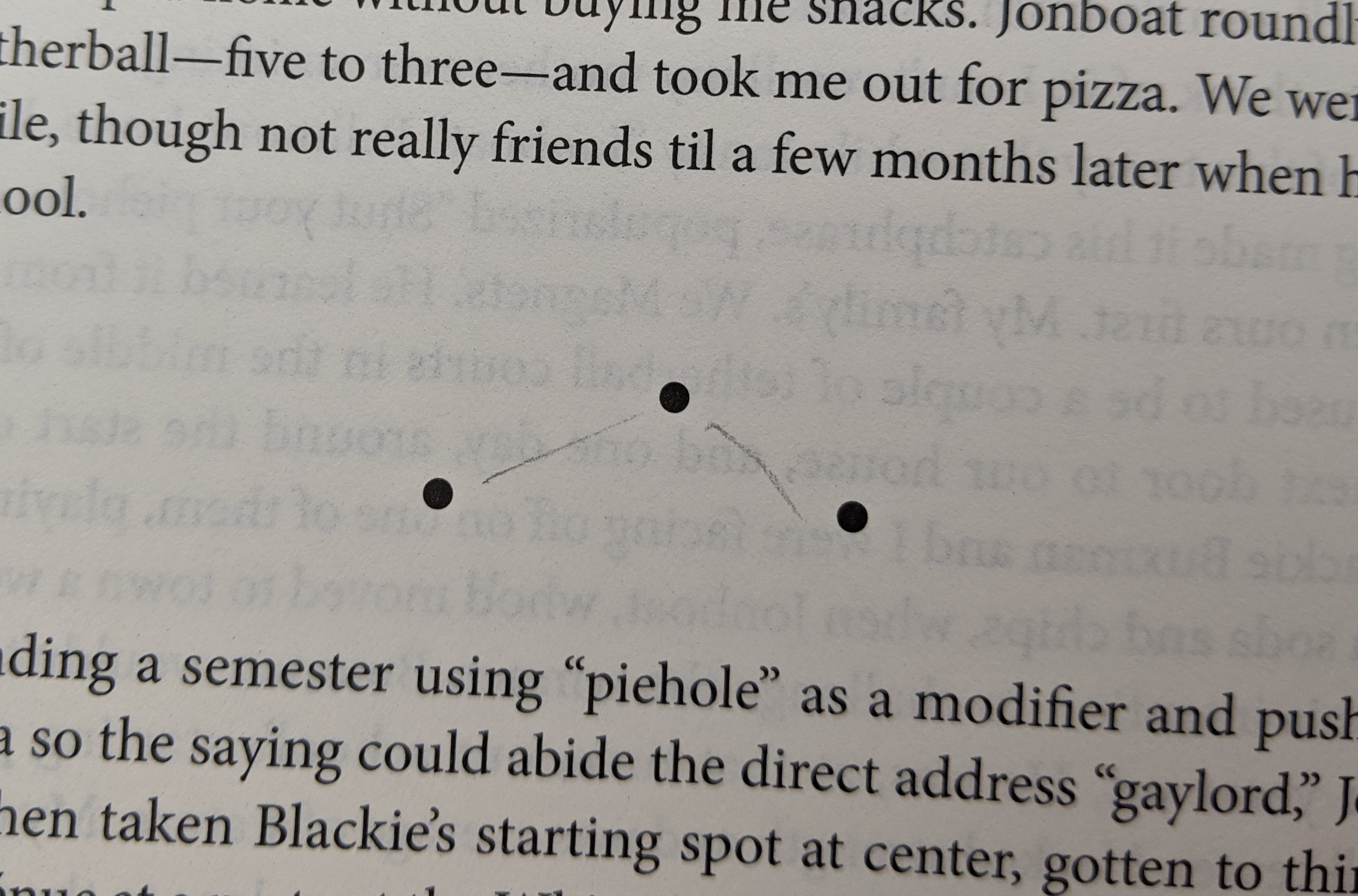
The first that really caught my eye occurs on page 4:

wp-1589057704346.jpg

We see here three dots that, if connected, would form an isosceles triangle, right? I didn’t think so. The rightmost dot looked just a little closer to the top dot than the leftmost did. I didn’t measure the distances initially, but I marked the dots in my book to remind me to come back to them later. I wondered if the configuration of the dots might change somehow as the book went on and be imbued thus with some sort of meaning. So far, they seem to’ve kept this same configuration. I did wind up breaking out a ruler and measuring the distances later, and indeed the rightmost dot is closer to the top dot than the leftmost dot is, by just a little bit. But what does it mean? I have no idea. Belt on page 52 describes his Cure as a single-legged triped. Does this little three-dot section-divider represent something like the points Blank’s “peds” would make when it stands on all three of its limbs? Whether or not that’s the idea, why the subtle difference in distance?

The next close attention to marks in the book is the argument between Belt and Jonboat about commas and hyphens in the phrase they plan to ink onto tee-shirts:

I, however, was of the opinion that, absent “gaylord,” the comma should be restored to its original position between “piehole” and “cakeface,” whereas Jonboat claimed restoring it would ruin the shirt. He said that, first of all, with a comma before “cakeface,” the shirt would have to be considered “officially punctuated,” which would require a period be placed after “cakeface,” not to mention a colon, if not another comma, after “Jonboat Say,” and quotation marks around the catchphrase itself, i.e….

This, believed Jonboat, was more punctuation than a t-shirt could abide… But I did suggest that a hyphen be placed between “piehole” and “cakeface”… Jonboat wasn’t sure. He thought a  hyphen might suggest “official punctuation,” giving rise to the problem that ditching the comma had already solved. Then again, it might not. A hyphen might be more like a spelling thing — more like an apostrophe.

I’ve cut out a fair bit here, and the two boys talk about it further later. Later still, on page 50, Belt explains that he has taken some liberties in his reproduction of conversations he has had with Lotta and Chad-Kyle:

I’ve reported Lotta saying what she said the first way rather than reporting it the second or third way not because the first way seems to me to more accurately depict what Lotta said or who Lotta is than do the second or third way, but because all three seem to me to be highly and equally accurate depictions and, to my ear at least, the first way sounds better (it’s more in keeping with the rhythm of the paragraph from which I’ve excerpted it, and it comes across more clearly with regard to pronouns) than the second or third way.

So, Belt via Levin is paying special attention to how he puts things on the page, to how the arrangement of the marks on the page sort of regulates the flow of the ticker tape of meaning. The how of the saying is as important as the why to Belt, the way you hear it in your own private head as important as what what you hear means.

Belt’s mention here of pronouns takes me back to page 3, when a word in the second sentence caught my attention: “The piehole thats shutting he’d demand was rarely mine, though.” We’re accustomed to using “whose” as an inanimate possessive pronoun, or using something twisted like “The piehole of which he spoke of the shutting of was rarely mine, though.” We don’t know it yet when we get to this 23rd word of the novel, but there’s a lot of meaning in this weird “thats.” It’s as if Belt is sort of promoting the inanimate by giving them a real pronoun of their own, calling attention to the lack of one and thus, perhaps, to their sort of second-class status. When later we learn that Belt not only talks to inanimate objects but pities them, tries to help them — in short that he treats them as if they are sentient — his use of this odd new possessive pronoun makes pretty good sense.

The use of a whole new pronoun is a bit of a digression from the use of individual utility marks, which I’ll return to now.

On page 38, Levin introduces the || and | marks as substitutes for double and single quotation marks when inans speak to Belt. It makes a certain amount of sense. Belt tells us that they communicate directly into his brain. Why not indicate this via weird punctuation marks? Well, sure, I guess. But there are plenty of books in which people think to themselves (direct in-brain communication) and in which that thinking is written using regular old quotation marks or italics. I suppose there aren’t as many books in which inanimate objects communicate directly in-brain via something called a gate, though. Maybe that merits the use of a different mark. When I first ran across these marks on page 38, I jotted in the margin the word “caesura,” which is the name given to a big pause in the middle of a line of poetry. When marking the rhythm of poetry, you use the || to indicate where a caesura falls. Maybe Belt via Levin chose this mark to indicate some sort of mental pause bookending the injection of the inans’ communication into Belt’s brain. Or maybe he just wanted to use a different set of marks to set them off more starkly.

The final mark I’ll mention is one that’s missing. Belt’s book No Please Don’t should have a comma after “No.” I’m not just being picky about grammar myself here. Belt has demonstrated from as far back as middle school that he is a person who thinks about correct punctuation and punctuation’s influence on how you’d speak a phrase. He is also not stingy with commas on the whole. This title demands a pause — a caesura — after its “No.” It’s hard to imagine that the Belt who argued with Jonboat over commas and hyphens or the Belt who deliberated over the rhythm he used to relate Lotta’s telling of a story would omit the comma here. But he does.

While I don’t have a clear thesis about this stuff, I think there is an assumption I can acknowledge: that marks on the page that we don’t think of as signifiers themselves are  easy to not pay much attention to or assign much value to. They are utilitarian in that they help us navigate what we’re reading, offering pacing, rhythm, boundaries, and so on. But they are not, in general, the point.

To stretch a bit, I’ll suggest that the same is true of things like book jackets, which draw you in but then become largely an annoyance. My Bubblegum jacket sits limply now on a pile of neglected books on my nightstand, as I don’t want to have to fool with it as I lug the book around from room to room. A couple of people mentioned in comments here wondering if a faint whiff of bubblegum smell was real or imagined. Levin confirmed in a conversation on the podcast The Great Concavity that the jacket had been made with a heat-activated scent. The slight warmth of your hands on the jacket causes the jacket to smell faintly of bubblegum (the warmth of your skin in the world of Bubblegum also happens to keep cures alive). It’s kind of marvelous. And it also, to me, works as sort of a functional rhyme with some of what’s happening with the various marks I’ve made note of here. ||Attend more closely,|| these things seem to say to me, ||things that do not usually garner much attention are more significant than you think.||

On page 44, Belt says a fair bit about the phenomenon of his destruction of the Feathers swingset:

There were writers who insisted in their Herald op-eds that the swingsets functioned as symbolic metaphors of juvenescence… And I don’t know — maybe. But to me, those explanations seemed overblown… I think it was probably all a lot simpler. I think the aesthetic pleasures of watching a boy destroy a swingset were vastly underrated by our town’s editorialists. I think those kids found the act to be beautiful — not its “meaning” (at least not so much its “meaning”), but what the act looked like, sounded like, felt like…. And what I’m getting at is that while the “meaning” of a group of children standing around to watch a boy murder a swingset with a bat might not be much, if any different from the “meaning” of a group of children standing around to watch a boy murder a swingset with an ax, the experience of seeing the boy use a bat differs markedly from that of seeing the boy use an ax.

On pages 21 – 24, Belt mediates on bubblegum, its function and its meaning.

I still wasn’t sure Dubble Bubble stood for anything. I still wasn’t sure what I wanted it to stand for.

This feels pretty familiar to me. I have no tidy thesis here, but part of me wants to make an airtight case that calling our attention to easily-skipped-over marks on the page causes us to treat these marks, in a way, as Belt treats inans — giving them attention, engaging with them as items worth engaging with, and that in doing so, Levin is writing a book whose form at times sort of mirrors the content. Pope played with this in his “Essay on Criticism“, using a long slow Alexandrine (twelve syllables, alternating unstressed and stressed, with a caesura in the middle) to demonstrate how an Alexandrine could be long and slow:

A needless Alexandrine ends the song,
That, like a wounded snake, drags its slow length along.

Pope writes several similar lines in which the content demonstrates the precept he’s sharing (soft, whispery sounds in a line about the blowing wind, for example). Maybe Levin is doing something similar, giving marks on the page we would usually skim over more significance, as Belt grants inans and cures more significance and even a sort of sentience.

Or maybe he’s just playing around. Maybe I’m looking for significance where there is none. Still, it’s fun. Whether there’s meaning in these things or not, the possibility of meaning, the experience of reading a book that allows me to try to tease these sorts of things out, has so far been rewarding.

Turn and Face the Strange: On Bubblegum

The very existence of science fiction proves that people love weird, imaginative shit. As long as it rings true to the author, as long as it functions within its own logic, someone else out there in the world will also dig it. Like Dune, there are moments in Adam Levin’s Bubblegum where you will have no idea what is going on with the whole book. There are moments where you won’t have any context and things just seem postmodern a la Moe Szyslak’s definition: “weird for the sake of weird.” Hang in there, I am telling you. The structure of the novel artfully sifts together many divergent strands with the “main” story of Belt Magnet and his cure.

Why do we read books like this at all? Everyone has their own answer, but for me, part of it is to face the strangeness head on. In fact, I think there is no limit to the amount of strange, weird shit people will read or watch or look at. Have you ever stared at a Breughel painting or a Cy Twombly or Kandinsky painting and wondered not only what the thing was trying to communicate to you and the rest of the world, but also what sort of mind produced this particular image at that particular time? That’s a little bit of how I felt reading Bubblegum. As as sort of intro to the book, if you haven’t started yet or if you have only read a few pages, I encourage you to stay curious about the story and the storyteller.

Throughout this novel, you will see Adam Levin reveal himself as the artist in the picture (another postmodern / metafictional necessity), and some of the adolescent characters and their argot might be familiar if you have read The Instructions. But to me, there was enough substance in the book that resembled nothing I’d read before. That said, literary critic / icon Steven Moore notes in the introduction of the first volume of his book The Novel: An Alternative History that “avant-garde, experimental novels are not a 20th-century development, as is commonly believed, but instead have a long, rich history, one never properly told.” This style of storytelling, if it seems strange and new enough, is proof that it has been around forever. With its varying pieces sewn together with multiple characters and subplots, Bubblegum is a throwback in some ways, but, like all great novels, it feels completely a product of its moment in history.

Every book we read fits into the landscape of previous books we’ve read. If you’ve just spent months with Ahab and Ishmael and Queequeg occupying your every waking thought, and then you jump into something like Ducks, Newburyport or My Struggle, your brain might take a few clicks to recalibrate to the 21st Century, but soon enough you will start to see similarities, overlaps, parallels, symbolic analogies, harmony, etc. partly because of the whaling fiction already burned into your retinas and partly because that’s how brains work: seeking patterns, fitting together loose parts in order to make sense.

There will be much for us to sort out in Bubblegum. What are these furry little creatures called Cures? What’s wrong with Belt Magnet? It’s a strange book, a strange object, but I’ve always liked this quote from Donald Barthelme:

‘“The aim of literature”, Baskerville replied grandly, “is the creation of a strange object covered with fur which breaks your heart.”’

The Hat Act

I’m going to cheat just the tiniest bit here on the schedule and mention something from the end of the first week’s reading, on page 75. It’s not especially spoilery — indeed I’m not really going to write about Bubblegum very much at all — and I think it might help sort of set the table a little. If you’ve read anything about Bubblegum, you’ve likely read that the book does a bit with metafiction. Levin’s first lengthy novel, The Instructions, has been compared to work by Pynchon, Gaddis, Barth, Wallace — you know, the big writers of metafictional and postmodern bricks (we’ve written about books by three of them here; maybe we should add Barth to the list at some point). It is no stretch to imagine that Levin might continue in a similar vein in Bubblegum.

Cue on page 75 the mention of a story called “The Hat Act” by Robert Coover, another of the grandsires of metafiction. I didn’t remember this story, but it turns out that I had read it some years ago in Coover’s collection Pricksongs and Descants, which I happen still to own a copy of. I unshelved the book and gave the story a read.

Coover’s story starts with a sort of a mise en scène:

In the middle of the stage: a plain table.

A man enters, dressed as a magician with black cape and black silk hat. Doffs hat in wide sweep to audience, bows elegantly.

Applause.

From there it escalates, alternating between magician and audience reaction, with the magician doing increasingly impossible things and the audience amping up its response, booing when things go wrong, catcalling the magician’s assistant, and so on as the magician’s act, which starts with a simple rabbit-out-of-a-hat trick, becomes increasingly impressive and ultimately troubling and unsatisfying.

It doesn’t take much imagination to suggest that Coover is here writing about writing, about how you try to do all these neat tricks to write something new and unconventional, and the more fantastic your tricks the more you must continue to amp up the tricks and the greater the demands of the audience until ultimately everyone winds up in a panic or a snit and is, in the end, unsatisfied somehow. Such a lack of imagination does it take to suggest as much that I suspect it’s a facile reading of the story and that more is going on here than I’ve got the smarts to detect.

Facile or not as a reading of Coover’s work, I still think it’s worthwhile to keep this little reference and context in mind as you wade into Levin’s book. He is a writer working within, or maybe trying to work beyond (I don’t know yet), a tradition that itself seeks to inspect and play with traditions. Levin includes the reference at a point in his narrative at which it is especially fruitful to think about signal and noise, call and response, action and reaction, actor and acted-upon, interpretation and misinterpretation. It’s very clever and feels pretty richly layered to me.

All of which is to say here as I wrap up this first post proper that — acknowledging first that I’m only 81 pages into a nearly-800-page book and that there are acres of room for me to be off base here — I think it’ll be useful to think in particular, as we read, about things like who is manipulating whom. Is it more interesting that the magician creates the audience’s response or that the audience’s response influences the magician’s actions? What does this mean about Levin as an author, and about us as readers, and about us as readers responding to one another’s writing about this book that seems to be responding in part to other work? How should we (or should we even) think about this stuff with respect to how we exist in the world? When reading a book set in a world (mild spoiler, but again, if you’ve read a blurb for this book, you know this already) without the internet, how should we (or should we even) think about this stuff with respect to how we exist in a world in which so many of us live staring at these little mechanical devices hooked up to a vast network of call and response, action and reaction, tweet and subtweet, and so on? I don’t know. Maybe it’s a throw-away reference, a little shibboleth winking at metafiction without all the import I’m here assigning it. But maybe not. We’ll see as we go. Turning it over in my mind has been a pretty fun exercise at any rate, and I’m enjoying the book a lot so far.